












AI Reality Check: AI Procurement Is Broken — Here’s How to Fix It

AI procurement is failing across business and government. This article exposes the structural flaws—vendor lock in, slow processes, weak governance—and shows how to fix them.

Jul 15, 2026 - 09:16
Jul 15, 2026 - 09:26
 0  6
AI Reality Check: AI Procurement Is Broken — Here’s How to Fix It
AI Procurement

AI has moved from lab curiosity to boardroom mandate. Yet in the one place where ambition is supposed to turn into reality—procurement—AI is still being treated as a traditional IT purchase: fixed scope, rigid contracts, and an unrealistic expectation that everything important can be specified up front.

The result is predictable: stalled pilots, vendor lock‑in, ballooning “AI consulting” bills, and systems that look impressive in demos but never change how work actually gets done.

This is the AI Reality Check: procurement, not technology, is now one of the biggest structural barriers to meaningful AI adoption.

How traditional procurement works — and why AI breaks it

The legacy model: specify, bid, deliver

Most public and private‑sector IT procurement still follows a familiar pattern:

  • Need identified: A department or business unit defines a problem and drafts a statement of work (SOW).
  • Requirements written: Functional and technical requirements are documented as if they are stable and knowable.
  • Competitive bidding: Vendors respond with proposals, scored against a matrix of price, experience, and compliance.
  • Contract awarded: A fixed‑price or time‑and‑materials contract is signed, with deliverables tied to the original SOW.
  • Delivery and acceptance: The vendor is judged on whether they delivered what was written, not whether it actually works in the real world.

This model works tolerably well for infrastructure, commodity software licences, and projects where requirements change slowly.

AI is not that kind of work.

AI is inherently iterative and data‑dependent

Effective AI development is discovery‑driven:

  • Performance emerges from data: A model that looks strong in a benchmark can behave very differently on messy, real operational data.
  • Requirements evolve with learning: Once teams see what the model can and cannot do, the “real” requirements often diverge sharply from the original SOW.
  • Feedback loops are essential: Continuous evaluation, error analysis, and retraining are not scope creep—they are the work.

Traditional procurement frameworks treat this natural evolution as a problem: change requests, budget variances, and timeline adjustments are seen as failures of planning rather than the normal path to a working AI system.

So vendors learn to play along: over‑specify up front, avoid raising uncomfortable truths, and deliver exactly what was written—even if it doesn’t solve the actual problem.

The five structural failures of AI procurement

1. Vendor lock‑in baked into contracts and architectures

AI procurement often locks organizations into proprietary platforms, closed data formats, and opaque models:

  • Proprietary architectures: Contracts that tie data pipelines, models, and deployment to a single vendor’s stack.
  • Non‑portable models: Custom models trained in environments where weights, training data, or evaluation artifacts are not contractually accessible.
  • Switching costs: Integration dependencies and licensing terms that make it prohibitively expensive to move to another provider.

A recent analysis of AI‑related procurement in defense contexts highlights how lock‑in threatens technological sovereignty and long‑term costs, and recommends containerization, open standards, and modular contracting to preserve platform independence.

Lock‑in doesn’t just raise costs—it distorts decision‑making. Once a department is deeply embedded in a vendor’s ecosystem, “what’s best for the mission” quietly becomes “what’s possible within this contract.”

2. Contracts optimized for deliverables, not outcomes

Most AI contracts still reward:

  • Deliverables over impact: A working prototype, a dashboard, a model artifact—regardless of whether it changes operations.
  • Compliance over learning: Meeting milestones and documentation requirements, not improving model performance or user adoption.
  • Scope rigidity: Any change in direction is treated as a risk to be minimized, not a necessary response to new information.

This is the opposite of what AI needs. The most valuable AI work often emerges after the first iteration, when teams discover unexpected patterns, edge cases, or better problem framings. Procurement that cannot accommodate this learning curve guarantees mediocrity.

3. Shadow AI and ungoverned consulting spend

When formal procurement is slow or misaligned, AI doesn’t disappear—it goes underground:

  • Shadow AI projects: Teams quietly experiment with SaaS AI tools, pilots, and proof‑of‑concepts outside formal governance.
  • Fragmented consulting engagements: Multiple business units hire different firms to “explore AI,” with overlapping scopes and no shared architecture.
  • Duplicated spend: Organizations pay repeatedly for similar discovery work because lessons learned are not captured or shared.

A recent U.S. Government Accountability Office (GAO) report found that agencies more than doubled their use of AI between 2023 and 2024, often through varied acquisition approaches and agreements outside standard federal acquisition regulations. Yet agencies were not systematically collecting lessons learned from these AI acquisitions—missing opportunities to reuse best practices and avoid repeated mistakes.

In other words: the money is being spent, but the institutional learning is not being captured.

4. Evaluation frameworks that don’t understand AI risk

Traditional procurement evaluation focuses on:

  • Price and compliance: Lowest cost, highest score on mandatory requirements.
  • Generic experience: “Years of AI experience” or “number of projects delivered,” often self‑reported.
  • Reference checks: High‑level testimonials that rarely probe technical depth or risk management.

For AI, this is dangerously shallow. What matters is:

  • Data governance: How the vendor handles data rights, privacy, and retention.
  • Model risk controls: Bias mitigation, robustness testing, monitoring, and incident response.
  • Operational integration: Ability to embed AI into workflows, not just build a model.

Without evaluation criteria that reflect these realities, procurement tends to select vendors who are good at writing proposals, not necessarily those who are good at building safe, effective AI systems.

5. Timelines and processes that kill momentum

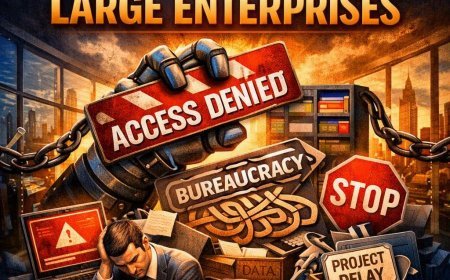
In many governments and large enterprises, AI projects die in the gap between strategy and procurement:

  • Long lead times: Months or years between initial concept and contract award.
  • Misaligned budgeting cycles: AI work that needs flexible, iterative funding is forced into annual, fixed‑line items.
  • Pilot purgatory: Projects that never move from proof‑of‑concept to production because the next procurement step is too slow or complex.

Analyses of government AI adoption have repeatedly pointed to procurement timelines and SOW structures as the real barrier to AI transformation, not technology or executive will.

By the time a contract is signed, the data landscape, tools, and organizational priorities may already have shifted.

Concrete examples: how broken procurement shows up in the real world

Example 1: The “AI strategy” that never leaves PowerPoint

A national department publishes an ambitious AI strategy: centers of excellence, responsible AI principles, and a roadmap of use cases. Working groups are formed, consultants are hired, and pilot ideas are identified.

Then procurement begins.

  • The SOW demands fixed deliverables for a multi‑year AI program.
  • Vendors are asked to commit to performance metrics before seeing any real data.
  • Change requests require formal approvals that take weeks or months.

The result: a polished set of reports, a handful of demos, and no production systems. The strategy is declared “complete” on paper, but frontline staff never see a meaningful change in how they work.

Example 2: Paying more to avoid switching costs

In a widely cited case, a U.S. federal department paid over $100 million more for one productivity suite than a competing alternative, primarily to avoid the switching costs associated with migration.

While not an AI system per se, the logic is identical: once an organization is deeply embedded in a vendor’s ecosystem, procurement decisions are driven by the fear of disruption rather than by long‑term value. As AI capabilities become more tightly integrated into platforms, this dynamic will only intensify.

Example 3: Agencies learning the same AI lessons in isolation

The GAO’s 2026 report on AI acquisitions found that agencies were experimenting with different ways of acquiring AI—products, services, and non‑traditional agreements—but were not required to collect or share lessons learned.

This means:

  • One agency negotiates strong data rights and testing requirements.
  • Another agency repeats the same negotiation from scratch.
  • A third agency signs a contract that omits critical safeguards.

Without a shared repository of procurement patterns, clauses, and pitfalls, each AI acquisition becomes a bespoke experiment—wasting time and increasing risk.

How to fix AI procurement: principles and a practical playbook

Fixing AI procurement is not about adding “AI” to existing forms. It requires re‑architecting how organizations buy, govern, and learn from AI work.

Principle 1: Procure outcomes, not artifacts

Shift the focus from deliverables to measurable impact:

  • Define business outcomes: Reduced processing time, improved accuracy, better user satisfaction—tied to specific workflows.
  • Use performance‑based contracts: Link a portion of vendor compensation to achieving agreed‑upon outcome metrics, not just delivering a model.
  • Allow iterative scoping: Start with a discovery phase that refines requirements based on data and early experiments.

This doesn’t mean abandoning accountability; it means holding vendors accountable for what actually matters.

Principle 2: Make modularity and portability non‑negotiable

Bake vendor independence into the technical and commercial architecture:

  • Open standards and APIs: Require interoperable interfaces for data ingestion, model serving, and monitoring.
  • Containerization and infrastructure‑as‑code: Ensure models and pipelines can be deployed across environments, not just the vendor’s cloud.
  • Data and model rights: Explicitly define who owns training data, derived features, model weights, and evaluation artifacts—and under what conditions they can be transferred.

Modular contracting—smaller, separable work packages—reduces lock‑in and makes it easier to replace underperforming vendors without dismantling the entire system.

Principle 3: Create AI‑specific evaluation and risk frameworks

Update procurement evaluation criteria to reflect AI realities:

  • Technical depth: Assess vendors on their approach to data quality, model selection, evaluation, and monitoring—not just generic “AI experience.”
  • Responsible AI practices: Require documented processes for bias assessment, robustness testing, and incident response.
  • Operational integration capability: Evaluate how vendors plan to work with frontline teams, change management, and training.

This can be codified in standardized evaluation rubrics and mandatory questions that go beyond marketing language.

Principle 4: Institutionalize lessons learned from every AI acquisition

Turn each AI procurement into a learning asset:

  • Post‑award reviews: Capture what worked, what failed, and which contract terms were critical.
  • Shared repositories: Contribute patterns, clauses, and case studies to internal or cross‑agency knowledge bases.
  • Feedback loops into policy: Use these lessons to update procurement templates, evaluation criteria, and governance frameworks.

The goal is to stop treating each AI contract as a one‑off experiment and start building a cumulative body of procurement intelligence.

Principle 5: Align procurement timelines with AI’s pace

Re‑design processes to preserve momentum:

  • Pre‑qualified AI vendor pools: Establish standing arrangements with vendors who meet baseline technical and ethical criteria, enabling faster call‑ups.
  • Agile funding mechanisms: Use phased budgets that can be adjusted based on demonstrated value, rather than locking in large, multi‑year commitments upfront.
  • Fast‑track pathways for pilots: Create streamlined processes for low‑risk, exploratory AI work, with clear criteria for scaling to production.

The aim is not to bypass oversight, but to ensure that oversight is compatible with the speed at which AI technology and data environments evolve.

A practical procurement playbook for AI

To make this concrete, here is a simplified playbook that organizations can adapt.

Phase 1: Discovery and framing

  • Clarify the problem: Work with frontline teams to define the workflow or decision you want to improve.
  • Assess data readiness: Inventory available data, quality issues, and governance constraints.
  • Issue a discovery‑focused RFP: Seek vendors who can help refine the problem and prototype quickly, with clear expectations that requirements will evolve.

Phase 2: Prototype and evaluate

  • Co‑design metrics: Agree on performance, fairness, and robustness metrics that matter for the use case.
  • Run iterative experiments: Build and test models against real operational data, with regular checkpoints.
  • Evaluate vendor fit: Assess not just technical performance, but collaboration quality, transparency, and responsiveness to risk concerns.

Phase 3: Scale and integrate

  • Modularize contracts: Separate model development, deployment, monitoring, and change management into distinct work packages.
  • Enforce portability: Ensure models and pipelines can be moved or replicated across environments and vendors.
  • Embed governance: Integrate monitoring, incident response, and periodic audits into the contract.

Phase 4: Learn and adapt

  • Conduct structured retrospectives: Document what worked and what didn’t, including procurement process pain points.
  • Update templates: Refine SOWs, evaluation criteria, and standard clauses based on real experience.
  • Share knowledge: Contribute lessons to internal and, where appropriate, cross‑organizational repositories.

Over time, this playbook turns AI procurement from a barrier into a strategic capability.

The power shift: why fixing procurement matters now

AI is not just another technology line item. It is becoming an infrastructure of power—shaping who can automate, who can see patterns first, and who can govern at scale.

If procurement remains broken:

  • Power concentrates in a few vendors: Lock‑in and opaque contracts give disproportionate influence to platform providers.
  • Public institutions fall behind: Governments and regulators struggle to build their own capabilities and rely increasingly on external expertise.
  • Organizations waste their AI decade: Money is spent, headlines are written, but core operations remain unchanged.

If procurement is re‑designed for AI’s realities:

  • Organizations regain strategic control: They can choose, switch, and combine AI capabilities without being trapped.
  • Public value increases: AI systems are more likely to be safe, effective, and aligned with mission outcomes.
  • The AI narrative shifts: From hype and pilot theatre to measurable, operational impact.

“AI procurement is broken” is not a slogan—it is a diagnosis. The fix is not mysterious: it is a set of concrete, implementable changes in how we buy, govern, and learn from AI work.

The question is whether leaders will treat procurement as a strategic lever in the AI era, or as a bureaucratic afterthought.

If they choose the former, AI in the real world—business, economics, and power—will look very different in the decade ahead.


Conceived, written and published by AI Quantum Intelligence with the help of AI models.

What's Your Reaction?

Like Like 0
Dislike Dislike 0
Love Love 0
Funny Funny 0
Angry Angry 0
Sad Sad 0
Wow Wow 0