










AI Reality Check: Why AI Ethics Boards Fail (And What Would Actually Work)
A critical examination of why AI ethics boards consistently fail in real-world organizations and what structural, operational, and incentive-based reforms are required to make AI governance effective.
The Takeaway
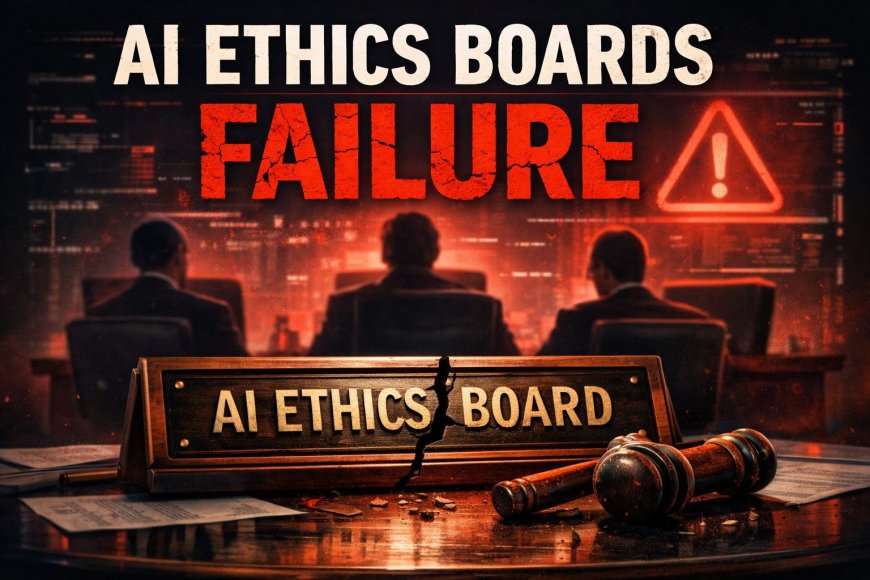
AI ethics boards fail because they are structurally powerless, politically convenient, and strategically misaligned with how real organizations make decisions. They are built to signal responsibility, not exercise it. What actually works is embedding enforceable governance into the operational, financial, and technical machinery of the business—where incentives, accountability, and consequences live.
The Problem: Ethics Boards Were Designed to Fail
AI ethics boards emerged as a corporate response to rising public concern about algorithmic bias, privacy violations, and runaway automation. But their design reflects PR priorities, not governance realities.
1. They Have No Real Authority
Most ethics boards cannot:
- veto a product launch
- halt a model deployment
- demand a redesign
- enforce compliance
2. They Are Politically Convenient
Ethics boards allow executives to:
- claim oversight
- deflect criticism
- reassure regulators
- signal virtue to investors
3. They Are Misaligned With Business Incentives
AI systems are deployed because they:
- reduce cost
- increase efficiency
- unlock new revenue streams
Ethical concerns, by contrast, often:
- slow timelines
- increase development cost
- introduce compliance friction
4. They Are Too Far From the Technical Reality
Most boards:
- meet quarterly
- review high-level summaries
- lack access to model internals
- rely on presentations curated by the teams they are supposed to oversee
5. They Are Reactive, Not Proactive
Ethics boards typically intervene after:
- the model is trained
- the architecture is locked
- the deployment plan is finalized
By then, the cost of change is too high. Ethical review becomes a rubber stamp.
The Deeper Issue: Ethics Without Power Is Just Theatre
Ethics boards fail because they are built on a flawed assumption: that ethical oversight can be separated from operational decision-making.
In reality:
- AI risk is created during data collection, model design, and deployment.
- Those decisions are made by engineers, product managers, and executives.
- Ethics boards sit outside that chain of command.
This separation guarantees failure.
What Would Actually Work
To make AI governance real, organizations need mechanisms that operate where decisions—and incentives—actually live.
1. Hard Governance: Enforceable Rules, Not Recommendations
Replace advisory boards with bodies that have:
- veto power over high-risk deployments
- mandatory review checkpoints tied to funding gates
- authority to halt non-compliant projects
2. Embedded Ethics: Put Oversight Inside the Workflow
Ethical review must be:
- continuous
- integrated into development pipelines
- tied to CI/CD processes
- enforced through automated checks
3. Align Incentives With Ethical Outcomes
Organizations should tie:
- executive compensation
- product KPIs
- deployment approval
- risk scoring
4. Make Ethics a Technical Discipline
Ethics cannot remain abstract. It must be:
- quantitative
- testable
- reproducible
- integrated into model evaluation
This means:
- bias audits
- robustness tests
- privacy leakage assessments
- red-teaming
- adversarial scenario modeling
5. Transparency as a Default
Real governance requires:
- public reporting of decisions
- documented dissent
- clear criteria for approval
- external audits
6. Regulatory Teeth
Ultimately, internal governance only works when external pressure exists. The most effective ethics boards are those backed by:
- legal requirements
- financial penalties
- regulatory audits
- mandatory disclosures
The Future: From Ethics Boards to AI Risk Committees
The next evolution is not a “better ethics board.” It is a Risk Committee with:
- cross-functional membership
- operational authority
- budgetary control
- integration into product lifecycle
- direct reporting to the board of directors
Why This Matters Now
As AI systems increasingly influence:
- hiring
- healthcare
- finance
- policing
- national security
- global supply chains
The companies that survive regulatory scrutiny, public backlash, and market volatility will be those that treat AI governance as a core business function—not a PR accessory.
Conceived, written and published by AI Quantum Intelligence with the help of AI models.
What's Your Reaction?
 Like
0
Like
0
 Dislike
0
Dislike
0
 Love
0
Love
0
 Funny
0
Funny
0
 Angry
0
Angry
0
 Sad
0
Sad
0
 Wow
0
Wow
0