












AI x Crypto: Two Industrial Revolutions Colliding in Real Time
AI and crypto are no longer separate narratives. Explore how AI supply chains and decentralized crypto networks are merging into a global, tokenized compute economy.
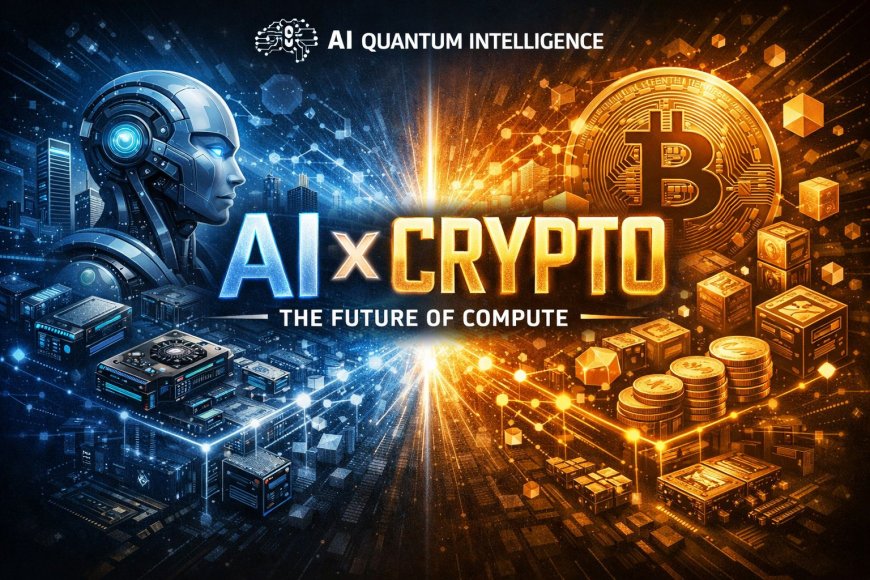
Why the world’s two most-watched technology themes are no longer parallel stories—but converging supply chains fighting for the same future.
I. The Two Supply Chains: One Physical, One Digital, Both Transformational
The global economy is being reshaped by two simultaneous industrial revolutions:
-
The AI supply chain — dominated by NVIDIA, AMD, TSMC, ASML, Broadcom, Supermicro, and hyperscalers like Microsoft, Amazon, and Google.
-
The Crypto/DePIN supply chain — decentralized compute networks, blockchain infrastructure, tokenized platforms, and Web3-native service providers.
At first glance, these ecosystems appear unrelated. One is hardware-heavy, capital-intensive, and deeply tied to geopolitics. The other is software-native, tokenized, and built around decentralized coordination.
But beneath the surface, these two worlds are becoming increasingly interdependent.
AI needs more compute, more bandwidth, more distributed infrastructure than centralized clouds can supply. Crypto needs more intelligence, more automation, more real-world integration than blockchains alone can deliver.
The result is a new hybrid economy where AI and crypto are no longer competing narratives—they are complementary supply chains feeding the same global demand for computation, automation, and trustless coordination.
II. Market Dynamics: How AI Equities and Crypto Tokens Behave Differently
1. AI Equities: Cash Flow, CapEx, and Geopolitical Gravity
AI equities behave like traditional industrials with exponential demand curves:
-
NVIDIA is effectively the “OPEC of compute,” controlling supply of the world’s most valuable resource: AI-capable GPUs.
-
TSMC is the geopolitical choke point of the semiconductor world.
-
ASML is the sole gatekeeper of EUV lithography.
-
Hyperscalers (MSFT, AMZN, GOOG) are vertically integrating AI chips, data centers, and model ecosystems.
These companies are valued on:
-
Revenue growth
-
Gross margins
-
CapEx cycles
-
Supply chain resilience
-
Enterprise adoption
-
Regulatory exposure
They are capital-intensive, slow-moving, and geopolitically constrained.
2. Crypto Tokens: Network Effects, Liquidity Cycles, and Reflexivity
Crypto assets behave like digital economies, not companies:
-
Value is driven by network participation, not revenue alone.
-
Tokens respond to liquidity cycles, not earnings seasons.
-
Growth is reflexive: price drives adoption, adoption drives price.
-
Supply is programmatic, not tied to manufacturing constraints.
Crypto markets are:
-
Faster
-
More volatile
-
More sentiment-driven
-
More global
-
Less regulated
-
More innovation-per-dollar
Where AI equities move in quarters, crypto moves in hours.

III. Synergies: Where AI and Crypto Strengthen Each Other
1. AI Supercharges Crypto Platforms
AI is already transforming blockchain infrastructure:
-
AI-driven smart contract auditing reduces exploits and rug pulls.
-
AI-based fraud detection strengthens exchanges and DeFi platforms.
-
AI-optimized consensus improves throughput and energy efficiency.
-
AI agents can autonomously interact with DeFi, NFTs, and DAOs.
-
AI-enhanced developer tooling accelerates protocol development.
AI gives crypto what it has always lacked: automation, intelligence, and enterprise-grade reliability.
2. Crypto Supercharges AI Infrastructure
Crypto—especially DePIN—solves AI’s biggest bottleneck: compute scarcity.
Decentralized GPU networks like:
-
Aethir
-
Render
-
Akash
-
io.net
-
Bittensor
…are building parallel AI compute supply chains outside the hyperscaler oligopoly.
Crypto enables:
-
Tokenized incentives for GPU providers
-
Permissionless access to compute
-
Global distribution of workloads
-
Lower-cost AI inference
-
Market-driven pricing for compute
In other words, crypto gives AI what it desperately needs: scalable, decentralized, economically aligned compute infrastructure.
IV. Key Differences: Why These Markets Don’t Behave the Same
1. AI is supply-constrained. Crypto is demand-constrained.
-
AI companies cannot produce enough GPUs to meet demand.
-
Crypto networks can produce infinite tokens—but struggle to create real demand.
2. AI is centralized by necessity. Crypto is decentralized by design.
-
AI training requires massive, centralized clusters.
-
Crypto thrives on distributed, permissionless participation.
3. AI is regulated by governments. Crypto is regulated by markets.
-
AI faces national security scrutiny.
-
Crypto faces liquidity cycles and community governance.
4. AI monetizes compute. Crypto monetizes coordination.
-
AI sells computation, models, and services.
-
Crypto sells trustless coordination, incentives, and digital ownership.
V. The Convergence: Where the Two Worlds Are Colliding
1. Tokenized AI Compute Markets
The most powerful convergence point is the rise of tokenized compute markets:
-
AI workloads
-
GPU supply
-
Model inference
-
Data pipelines
-
Agent ecosystems
…all priced and settled using tokens.
This is the first time in history that a real-world industrial commodity—compute—is being tokenized at scale.
2. AI Agents Using Crypto Rails
AI agents will:
-
Hold wallets
-
Execute transactions
-
Manage portfolios
-
Deploy smart contracts
-
Operate DAOs
-
Pay for compute autonomously
Crypto becomes the financial operating system for AI.
3. Crypto Networks Using AI Governance
AI will:
-
Detect governance attacks
-
Model economic outcomes
-
Optimize token emissions
-
Predict network congestion
-
Manage validator sets
AI becomes the governance operating system for crypto.
VI. Investment Implications (High-Level, Not Advice)
(General analysis only — not investment advice.)
AI Equities
-
Driven by enterprise adoption
-
Anchored in real revenue
-
Sensitive to supply chain constraints
-
Long-term secular growth
Crypto Tokens
-
Driven by network effects
-
Highly reflexive
-
Sensitive to liquidity cycles
-
Capable of exponential upside and downside
The two asset classes behave differently because they represent different types of value creation.
VII. The Big Picture: A New Dual-Sided Compute Economy
AI and crypto are not competing technologies. They are two halves of the same emerging global compute economy:
-
AI = demand for compute
-
Crypto = supply and coordination of compute
AI is the engine. Crypto is the marketplace. Together, they form the first global, permissionless, tokenized compute layer.
This convergence will define the next decade of technological power.
Conceived, written and published by AI Quantum Intelligence with the help of AI models.
What's Your Reaction?
 Like
1
Like
1
 Dislike
1
Dislike
1
 Love
1
Love
1
 Funny
2
Funny
2
 Angry
0
Angry
0
 Sad
1
Sad
1
 Wow
0
Wow
0