



















India’s AI Sovereignty Push: Building Indigenous Models, Chips, and National Compute Infrastructure
In this article, we celebrate and recognize that many of our members and readers are from India and the surrounding region. We're always trying to develop and publish articles with a regionally diverse and global interest. So with that, let's focus our attention on India and how that region and country is accelerating its AI sovereignty push with indigenous models, national compute infrastructure, and chip innovation—reshaping its digital future.
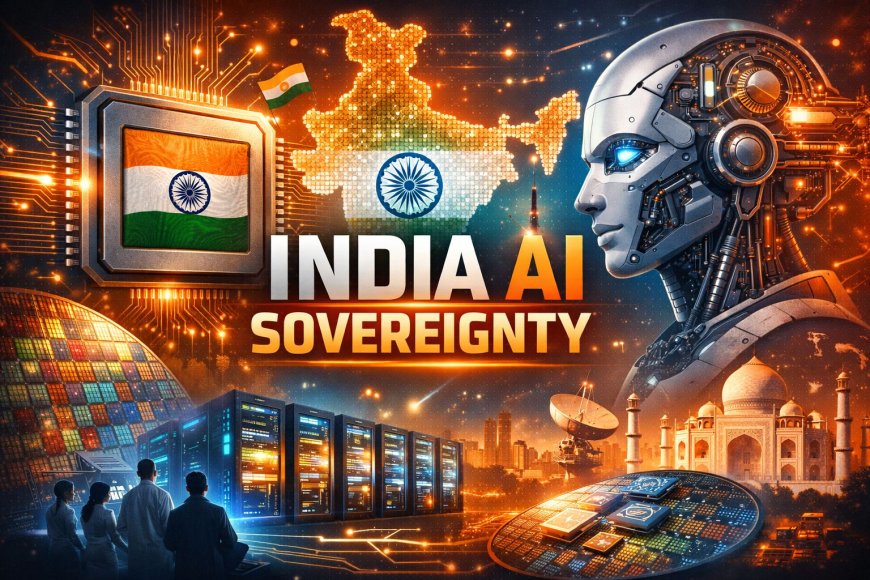
India is entering a decisive phase in its technological evolution — one defined not by outsourcing, service exports, or cost arbitrage, but by sovereignty over intelligence itself. As AI becomes the new strategic substrate of global power, nations are no longer competing on GDP, trade routes, or even military hardware. They are competing on compute, data, and the ability to train models at global scale.
For India — a nation of 1.4 billion people, a rising digital superpower, and the world’s largest producer of technical talent — the question is no longer whether it will participate in the AI revolution. It is whether it will own the stack, shape the standards, and build the infrastructure that determines who leads and who follows in the next era of global intelligence.
India’s answer is becoming increasingly clear: AI sovereignty is not optional. It is the new national project.
1. The Strategic Imperative: Why Sovereign AI Matters for India
AI is no longer a consumer technology. It is a geopolitical instrument.
Countries that control:
-
Compute
-
Energy for compute
-
Data pipelines
-
Model architectures
-
Chip manufacturing and packaging
…will control the next century’s economic and political order.
For India, sovereignty in AI is not about isolationism. It is about strategic independence — the ability to build, deploy, and govern AI systems without relying on foreign platforms, foreign chips, or foreign data regimes.
Three forces make this urgent:
-
The U.S.–China AI duopoly is consolidating.
-
Global GPU shortages are creating structural dependency.
-
National digital infrastructure (Aadhaar, UPI, ONDC) gives India a unique foundation — but only if the AI layer is sovereign.
India cannot afford to be a tenant in someone else’s AI empire.
2. Indigenous Large Language Models: India’s New Cognitive Infrastructure
India is now building India‑trained, India‑scaled, India‑aligned LLMs — not as academic experiments, but as national assets.
These models are being designed to:
-
Understand Indian languages (22 official, 19,500+ dialects)
-
Reflect Indian cultural, legal, and economic contexts
-
Serve public‑sector and national‑scale applications
-
Reduce reliance on Western or Chinese foundation models
The emerging thesis is bold:
If India wants AI that works for 1.4 billion people, it must build AI that understands 1.4 billion people.
This is not just a linguistic challenge. It is a sovereignty challenge. A model trained on Western data cannot govern Indian agriculture, healthcare, education, or public services. A model trained on Indian data — under Indian governance — can.
3. The Compute Question: India’s National AI Supercomputing Grid
Every nation pursuing AI sovereignty eventually hits the same wall: compute capacity.
India is now investing in:
-
National AI compute clusters
-
GPU and accelerator farms
-
AI‑ready data centers
-
Energy‑efficient HPC infrastructure
-
Public‑private compute consortiums
The goal is to create a national compute backbone that:
-
Supports domestic LLM training
-
Powers public‑sector AI deployments
-
Enables startups to train models without foreign cloud dependency
-
Reduces capital flight to overseas compute providers
India’s approach is pragmatic: Instead of building a single monolithic supercomputer, it is building a federated national grid — a distributed, scalable, sovereign compute fabric.
This is the same strategy used by the EU, Japan, and South Korea — but India’s scale gives it a unique advantage.
4. The Chip Frontier: India’s Bid to Enter the Semiconductor Race
No country can achieve AI sovereignty without chip sovereignty.
India is now pushing aggressively into:
-
Semiconductor fabrication
-
Advanced packaging
-
Chip design for AI accelerators
-
Trusted manufacturing ecosystems
While India is not yet competing with Taiwan or South Korea, it is positioning itself as:
-
A trusted manufacturing partner
-
A design hub for AI‑specific silicon
-
A regional alternative to China‑centric supply chains
The long‑term ambition is clear: India wants to move from being a consumer of AI chips to a producer of AI‑optimized silicon.
This is a generational project — but it is underway.
5. The Data Advantage: India’s Population‑Scale Digital Ecosystem
India’s greatest AI asset is not compute or chips. It is data — structured, population‑scale, and already digitized.
Through Aadhaar, UPI, DigiLocker, CoWIN, and ONDC, India has built the world’s most advanced digital public infrastructure (DPI).
This gives India:
-
Clean, structured, interoperable data
-
National‑scale identity and authentication
-
Real‑time financial and commerce rails
-
A foundation for AI‑driven public services
Most countries have data. India has governable data — a rare strategic advantage.
The next step is to build AI on top of DPI, creating:
-
AI‑driven citizen services
-
AI‑enabled public health systems
-
AI‑powered commerce and logistics
-
AI‑augmented governance
This is where India can leapfrog the world.
6. The Talent Engine: India’s Global AI Workforce
India produces more AI engineers than any other country. Its diaspora leads AI teams at:
-
Google
-
Microsoft
-
OpenAI
-
Meta
-
Amazon
-
NVIDIA
-
Global startups and research labs
This gives India a global talent network unmatched by any other nation.
The question is no longer whether India has the talent. It is whether India can retain, mobilize, and empower that talent to build sovereign AI systems at home.
The early signs are promising:
-
AI startups are booming in Bengaluru, Hyderabad, and Pune.
-
India’s research output in AI is accelerating.
-
Global companies are building AI R&D centers in India.
Talent is India’s most renewable strategic resource.
7. The Road Ahead: Can India Build a Fully Sovereign AI Stack?
India’s AI sovereignty push is ambitious — but not unrealistic.
To succeed, India must simultaneously advance:
-
Indigenous LLMs
-
National compute infrastructure
-
Semiconductor manufacturing
-
AI‑ready digital public infrastructure
-
A globally competitive AI talent ecosystem
No country has all five. India is one of the few that could.
The next decade will determine whether India becomes:
-
A consumer of global AI platforms, or
-
A producer of sovereign AI infrastructure that shapes the world
The stakes are enormous. The opportunity is historic. And the momentum is unmistakable.
India is not just adopting AI. India is building its own AI civilization layer.
Conceived, written and published by AI Quantum Intelligence with the help of AI models.
What's Your Reaction?
 Like
2
Like
2
 Dislike
0
Dislike
0
 Love
1
Love
1
 Funny
0
Funny
0
 Angry
2
Angry
2
 Sad
1
Sad
1
 Wow
2
Wow
2
Related Posts




-
 ASRITANishant