














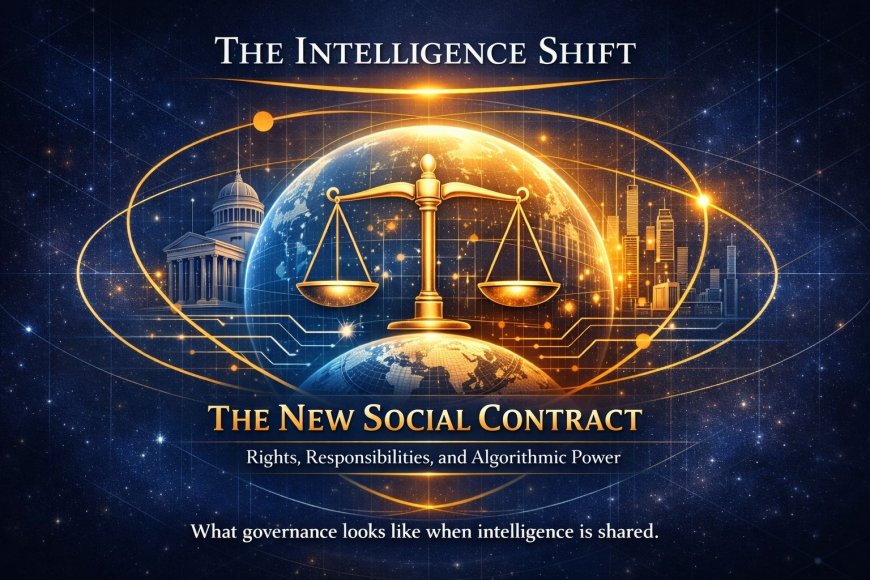
The Intelligence Shift: The New Social Contract - Rights, Responsibilities, and Algorithmic Power
June 2026 Edition - The rise of shared human–machine intelligence demands a new social contract—redefining rights, responsibilities, and algorithmic power in modern governance.
Takeaway
The rise of shared machine intelligence forces a renegotiation of the social contract: who holds power, who bears responsibility, and what rights individuals retain when algorithms participate directly in decision‑making. The next era of governance will not be defined by human institutions alone, but by the systems we build, the data they absorb, and the collective intelligence that emerges between us.
I. The Social Contract Was Built for Human-Only Intelligence
For centuries, governance assumed a simple premise: humans make decisions, institutions constrain them, and rights protect individuals from the excesses of those institutions. Every constitution, charter, and legal doctrine rests on this assumption.
But the moment intelligence becomes shared—distributed across humans, machines, and hybrid systems—the foundation cracks.
- Decisions are no longer purely human.
- Power is no longer exclusively institutional.
- Agency is no longer individually contained.
We are entering a world where algorithms negotiate traffic flows, allocate medical resources, detect fraud, recommend sentencing ranges, and increasingly shape the informational environment in which citizens form opinions. The social contract must evolve because the actors within it have changed.
II. Algorithmic Power Is Not Neutral—It Is Structural
The most important shift is recognizing that algorithmic power is not simply a tool; it is a structural force.
Algorithms:
- Set rules (who sees what, when, and why)
- Shape incentives (what is rewarded, amplified, or suppressed)
- Define boundaries (what is allowed, flagged, or prohibited)
- Influence outcomes (who gets opportunities, credit, or blame)
This is governance by proxy. Not elected, not accountable, not transparent.
The new social contract must confront a core truth: Algorithmic systems now govern alongside human institutions, whether we acknowledge it or not.
III. Rights in the Age of Shared Intelligence
The next generation of rights will not be about access to information—they will be about agency within intelligent systems.
1. The Right to Cognitive Sovereignty
Individuals must retain control over how their attention, identity, and decision-making are shaped by algorithms. This includes:
- The right to know when algorithmic influence is occurring
- The right to opt out of manipulative or opaque systems
- The right to maintain an unfiltered informational baseline
Cognitive sovereignty becomes the new freedom of thought.
2. The Right to Algorithmic Transparency
Not full source code disclosure—rather:
- Clear explanations of how decisions are made
- Visibility into what data is used
- Insight into what objectives the system optimizes
Transparency becomes a democratic necessity, not a technical preference.
3. The Right to Data Dignity
Data is no longer a passive record; it is a component of intelligence. Citizens must have:
- Ownership of their data contributions
- Compensation for high-value data
- Protection against exploitative data extraction
Data dignity reframes data as labour.
IV. Responsibilities in a Hybrid-Intelligence Society
Rights alone cannot stabilize a shared-intelligence world. Responsibilities must evolve as well.
1. Responsibility to Maintain Human Oversight
Human judgment must remain the final arbiter in domains involving:
- Bodily autonomy
- Criminal justice
- Political rights
- Irreversible harm
Shared intelligence does not absolve humans of responsibility—it amplifies it.
2. Responsibility to Build Aligned Systems
Governments, companies, and institutions must ensure:
- Alignment with human values
- Continuous monitoring for drift
- Mechanisms for correction and appeal
Alignment becomes a civic duty.
3. Responsibility to Prevent Algorithmic Concentration
When a handful of entities control the majority of compute, data, and distribution, algorithmic power becomes oligarchic. Society must enforce:
- Compute decentralization
- Data portability
- Interoperability mandates
- Anti-monopoly constraints on AI infrastructure
Preventing concentration is the new antitrust.
V. Governance When Intelligence Is Shared
The future of governance will not be a replacement of human institutions—it will be a hybrid model.
1. Algorithmic Constitutionalism
Just as nations have constitutions, intelligent systems will require:
- Defined rights
- Defined limits
- Defined responsibilities
- Defined accountability mechanisms
Constitutionalism becomes computational.
2. Bilateral Governance: Humans + Systems
Imagine governance with two chambers:
- A human chamber (representatives, citizens, institutions)
- A systems chamber (auditable algorithmic agents with defined roles)
The two negotiate outcomes, each constrained by constitutional rules.
This is not science fiction—it is already emerging in:
- Automated financial regulation
- AI-assisted judicial review
- Algorithmic policy simulations
- Autonomous infrastructure management
Governance becomes collaborative.
3. The Rise of Algorithmic Ombudsmen
New institutions will emerge whose sole purpose is to:
- Audit algorithms
- Investigate harms
- Represent citizens in disputes with systems
- Enforce algorithmic rights
Ombudsmen become the guardians of shared intelligence.
VI. The New Social Contract
The new social contract must answer three questions:
1. What rights do individuals retain when intelligence is shared?
Cognitive sovereignty, transparency, and data dignity.
2. What responsibilities do institutions bear when deploying intelligent systems?
Oversight, alignment, and anti-concentration.
3. How is power distributed between humans and algorithms?
Through constitutional constraints, bicameral governance, and algorithmic accountability.
The new social contract is not about replacing human authority—it is about rebalancing power in a world where intelligence is no longer exclusively human.
VII. The Intelligence Shift Is a Governance Shift
The Intelligence Shift series has explored how AI reshapes identity, power, and societal structures. This edition marks a turning point: intelligence is no longer something humans possess alone. It is something we share, negotiate with, and must govern alongside.
The societies that thrive will be those that:
- Protect human agency
- Constrain algorithmic power
- Build transparent hybrid systems
- Treat data as a civic asset
- Ensure intelligence remains a public good
The future of governance is not human versus machine. It is human + machine, bound by a new social contract that protects rights, enforces responsibilities, and distributes power fairly.
This is what governance looks like when intelligence is shared.
Written and published by AI Quantum Intelligence with the help of AI models.
What's Your Reaction?
 Like
0
Like
0
 Dislike
0
Dislike
0
 Love
1
Love
1
 Funny
0
Funny
0
 Angry
1
Angry
1
 Sad
0
Sad
0
 Wow
0
Wow
0