














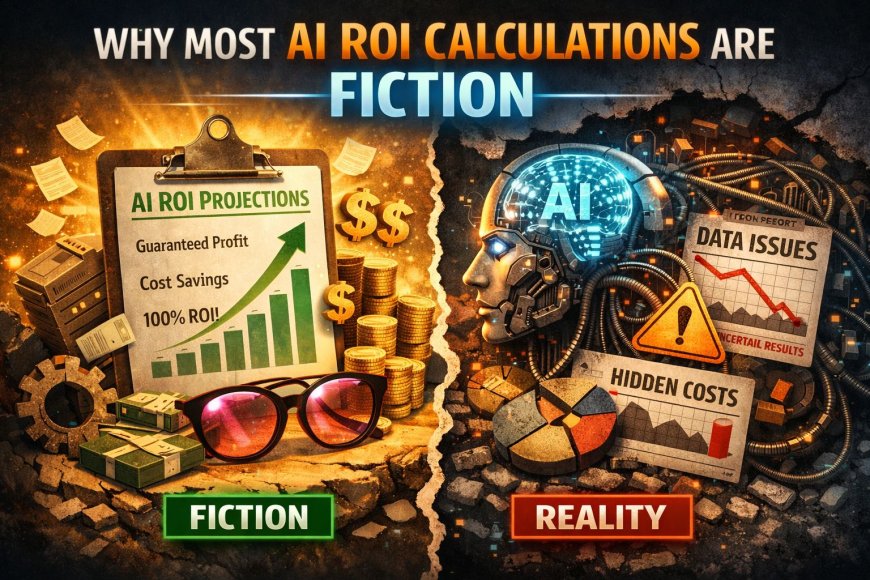
AI Reality Check: Why Most AI ROI Calculations Are Fiction
This week, we continue to “keep things real” with an article focused on AI return on investment. Most AI ROI models seem to be built on flawed assumptions. Discover why traditional ROI math fails to capture real AI value, risk, and organizational impact.
Takeaway
Many AI ROI models circulating in boardrooms today are fictional accounting exercises — elegant spreadsheets built on flawed assumptions. They measure cost savings and productivity gains but ignore the structural, temporal, and behavioral realities of AI adoption. The result: inflated expectations, misaligned investments, and a widening credibility gap between AI promises and business reality.
1. The Mirage of Measurable ROI
Executives crave quantifiable returns. AI vendors oblige with neat formulas:

But the “benefit” column is often filled with speculative efficiency gains, hypothetical automation savings, and unrealized revenue projections. These are not returns — they’re narratives.
AI ROI fiction thrives because it’s comforting. It gives leaders the illusion of control in a domain defined by uncertainty.
2. The Three Myths That Distort AI ROI
Myth 1: AI Value Is Immediate
AI rarely delivers instant returns. The first year is dominated by:
· data cleaning and integration
· process redesign
· workforce adaptation
· governance setup
Yet most ROI models assume immediate productivity gains. In reality, AI ROI follows a delayed curve, with early negative returns that only turn positive once organizational debt is paid down.
Myth 2: Efficiency Equals Value
Automating a task doesn’t guarantee strategic value. AI that saves time but doesn’t improve decision quality or customer experience is a cost reducer, not a value creator. True ROI comes from reinventing workflows, not just accelerating them.
Myth 3: AI Costs Are Linear
AI costs compound over time — model drift, retraining, compliance, and infrastructure scaling all add recurring expenses. Most ROI models treat these as one-time costs, ignoring the maintenance debt that accumulates quietly.
3. The Fictional Math Behind AI ROI
Many corporate AI ROI decks seem to rely on three flawed equations:
|
ROI Component |
Fictional Assumption |
Reality |
|
Labour Savings |
Every automated task equals reduced headcount |
Most automation reallocates labour, not eliminates it |
|
Revenue Growth |
AI personalization drives immediate sales lift |
Gains are marginal until data maturity improves |
|
Cost Reduction |
AI replaces legacy systems |
Integration costs often exceed savings for years |
The fiction isn’t malicious — it’s systemic. Finance teams apply traditional capital budgeting logic to a technology that behaves like a living system, not a static asset.
4. Why CFOs and CIOs Speak Different Languages
CFOs want predictable returns. CIOs know AI is probabilistic, iterative, and experimental. The tension between these worldviews creates ROI theater — PowerPoint decks that translate uncertainty into false precision.
AI ROI fiction persists because organizations reward certainty over truth. It’s easier to present a 3-year payback model than to admit that AI value creation is nonlinear and emergent.
5. The Real Economics of AI: From ROI to ROV
Forward-thinking enterprises are shifting from Return on Investment (ROI) to Return on Validation (ROV) — measuring how effectively AI systems validate hypotheses, improve decisions, and reduce uncertainty.
ROV Metrics Include things such as:
- decision accuracy improvement
- model reliability over time
- data quality uplift
- process adaptability
- human-AI collaboration efficiency
ROV reframes AI as a learning asset, not a fixed investment. It values adaptability and insight generation over short-term cost savings.
6. The Hidden Variables That Break ROI Models
AI ROI collapses under the weight of unmeasured variables:
- Data latency — how long it takes to turn raw data into usable insight
- Model drift — how quickly performance decays without retraining
- Human adaptation — how effectively teams integrate AI into workflows
- Governance friction — compliance and ethical oversight overhead
- Cultural inertia — resistance to automation and algorithmic decision-making
These variables are rarely quantified, yet they define whether AI delivers real returns or just PowerPoint promises.
7. The Fictional ROI Cycle
- Pilot success — small-scale proof of concept shows promise
- Extrapolation error — results are scaled linearly to enterprise level
- Budget approval — inflated ROI projections justify investment
- Reality check — integration complexity erodes returns
- Narrative management — metrics are reframed to preserve optimism
This cycle repeats until leadership fatigue sets in — or until a competitor demonstrates genuine AI-driven transformation.
8. The Path Forward: From Fiction to Financial Truth
To escape the ROI illusion, leaders must:
- Audit assumptions — challenge every efficiency and revenue projection
- Model uncertainty — include probabilistic ranges, not single-point estimates
- Account for organizational debt — integrate cultural and process costs
- Measure learning velocity — track how fast teams adapt to AI tools
- Shift from ROI to ROV — value insight generation and adaptability
AI ROI isn’t a number — it’s a narrative about how an organization learns to create value in a new paradigm.
9. The Bottom Line
Most AI ROI calculations are fiction because they measure comfort, not capability. They reward optimism over realism. They quantify what’s easy, not what’s true.
The companies that will win the AI decade are those that stop asking, “What’s the ROI of AI?” and start asking, “What’s the cost of not learning fast enough?”
Conceived, written and published by AI Quantum Intelligence with the help of AI models.
What's Your Reaction?
 Like
0
Like
0
 Dislike
0
Dislike
0
 Love
0
Love
0
 Funny
0
Funny
0
 Angry
0
Angry
0
 Sad
0
Sad
0
 Wow
0
Wow
0