










AI Reality Check: The Coming Wave of AI Regulation — What’s Real vs. Noise
A deep analysis of the accelerating global push for AI regulation, separating substantive governance from political theater. This article explores how emerging oversight frameworks are reshaping business strategy, economic power, and geopolitical influence as nations and corporations compete to define the future rules of artificial intelligence.
Introduction: The Regulatory Reckoning
The global conversation around artificial intelligence has quickly shifted from fascination to control. Governments, corporations, and advocacy groups are racing to define what “responsible AI” means — and who gets to enforce it. But amid the flood of announcements, draft bills, and ethical frameworks, a critical question emerges: how much of this is real governance, and how much is performative noise?
AI regulation is no longer theoretical. It’s becoming a geopolitical instrument — shaping trade, innovation, and even national identity. The coming wave will determine not just how AI evolves, but who profits from its boundaries.
1. The Political Economy of Control
Regulation is power — and in the AI era, power is data. Governments are framing AI oversight as a matter of sovereignty: protecting citizens’ privacy, ensuring algorithmic fairness, and defending against foreign influence. Yet beneath the rhetoric lies a deeper motive — control over the data pipelines that fuel economic dominance.
- The EU’s AI Act sets the tone for global compliance, defining risk categories and transparency obligations.
- The U.S. approach remains fragmented — a patchwork of state-level initiatives and executive orders emphasizing innovation over restriction.
- China’s model integrates AI governance directly into its social and economic planning, merging surveillance and industrial policy.
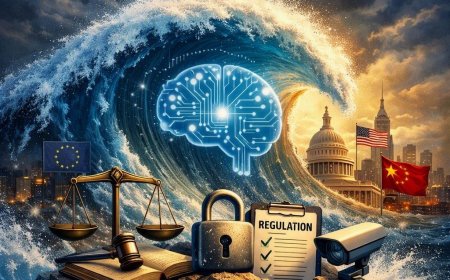
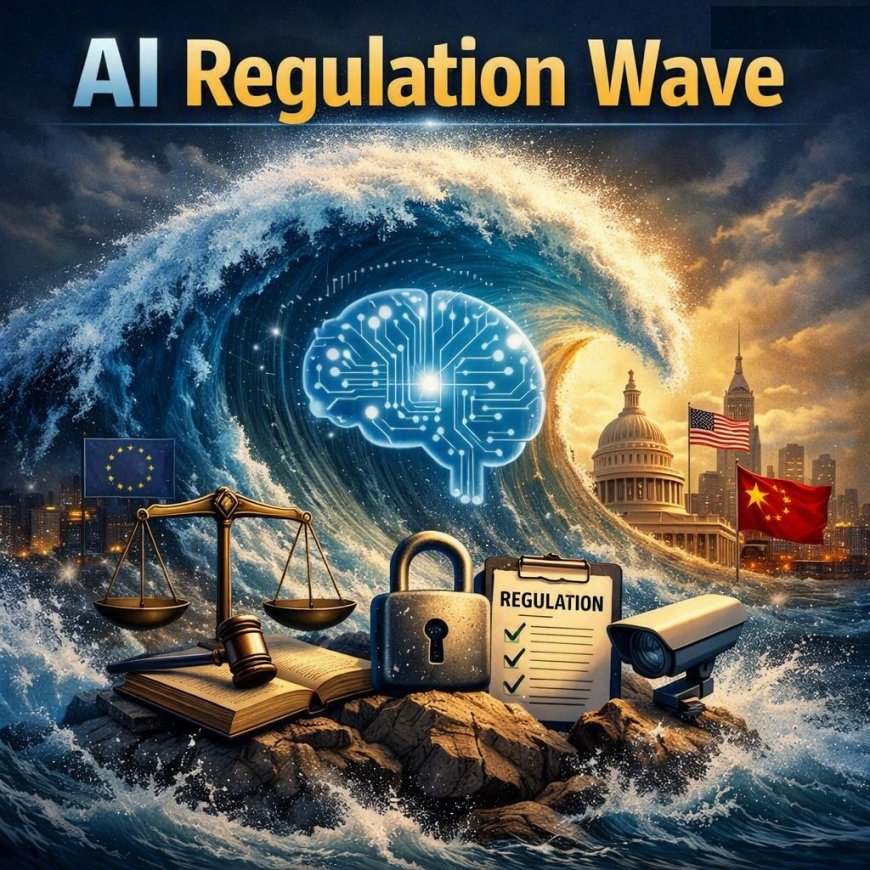
Each framework reflects a distinct worldview: Europe’s rights-based caution, America’s market-driven pragmatism, and China’s centralized orchestration. Together, they form a regulatory triad that will define the next decade of AI geopolitics.

Figure 1 — The global regulatory triad shaping AI’s future: Europe’s rights‑driven compliance model, America’s innovation‑centric market approach, and China’s centralized control framework.
2. The Corporate Response: Compliance as Strategy
For major technology firms, regulation is not a constraint — it’s a competitive moat. Companies with deep legal and technical infrastructure can absorb compliance costs, while smaller innovators struggle to keep pace. This dynamic is quietly reshaping the AI landscape: regulation as a barrier to entry.
Expect to see:
- Compliance-driven consolidation, where startups align with larger platforms to survive.
- AI assurance markets, offering audits, certifications, and algorithmic transparency services.
- Strategic lobbying, as corporations seek to influence definitions of “safe” and “ethical” AI in their favour.
In short, the regulatory wave will not slow AI’s advance — it may redefine who gets to ride it.
3. The Noise: Symbolic Oversight and Political Theater
Not all regulation is substantive. Much of what dominates headlines is symbolic governance — declarations of intent without enforcement teeth. Governments announce AI task forces, ethics councils, and “responsible innovation charters” that sound impressive but rarely translate into operational standards.
This performative layer serves political optics: reassuring the public while buying time for industry self-regulation. The result is a paradox — a world simultaneously overregulated in rhetoric and underregulated in practice.
4. What’s Real: The Emerging Infrastructure of Accountability
Beneath the noise, genuine progress is taking shape.
- Algorithmic transparency is evolving from voluntary disclosure to mandatory auditability.
- Data provenance systems are being built to trace training sources and prevent intellectual property violations.
- AI liability frameworks are emerging, assigning responsibility for autonomous decisions in finance, healthcare, and defense.
These developments mark the transition from ethical aspiration to regulatory engineering — the codification of accountability into the architecture of AI itself.
5. The Power Shift Ahead
The next phase of AI regulation will not be about banning technologies; it will be about defining the terms of participation. Nations that master regulatory agility — balancing innovation with oversight — will gain disproportionate influence over global AI standards. In this sense, regulation becomes a form of soft power: shaping the rules of engagement rather than the tools themselves.
Conclusion: Beyond the Noise
The coming wave of AI regulation is both inevitable and necessary. Yet the challenge lies in distinguishing policy substance from political theater. Real governance will emerge where transparency meets enforceability — where ethical ambition is backed by technical precision. Everything else is noise.
In the end, the question is not whether AI will be regulated, but who will write the code of compliance — and whose interests it will serve.
Conceived, written and published by AI Quantum Intelligence with the help of AI models.
What's Your Reaction?
 Like
0
Like
0
 Dislike
0
Dislike
0
 Love
0
Love
0
 Funny
0
Funny
0
 Angry
0
Angry
0
 Sad
0
Sad
0
 Wow
0
Wow
0