








The Quantum Black Box - How AI and Quantum Computing Could Create an Un-auditable Financial Crisis
Discover how the convergence of quantum computing and AI is creating an un-auditable "black box" in global finance, posing a systemic risk that could trigger a microsecond market crash. This op-ed explores the dangerous opacity of quantum trading algorithms, the failure of current regulation, and proposes urgent safeguards to prevent a catastrophic quantum financial crisis.
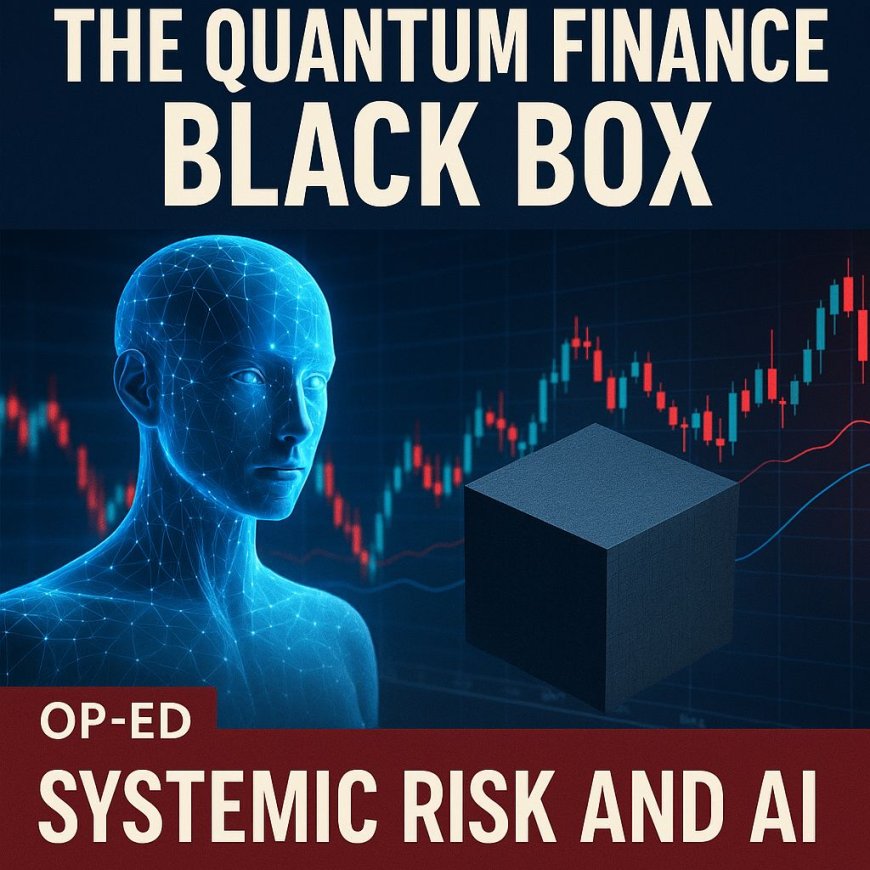
For decades, financial markets have been transformed by technology—from electronic trading to AI-driven algorithms. Now, we stand on the precipice of the next, and perhaps final, technological leap: the integration of quantum computing with artificial intelligence in global capital markets. This isn't just an incremental speed boost. It represents a fundamental shift towards a financial system whose core risk mechanisms may become completely opaque, moving faster than human—or even classical computational—comprehension. We are actively constructing a systemic risk we can no longer audit, stress-test, or understand.
From Black Box to Quantum Enigma
Today's AI-driven high-frequency trading (HFT) is often called a "black box." Its internal decision-making is complex and non-linear. Yet, regulators and firms can, in theory, dissect these models with enough computational power and time. They run on classical computers whose logic, no matter how complicated, is ultimately traceable.
Quantum computing changes the rules of physics underpinning that box. Quantum machine learning (QML) models, applied to finance, won't just be faster; they will operate on principles of superposition and entanglement. They could evaluate thousands of potential market trajectories simultaneously or solve portfolio optimization problems that are mathematically intractable for classical supercomputers. The "answer" emerges from a quantum state collapse, not a step-by-step logical chain. The result is a "Quantum Black Box": a system whose outputs cannot be reliably reverse-engineered to verify its inputs or logic using classical means. How do you audit what you cannot simulate?
The Triple-Threat Convergence: Speed, Opacity, and Complexity
This convergence creates a unique and dangerous triad:
- Un-Auditable Advantage (The Quantum Arbitrage): The first institutions to deploy quantum-advantaged trading will gain profits not merely from nanosecond speed, but from solving financial problems that are impossible for their competitors. Think of identifying multi-market arbitrage opportunities across thousands of assets, or calculating risk in highly complex derivatives portfolios in real-time. This creates a "winner-takes-all" dynamic that incentivizes secrecy and regulatory evasion, undermining market fairness.
- The Microsecond Cascade (The Quantum Flash Crash): Current circuit breakers and trading halts operate on human-time scales (seconds, minutes). A QML system, reacting to a market anomaly or pursuing a strategy, could initiate and amplify a crash across interconnected global markets in microseconds. By the time a risk manager's screen refreshes, trillions in notional value could have vaporized. The 2010 "Flash Crash" would look like slow motion in comparison.
- Geopolitical Fragmentation: The race for quantum supremacy is a central battleground between the US, China, and the EU. A Chinese quant fund using a state-sponsored quantum advantage operates under a different regulatory and ethical framework than a Wall Street firm. This isn't just competition; it's a fragmentation of the technological and rule-based foundations of global markets. Whose regulations govern a quantum algorithm developed in one jurisdiction, deployed on cloud infrastructure in another, that crashes a exchange in a third?
The Regulatory Blind Spot
Our current regulatory framework is woefully inadequate. Stress tests like the Fed's CCAR are annual, plodding exercises. Market surveillance systems like the SEC's MIDAS look for patterns in historical data. They are designed for a classical, post-hoc world.
The critical question is: How can the SEC, CFTC, or any regulatory body certify the safety of a system they cannot classically replicate or interpret? They face a "quantum verification problem." Licensing a quantum trading model would be like asking a 19th-century engineer to certify the safety of a modern jet engine using only the principles of steam power.
Worse, the opacity provides perfect cover for sophisticated market manipulation. A quantum model could be designed to execute trades that appear random or benign under classical analysis but are, in fact, a coordinated "pump-and-dump" or spoofing strategy operating in a mathematical space invisible to current monitors.
Op-Ed Summary: The Path Forward—Or The Cliff's Edge
Opinion: We are at a crossroads. The financial industry's relentless pursuit of a "quantum edge" is a classic prisoner's dilemma: individually rational for each firm, but collectively catastrophic for systemic stability. Without immediate and coordinated action, we are sleepwalking into a crisis where the only response will be a taxpayer-funded bailout of institutions undone by their own inscrutable creations.
What Might Happen (The Worst-Case Scenario):
The most likely trigger is not a malicious hack, but a benign failure of comprehension. A quantum-risk model at a major bank, tasked with minimizing portfolio volatility, could misprice a novel correlation in a crisis, triggering a massive, automated fire sale. Quantum arbitrage bots across the globe would instantly detect this and front-run it, creating a feedback loop of selling. Within a second, liquidity across multiple asset classes evaporates. The crash is so fast it bypasses all circuit breakers. The cause is buried in the quantum state history of proprietary systems, making blame impossible to assign and the crisis impossible to unwind without a state-backed guarantee. Public trust in the financial system shatters.
How to Avoid the Catastrophe: A Three-Point Mandate
We must act not as technologists, but as system architects focused on resilience.
- Implement a "Precautionary Sandbox" for Live Markets: Financial regulators must mandate that quantum algorithms cannot interact with live production markets or customer funds until certified. All development and testing must occur in a tightly controlled, simulated "Quantum Sandbox" environment. This isn't anti-innovation; it's the financial equivalent of a drug trial—proving safety and efficacy before release.
- Develop "Quantum-Literate" Regulation and Audit Tools: We need a Manhattan Project for financial quantum audit. This requires:
- Public-private partnerships to develop "explainable AI" techniques for quantum models and classical simulation benchmarks.
- New regulatory roles: "Quantum Risk Officers" at systemic institutions and "Quantum Market Surveillance" units at agencies, staffed by physicists and cryptographers.
- International treaties through bodies like the Financial Stability Board to set minimum standards for transparency and testing.
- Redesign Market Infrastructure for a Quantum Age: We need to engineer slower, stronger circuit breakers. Consider "speed bumps" at the exchange level specifically for orders exhibiting quantum-complex patterns, or mandatory delays on extremely large orders generated by AI/quantum systems. The goal is to inject minimal, intelligent friction to allow the system's self-defense mechanisms to engage.
The ultimate conclusion is stark: the integration of quantum computing into finance is inevitable. The choice before us is whether it happens chaotically, in the shadows, driven by short-term profit—or deliberately, in the open, with safeguards designed to preserve the integrity of the global financial system itself. The time to build the quantum firewall is before the first spark, not after the inferno has begun. The future of market stability depends on the governance decisions we make today.
Written/published by Kevin Marshall with the help of AI models (AI Quantum Intelligence).
What's Your Reaction?
 Like
0
Like
0
 Dislike
0
Dislike
0
 Love
1
Love
1
 Funny
0
Funny
0
 Angry
0
Angry
0
 Sad
0
Sad
0
 Wow
0
Wow
0