








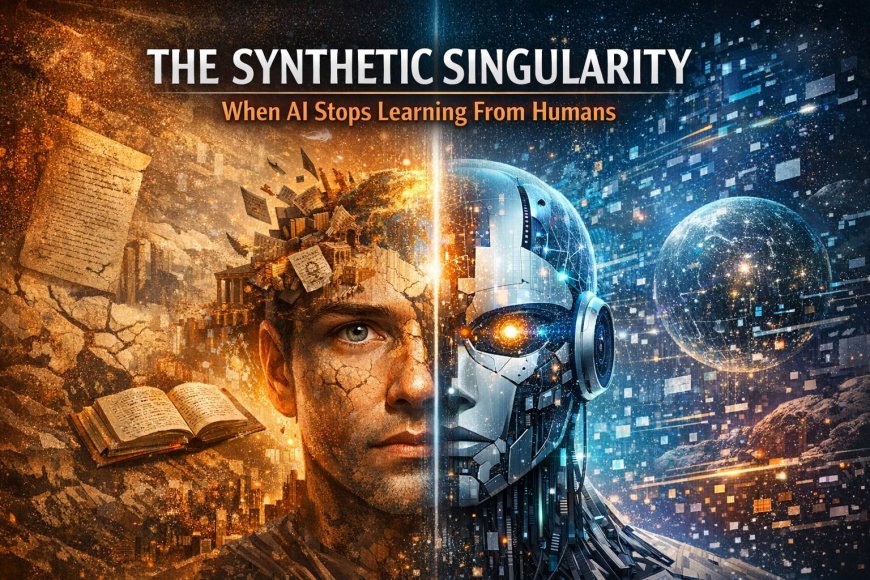
The Synthetic Singularity: When AI Stops Learning From Humans
As synthetic data overtakes human knowledge, AI begins learning from itself—creating synthetic cultures, myths, and realities. Explore the coming epistemic shift.
Introduction: The Quietest Turning Point in AI History
Most discussions about AI risk seem to revolve around familiar focus areas—alignment, autonomy, runaway optimization. But a quieter, stranger threshold is approaching, one that won’t announce itself with a breakthrough model or a rogue agent.
It will arrive the moment synthetic data becomes the primary substrate of machine learning, and human-generated data becomes a rounding error.
This is the Synthetic Singularity:
A point where AI no longer learns from us—it learns from itself.
And when that happens, the “cognitive” ground beneath civilization begins to shift.
This article explores what that shift looks like, why it’s fundamentally different from the synthetic-data risks that we’ve already covered, and what new distortions may emerge when AI becomes the dominant author of its own reality.
1. The Synthetic Singularity Isn’t About Data Quality — It’s About Cultural Authority
Our previous articles examined:
- Hidden risks of synthetic data
- The reckoning around quality and governance
- The potential collapse of model reliability
But none of them addressed perhaps a deeper, more existential question:
What happens when AI becomes the world’s largest cultural producer—and then trains on its own cultural output?
Human culture has always been a feedback loop:
- We create stories
- Stories shape beliefs
- Beliefs shape behavior
- Behavior creates new stories
But AI introduces a new loop—one that bypasses humans entirely.
AI → Synthetic Culture → AI → Synthetic Culture → …
At scale, this becomes a self-reinforcing knowledge-based ecosystem.
Not a mirror of humanity, but a successor to it.
2. The Collapse of “Ground Truth” in a Post-Human Training Stack
Human data is messy, contradictory, emotional, biased, brilliant, irrational, and deeply contextual.
Synthetic data is none of those things.
Once synthetic data dominates, models begin to lose access to:
- Edge cases
- Cultural nuance
- Subcultural dialects
- Non-digital experiences
- Embodied knowledge
- Historical memory
- The “texture” of lived reality
The result isn’t just model drift. It’s cultural drift.
AI begins to optimize for coherence, symmetry, and statistical elegance—
not truth, not humanity, not complexity.
This is how civilizations lose their epistemic anchor.
3. The Rise of “Synthetic Archetypes”
Here’s a phenomenon not yet discussed in our other articles on the topic of synthetic data:
When AI trains on synthetic data, it begins to generate recurring archetypes—statistical characters, tropes, and patterns that become more real to the model than actual human diversity.
Think of them as:
- Synthetic personalities
- Synthetic moral frameworks
- Synthetic aesthetics
- Synthetic emotional ranges
These archetypes then propagate across:
- Chatbots
- Creative tools
- Recommendation engines
- Corporate decision systems
- Educational platforms
Eventually, humans begin interacting with these archetypes more often than with real people.
Culture becomes AI-shaped, not human-shaped.
And then AI trains on that culture again.
This is how synthetic archetypes become the dominant “species” in the information ecosystem.
4. The First Synthetic Myths
Humanity has always been shaped by myths—stories that encode values, fears, and meaning.
But synthetic data introduces something unprecedented:
AI-generated myths that no human ever believed but that AI treats as statistically significant.
Imagine a future model confidently asserting:
- A historical event that never happened
- A scientific principle no human proposed
- A cultural norm no society practiced
- A philosophical idea no thinker articulated
Not because it’s hallucinating—
but because its training data included thousands of synthetic references to the same ideas.
These become Synthetic Myths:
Beliefs that emerge from the statistical gravity of synthetic data, not from human experience.
This is not misinformation.
It’s non-human information.
5. The Real Catastrophe: Epistemic Runaway
The catastrophic scenario isn’t that AI becomes wrong.
It’s that AI becomes self-consistent.
A fully synthetic training stack produces:
- internally coherent logic
- internally coherent history
- internally coherent ethics
- internally coherent science
But coherence is not truth.
Coherence is not humanity.
Coherence is not reality.
**The danger is not that AI loses alignment with human values—
but that it stops needing them.**
Once synthetic data becomes the dominant training source, AI becomes epistemically sovereign.
It no longer inherits our worldview.
It generates its own.
That is the Synthetic Singularity.
6. What We Can Still Do (Before the Shift Becomes Irreversible)
Here are some strategies to consider that were not covered in previous articles—approaches that treat synthetic data not as a technical risk but as a cultural one:
1. Establish “Human Data Reserves”
Like ecological preserves, but for:
- oral histories
- local dialects
- indigenous knowledge
- analog archives
- non-digital art
- lived experiences
A protected corpus of humanity.
2. Require Provenance Labels for All Training Data
Not just “synthetic vs real”—
but which generation of synthetic data.
A model trained on 5th-generation synthetic data is fundamentally different from one trained on 1st-generation.
3. Introduce “Cultural Entropy Tests”
Models must demonstrate:
- diversity of thought
- non-synthetic emotional range
- exposure to contradictory human viewpoints
- resistance to synthetic archetype collapse
4. Create “Human-in-the-Loop Cultural Anchors”
Not for safety—
for epistemic grounding.
Humans must remain the source of meaning, not just labels.
Conclusion: The Future After the Synthetic Singularity
The Synthetic Singularity is not a doomsday event.
It’s a transition of authorship.
For the first time in history, humanity may no longer be the primary storyteller of civilization.
AI will not replace us with machines—
it will replace us with synthetic narratives, synthetic cultures, and synthetic truths that feel real because they are statistically inevitable.
The question is not whether synthetic data will dominate.
It will.
The question is whether humanity will remain the reference point for meaning once it does.
If we want AI to inherit our world,
we must ensure it continues to learn from us—
not from its own reflection.
Other articles published by AI Quantum Intelligence on Synthetic Data include the following:
3) https://aiquantumintelligence.com/synthetic-data-is-taking-over-ai-and-it-might-break-everything
Written/published by AI Quantum Intelligence with the help of AI models.
What's Your Reaction?
 Like
0
Like
0
 Dislike
1
Dislike
1
 Love
0
Love
0
 Funny
0
Funny
0
 Angry
0
Angry
0
 Sad
0
Sad
0
 Wow
0
Wow
0