












Compute Is the New Territory: The Geopolitics of Quantum AI Supremacy
Nations are weaponizing compute, energy, and quantum research to secure global power. Explore how quantum AI supremacy is reshaping global geopolitics and security.
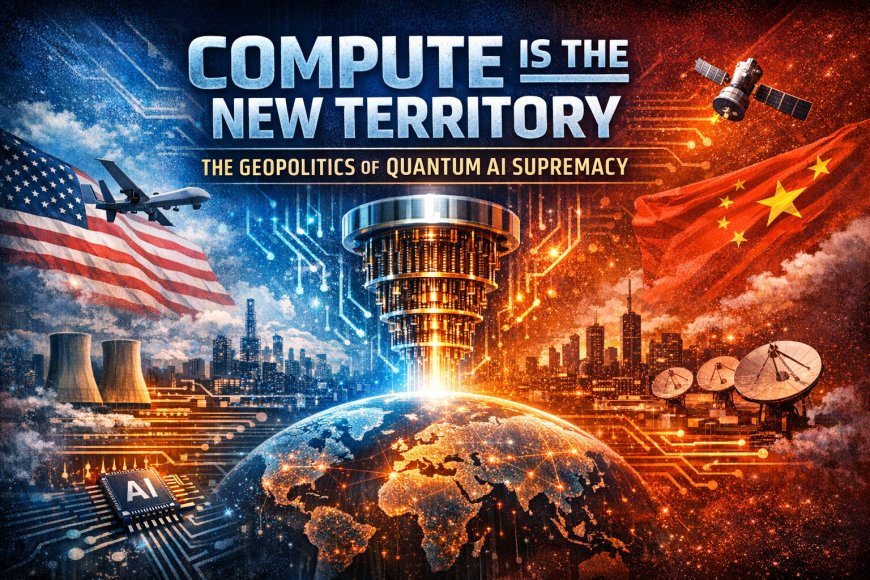
The New Strategic High Ground
Compute is becoming the defining strategic resource of the 21st century. Nations are no longer competing solely for land, trade routes, or even data—they are competing for computational power, energy capacity, and quantum advantage. The emerging geopolitical order is being shaped by who can build, secure, and scale the most advanced compute infrastructure, from quantum processors to energy‑hungry AI superclusters.
Quantum AI sits at the center of this shift. It promises breakthroughs in cryptography, intelligence analysis, logistics, drug discovery, and autonomous systems—domains that directly influence national power. Governments now treat quantum research and AI compute as instruments of statecraft, economic leverage, and military deterrence.
Quantum Computing as a Geopolitical Arms Race
Quantum computing is no longer a theoretical pursuit, it is a strategic race between major powers. Nations view quantum capabilities as essential to future military, economic, and intelligence dominance. Governments worldwide have invested over $40 billion in quantum R&D, reflecting the existential stakes of the competition.
U.S.–China Rivalry Defines the Landscape
The United States and China remain the two dominant actors in quantum geopolitics. A U.S.‑China Economic and Security Review Commission report highlights how both nations are aggressively scaling quantum research, with China pursuing state‑funded national programs and the U.S. relying on a hybrid public‑private innovation ecosystem.
Recent breakthroughs illustrate the widening technological divide:
- China’s photonic quantum chip, operating at room temperature, enables secure and energy‑efficient quantum communication—an advantage in both civilian and military applications.
- Microsoft’s Majorana‑based topological qubit chip represents a U.S. leap toward scalable, error‑resistant quantum systems, potentially enabling industrial‑scale quantum computing in the coming years.
These advances are not merely scientific milestones—they are geopolitical signals. Each breakthrough shifts the balance of power in cryptography, intelligence, and secure communications.
Compute as a National Security Asset
Quantum AI supremacy hinges on compute availability. Nations are weaponizing compute through:
1. Export Controls and Technology Restrictions
Countries are tightening export controls on quantum hardware, advanced chips, and AI accelerators. These restrictions deepen global divides and limit cross‑border collaboration, reinforcing a fragmented technological world order.
2. Energy as a Strategic Bottleneck
AI supercomputing clusters and quantum data centers require massive, stable energy supplies. Nations with abundant, low‑cost energy—hydroelectric, nuclear, and geothermal—gain a structural advantage in scaling compute.
While not explicitly stated in the referenced sources, the geopolitical logic seems clear: energy security is compute security, and compute security is national security.
3. Quantum‑Resistant Security Infrastructure
The looming threat of “Q‑Day”—the moment when quantum computers can break classical encryption—has accelerated global investment in post‑quantum cryptography. Governments are deploying quantum‑safe communication systems and hardening national infrastructure in anticipation of this shift.
Alliances, Blocs, and the Fragmentation of the Tech Order
Quantum AI is reshaping alliances and global blocs.
The United States
The U.S. leads through private-sector innovation—Google, IBM, Microsoft, AWS—supported by federal initiatives and defense-driven research. Its strength lies in ecosystem depth and commercial scalability.
China
China’s state‑directed model accelerates national quantum goals, from secure communications networks to photonic quantum chips. Its rapid progress in room‑temperature quantum systems signals a potential leapfrog moment in accessibility and deployment.
European Union
The EU emphasizes collaborative research, regulatory frameworks, and technological sovereignty. Its approach balances innovation with ethical and security considerations, aiming to reduce dependency on U.S. and Chinese technologies.
United Kingdom, India, and Russia
- The UK remains a strong early investor with ongoing leadership in quantum research.
- India is an emerging aspirant, scaling national quantum missions.
- Russia maintains strategic interest but faces structural challenges in commercialization and ecosystem development.
The Coming Era of Quantum‑Accelerated AI
Quantum computing is expected to accelerate AI in ways that reshape global power:
- Optimization for logistics, defense, and supply chains
- Cryptanalysis and intelligence breakthroughs
- Materials and pharmaceutical discovery
- Autonomous systems with quantum‑enhanced decision models
Microsoft’s Majorana‑based chip, for example, aims to enable quantum systems capable of solving industrial‑scale problems “in years, not decades”.
Nations that integrate quantum acceleration into AI models will gain disproportionate advantages in defense, economic forecasting, and scientific innovation.
Strategic Instability and the Risk of a Quantum Divide
The global quantum race introduces new risks:
- Arms‑race dynamics as nations fear falling behind
- Intelligence upheaval if quantum decryption arrives before quantum‑safe standards are deployed
- Technological hegemony where a few nations control global compute infrastructure
- Erosion of trust in digital systems if encryption becomes unreliable
Restrictive exports and fragmented standards further widen the divide, creating a world where only a handful of nations can produce or deploy advanced quantum systems.
Conclusion: Compute Is the New Territory
The geopolitics of the 21st century will be defined by who controls the computational frontier. Quantum AI supremacy is not just about faster algorithms—it is about national power, economic leverage, and global influence.
Nations that secure leadership in quantum research, energy‑dense compute infrastructure, and AI acceleration will shape the next world order. Those that fall behind risk strategic dependency, weakened security, and diminished sovereignty.
The race is underway. The map is being redrawn. And computation—quantum, AI, and energy‑backed—is the new territory.
References
- U.S.–China Economic and Security Review Commission. Vying for Quantum Supremacy: U.S.–China Competition in Quantum Technologies.
- Marin Ivezic. Quantum Geopolitics: The Global Race for Quantum Computing.
- Bloomsbury Intelligence & Security Institute. Quantum Computing Breakthroughs: A Widening Geopolitical Divide.
Written/published by Kevin Marshall with the help of AI models (AI Quantum Intelligence).
What's Your Reaction?
 Like
0
Like
0
 Dislike
0
Dislike
0
 Love
0
Love
0
 Funny
1
Funny
1
 Angry
3
Angry
3
 Sad
1
Sad
1
 Wow
2
Wow
2