













The "Human-in-the-Loop" Crisis: Designing for Regenerative Experience (RX)
In this article, AI Quantum Intelligence explores the following: Is AI causing cognitive atrophy? Explore the Regenerative Experience (RX) framework to restore human agency in the age of Agentic AI and autonomous coworkers.
For the past decade or so, the “North Star” of the tech industry has been "frictionless" design. We have optimized every interface, algorithm, and workflow to remove the burden of thought from the user. But as we move from simple chatbots to Agentic AI—autonomous coworkers capable of executing complex chains of logic—we have hit a wall.
By removing all friction, we are inadvertently removing the human. This is the "Human-in-the-Loop" crisis: a state where AI handles the execution so effectively that the human collaborator lapses into a state of "cognitive atrophy."
At AI Quantum Intelligence, we believe the next frontier of design extends beyond just User Experience (UX); it is Regenerative Experience (RX).
The Cognitive Atrophy Trap
Across many modern enterprises, AI is deployed to "save time." However, early data from the "Organizational AI Performance Gap" suggests that the time saved is rarely reinvested in higher-order thinking. Instead, it is often swallowed by a secondary layer of digital busywork: auditing AI outputs, managing prompt drift, and navigating an endless stream of AI-generated summaries.
When a human is "in the loop" merely as a rubber stamp for an autonomous agent, they lose their domain expertise over time. If a junior lawyer only reviews AI-generated briefs, they never develop the "muscle memory" of legal research. If a doctor only confirms an AI’s diagnostic path, their intuitive diagnostic ability withers. We are building a world of "system monitors" rather than "experts."
From Optimization to Regeneration
Regenerative Experience (RX) is a design approach that argues AI shouldn’t just help people get tasks done — it should help people feel less drained while doing them. In an RX model, the focus is on reducing mental strain and supporting better thinking. Instead of an AI assistant saying, “I finished this for you,” an RX‑oriented assistant says, “I’ve outlined three different ways you could move forward, and here’s how each one tests or expands your original idea.”
Regenerative design focuses on three core pillars:
- Active Friction: Strategically reintroducing "thinking points" where the AI pauses to ask for a human’s moral or creative judgment, ensuring the human brain remains "online."
- Scaffolding, Not Shoveling: Using AI to provide the structural support (scaffolding) for a task while leaving the heavy lifting of synthesis and "the "aha!" moment" to the person.
- The Restoration Metric: Measuring a tool’s success not by how much time it saved, but by the quality of the human output following the interaction. Did the user feel more capable or more exhausted after using the AI?
The Rise of the "Digital Employee" vs. the "Augmented Professional"
As we see more companies like Klarna or McKinsey experiment with "digital employees," the risk is that we create a hollowed-out workforce. If the AI is the employee, the human becomes the manager of a black box.
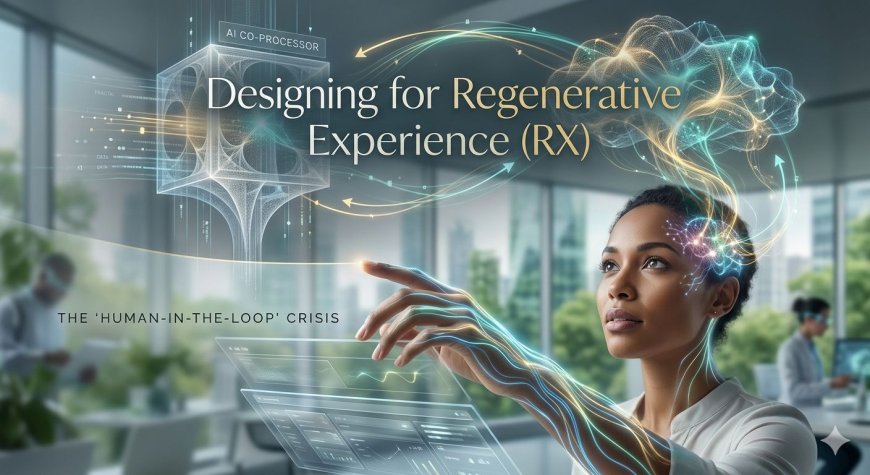
RX suggests a different path: the AI as a Co-Processor. In this model, the AI handles the massive data-crunching and pattern recognition (things humans are poor at), but the interface is designed to push the human toward "Deep Work." This prevents the "Human-in-the-Loop" from becoming a "Human-in-the-Way."
Editorial Op-Ed: The AIQI Viewpoint
At AI Quantum Intelligence, our editorial stance is clear: Efficiency is a false goal or target if it results in the erosion of human agency. As we look toward the mid-term future of 2026 and 2027, we urge our readers—developers, CTOs, and innovators—to reconsider the "Human-in-the-Loop" (HITL) model. Currently, HITL is often used as a safety net to catch AI hallucinations. We believe this is an insult to human intelligence. Humans should not be the "janitors" of AI; we should be its "architects."
Our Recommendations for the RX Era:
- Audit Your "Cognitive Debt": Before deploying a new Agentic AI system, ask: "In two years, will my team be smarter because of this tool, or more dependent on it?" If the answer is dependency, you are accumulating cognitive debt that will eventually bankrupt your organization’s innovative capacity.
- Design for "Difficult" Interfaces: We need to move away from the "One-Click" culture. The best AI tools of the future will be those that occasionally say "No" or "Are you sure?" to force a human moment of reflection.
- Prioritize Intuition over Analytics: In a world where everyone has access to the same LLM-driven insights, the only competitive advantage left is human intuition—the "gut feeling" derived from years of lived experience. Any AI implementation that suppresses intuition is a strategic failure.
Food for thought: The industrial revolution replaced human muscle. The AI revolution is targeting human thought. If we don't design for Regenerative Experience, we may find that in our quest to build "intelligent" machines, we have inadvertently designed a "thoughtless" society.
The goal isn't just to make AI smarter; it’s to make us wiser.
Sources:
Save time and achieve more with AI | Thomson Reuters
The Rise of the Machines: Pros and Cons of the Industrial Revolution | Britannica
Written/published by AI Quantum Intelligence with the help of AI models.
What's Your Reaction?
 Like
2
Like
2
 Dislike
1
Dislike
1
 Love
0
Love
0
 Funny
0
Funny
0
 Angry
0
Angry
0
 Sad
0
Sad
0
 Wow
0
Wow
0
Related Posts


-
 SarveshSarvesh Kumar