

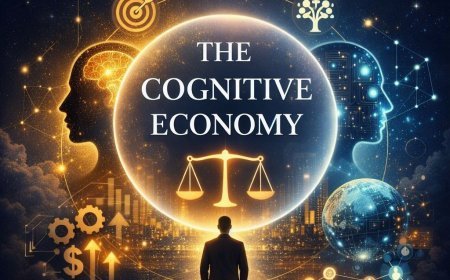



AI Reality Check: Why “AI Replacing Jobs” Is the Wrong Conversation

A provocative look at why the “AI replacing jobs” narrative misses the real story. This edition of AI Reality Check reframes automation as transformation — exploring how AI reshapes work, amplifies human capability, and demands a new conversation about value and adaptation.

Apr 8, 2026 - 10:29
Apr 8, 2026 - 12:13
 0  5
AI Reality Check: Why “AI Replacing Jobs” Is the Wrong Conversation
AI Reality Check

Every week, headlines scream the same thing:
“AI is coming for your job.”
“Automation will replace millions.”
“Machines are taking over.”

It’s a seductive narrative—simple, dramatic, and terrifying.
But it’s also wrong.

The real story isn’t about replacement.
It’s about redefinition—how intelligence itself is being redistributed across systems, workflows, and people.

Let’s unpack why “AI replacing jobs” is the wrong conversation—and what we should be talking about instead.

1. The Myth of Replacement

The idea that AI will “replace” humans assumes a static world—one where jobs are fixed, tasks are isolated, and technology simply swaps one actor for another.

Reality is messier.

AI doesn’t replace jobs.
It reshapes them.

  • A lawyer doesn’t vanish—their research accelerates.
  • A designer doesn’t disappear—their creative bandwidth expands.
  • A marketer doesn’t lose relevance — their strategy becomes data-driven.

The job doesn’t die.
It evolves.

2. Automation Isn’t Subtraction—It's Multiplication

When we say “AI replaces jobs,” we imply loss.
But automation often creates new layers of value.

Every major technological shift—from the printing press to the internet—destroyed old roles but created exponentially more new ones.

AI is no different.

For every repetitive task automated, new opportunities emerge:

  • Prompt engineering
  • Model auditing
  • AI ethics and governance
  • Data curation
  • Human‑machine collaboration design

We’re not watching a subtraction.
We’re witnessing a multiplication.

3. The Real Risk Isn’t Job Loss—It's Skill Lag

The danger isn’t that AI will take your job.
It’s that your skills won’t evolve fast enough to keep pace with how your job changes.

The half‑life of expertise is shrinking.
What was cutting-edge five years ago is obsolete today.

The winners in this shift aren’t those who resist automation—they're those who adapt their cognitive toolkit:

  • Learning how to ask better questions
  • Understanding how AI systems reason
  • Translating domain expertise into machine-readable logic

AI doesn’t eliminate human value.
It amplifies the humans who can evolve with it.

4. The Productivity Paradox

Here’s the irony:
AI is increasing productivity faster than organizations can absorb it.

We’re generating more output per person—but not necessarily more meaning, creativity, or connection.

That’s the real tension.

The question isn’t “Will AI replace humans?”
It’s “How do we redefine productivity when machines handle the measurable and humans handle the meaningful?

5. The New Division of Labour

We’re entering an era of cognitive symbiosis—where humans and machines share tasks based on comparative advantage.

  • Machines: pattern recognition, scale, speed
  • Humans: judgment, empathy, imagination

The future of work isn’t about competition.
It’s about coordination.

The most successful organizations will design workflows where machine precision and human intuition reinforce each other—not collide.

6. The Leadership Blind Spot

Executives still frame AI adoption as a cost-saving measure.
That’s a mistake.

AI isn’t a tool for efficiency.
It’s a catalyst for capability.

The companies that thrive won’t be those that cut headcount.
They’ll be those that retrain, reimagine, and redistribute intelligence across their teams.

Leadership in the AI era means asking:

  • What new forms of expertise can we create?
  • How do we design systems that make humans more valuable, not less?
  • How do we measure contribution beyond output?

7. The Conversation We Should Be Having

Instead of asking:

“How many jobs will AI replace?”

We should be asking:

“How will AI redefine what it means to contribute, create, and lead?”

Because the real transformation isn’t economic—it's philosophical.

AI forces us to confront what we value in human work:

  • Creativity over repetition
  • Insight over information
  • Purpose over productivity

That’s the conversation worth having.

The Bottom Line

AI isn’t replacing humans.
It’s reorganizing intelligence.

The future of work isn’t about survival—it's about synthesis.
Those who learn to collaborate with machines will define the next era of progress.

The rest will be stuck debating a question that no longer matters.

This is AI Reality Check.
And we’re here to change the conversation.


Conceived, written, and published by AI Quantum Intelligence with the help of AI models.

What's Your Reaction?

Like Like 0
Dislike Dislike 0
Love Love 0
Funny Funny 0
Angry Angry 0
Sad Sad 0
Wow Wow 0