












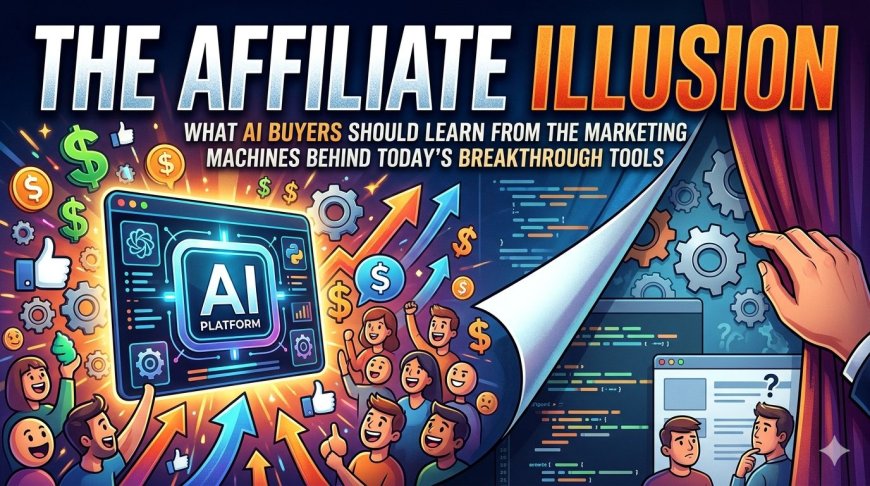
The Affiliate Illusion: What AI Buyers Should Learn From the Marketing Machines Behind Today’s “Breakthrough” Tools
An analysis of how affiliate-driven marketing shapes AI product quality, sustainability, and hype—plus what buyers should evaluate before subscribing to AI tools.
If you want to understand the future of AI, don’t start with the models. Start with the incentives.
In the last two years, the AI ecosystem has exploded with tools, wrappers, platforms, and “revolutionary” services—many of which seem to appear overnight, rocket across social feeds, and vanish just as quickly. Behind this churn is a quiet but powerful engine: affiliate and referral‑driven growth.
This isn’t new. Tech has always had its hype cycles, and every hype cycle has its preferred distribution mechanism. But AI’s current wave is uniquely shaped by performance-based marketing—an ecosystem where the loudest voices often have the strongest financial incentives and where the quality of the product is not always aligned with the enthusiasm of the promotion.
So the question for buyers, builders, and analysts is simple: Does the way an AI product goes to market tell us something about its long‑term viability?
Increasingly, the answer is yes.
The Data: Most Affiliate Programs Don’t Work—And That’s the Point
A 2026 analysis of 2,847 SaaS affiliate programs revealed a striking pattern:
- Only 15.6% of programs survive long-term.
- Only 7.6% of affiliates ever generate a single referral.
- Only 1.28% generate a sale.
- Average referral‑to‑sale conversion: 0.8%.
In other words: affiliate programs rarely scale, and when they do, it’s because the product already has real traction. The affiliate channel amplifies existing demand; it doesn’t create it.
A separate 2022 study on referral campaigns found that effectiveness depends heavily on trust networks—referrals from credible peers drive adoption and retention, while referrals from weak or opportunistic networks do not.
This is the first major signal: Healthy products use affiliates to accelerate growth. Weak products use affiliates to replace it.
The Good, the Bad, and the Ugly: What AI Buyers Should Watch For
The Good: Product‑First, Incentive‑Second
These companies treat affiliate programs as a multiplier, not a lifeline.
Examples:
- Notion, Webflow, Vercel, Perplexity — strong organic adoption, developer‑centric communities, and moderate, sustainable commissions.
- Midjourney (indirectly) — no formal affiliate program, yet massive word‑of‑mouth because the product itself is the marketing.
- OpenAI’s API ecosystem — developers promote tools because they work, not because they pay.
Characteristics:
- Transparent roadmaps
- Strong documentation
- Real user communities
- Measurable retention
- Commissions in the 15–30% range
These companies don’t need hype. Their users do the talking.
The Bad: The AI Wrapper Gold Rush
These are tools built on top of someone else’s model—thin, fast, and often disposable.
Examples (category, not naming specific companies):
- “One‑click” content generators with 40%+ commissions
- AI résumé builders that promise “instant job offers”
- AI chatbot clones with lifetime deals and aggressive influencer pushes
Characteristics:
- High churn
- Minimal differentiation
- Heavy reliance on paid influencers
- Commission rates that exceed product value
These products often spike quickly, then collapse once users realize the underlying value is shallow.
The Ugly: Incentive‑Driven Hype Machines
This is where AI meets the worst instincts of the crypto ICO era.
Examples (patterns, not brands):
- AI trading bots promising guaranteed returns
- “AI business in a box” schemes
- MLM‑adjacent AI platforms where the real product is the referral payout
Characteristics:
- Commissions higher than subscription revenue
- Complex tiered payouts
- Pressure to recruit, not use
- No meaningful product roadmap
- No evidence of real customers
These companies don’t sell AI. They sell the idea of selling AI.
The Pattern Across Tech History: When Incentives Outrun Innovation
AI is not the first technology to be distorted by its own distribution model.
- Mobile apps chased incentivized installs, leading to click‑farms and inflated metrics.
- Crypto ICOs used referral bonuses to mask the absence of real utility.
- Ad‑tech networks created entire ecosystems of low‑quality content optimized for clicks, not value.
In each case, the marketing engine outpaced the product engine—and the crash followed.
The lesson is consistent: When the incentive structure becomes the product, the product itself suffers.
So Is There an Inverse Relationship Between GTM Strategy and Product Quality?
Not inherently. But there are strong correlations.
Healthy AI companies:
- Build value first
- Layer affiliates on top
- Use moderate commissions
- Target credible creators
- Show real retention and usage
Fragile AI companies:
- Launch affiliate programs before product-market fit
- Offer extreme commissions
- Rely on hype-driven influencers
- Obscure churn and usage metrics
- Focus on acquisition, not retention
The difference is not the presence of an affiliate program—it’s the role it plays.
Food for Thought: How to Evaluate AI Products Before You Buy
Here are the questions every AIQI reader should ask before subscribing to any AI tool:
1. Who benefits most from this recommendation—the user or the promoter?
If the loudest voices are affiliates, not practitioners, proceed with caution.
2. Does the product have real depth, or is it a thin wrapper?
Look for documentation, API access, and evidence of technical investment.
3. Is the commission structure reasonable?
If the payout is higher than the subscription fee, something is off.
4. Are there real users, or just influencers?
Communities don’t lie. Influencers often do.
5. Does the company publish a roadmap or meaningful updates?
Sustainable AI companies show their work.
6. What happens if the hype fades?
If the product’s value disappears when the marketing stops, it was never real.
The Recommendation: Trust the Incentives, Not the Ads
AI is entering a maturity phase. The tools that survive will be the ones that deliver real value—not the ones that pay the highest commissions.
For buyers: Follow the product, not the promotion.
For creators and analysts: Interrogate the incentive structures behind every “must‑try” AI tool.
For the industry: Recognize that sustainable AI is built on retention, not referrals.
And for the companies building the future: Your go‑to‑market strategy is a signal. Make sure it signals quality.
Written/published by AI Quantum Intelligence with the help of AI model research.
What's Your Reaction?
 Like
0
Like
0
 Dislike
1
Dislike
1
 Love
0
Love
0
 Funny
1
Funny
1
 Angry
1
Angry
1
 Sad
0
Sad
0
 Wow
0
Wow
0