














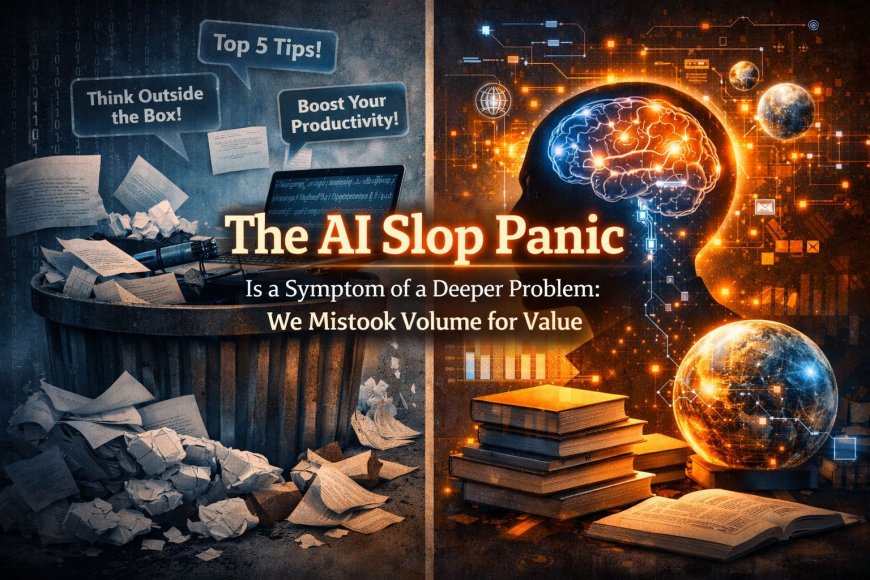
The AI Slop Panic Is a Symptom of a Deeper Problem: We Mistook Volume for Value
AI‑generated “slop” isn’t the real problem—our obsession with volume over value is. This AIQI op‑ed reframes the debate and exposes the deeper issue.
Executive Takeaway
The backlash against AI‑assisted content—what some pundits now call “AI slop”—is not a crisis of authenticity. It’s a crisis of literacy, economics, and expectation. We are not drowning because AI makes it easier to write; we are drowning because for a decade (or more) we rewarded volume over value. AI didn’t break thought leadership. It simply exposed how fragile and shallow the ecosystem already was.
1. The Panic Isn’t About AI. It’s About the Collapse of a Bad Incentive System.
For years, professional platforms rewarded:
-
Frequency over insight
-
Engagement over expertise
-
Visibility over credibility
The result? A generation of “thought leaders” who built careers on cadence, not contribution.
AI didn’t create this problem. AI simply removed the last remaining friction.
When anyone can produce a polished post in seconds, the illusion that writing volume = intellectual value collapses. The panic isn’t about AI-generated content. It’s about the sudden realization that much of what we once celebrated as “thought leadership” was already formulaic, derivative, and strategically optimized for algorithms—not humans.
AI didn’t cheapen thought leadership. It revealed how cheap it already was.
2. The Anti‑AI Argument Is Just the Latest Version of an Old Story
Every era of technological augmentation triggers the same existential question:
“If a tool helps you do the work, is it still really your work?”
We’ve seen this movie before:
-
Software testers were told automation meant they “weren’t really testing.”
-
Manufacturing specialists were told robotics meant they “weren’t really building.”
-
Photographers were told digital cameras meant they “weren’t really creating.”
-
Designers were told Figma meant they “weren’t really designing.”
-
Writers were told spellcheck meant they “weren’t really writing.”
And now:
-
Thought leaders are told AI assistance means they “aren’t really thinking.”
This argument has never held up. It didn’t in manufacturing. It didn’t in software. It won’t in intellectual work either.
Augmentation doesn’t erase expertise. It amplifies it.
The tester who uses automation isn’t less of a tester—they’re more efficient, more thorough, and more capable of exploring edge cases humans alone could never reach.
The manufacturer who uses robotics isn’t less of a builder—they’re safer, more precise, and able to scale production that would be impossible by hand.
Likewise, the strategist who uses AI isn’t less of a thinker—they’re able to explore more hypotheses, validate more assumptions, and synthesize more global signals than any unaided human could.
The fear of augmentation is always strongest among those who benefited most from the inefficiencies of the previous era.
3. The Real Divide Isn’t Human vs. AI. It’s High‑Intent vs. Low‑Intent Creators.
The “AI slop” narrative assumes that:
-
AI = generic
-
Human = authentic
But this is empirically false.
Humans have produced generic, templated, derivative content for decades. AI just made it impossible to pretend otherwise.
The real distinction is:
-
Low‑intent creators use AI to produce more of what was already shallow.
-
High‑intent creators use AI to deepen research, expand perspective, and accelerate synthesis.
AI is not a replacement for expertise. It is a multiplier of it.
The creators who bring lived experience, domain knowledge, and original insight will rise. The creators who relied on cadence, clichés, and content mills will fade.
AI didn’t break the hierarchy. It clarified it.
4. The Irony: AI Finally Allows Thought Leadership to Be What It Always Claimed to Be
Historically, the loudest voices in thought leadership were not the most knowledgeable—they were the most available.
The people who had time to:
-
write daily
-
post constantly
-
engage endlessly
-
optimize for algorithms
…were rarely the people doing the deepest work.
Meanwhile, the practitioners—the ones building, testing, deploying, failing, iterating—had less time to write. Their insights were richer, but their exposure was limited.
AI changes that.
For the first time:
-
Practitioners can publish without sacrificing their craft.
-
Experts can articulate insights without spending hours polishing prose.
-
Strategists can explore ideas backed by global research, not just personal anecdotes.
-
Analysts can synthesize data at a scale previously reserved for institutions.
AI democratizes depth.
It gives the doers a voice equal to the talkers.
This is the opposite of “slop.” This is the beginning of a more meritocratic intellectual ecosystem.
5. The Real Threat Isn’t AI. It’s Our Failure to Evolve Our Standards.
If we continue to judge content by:
-
how often it appears
-
how polished it looks
-
how well it performs in the feed
…we will continue to reward noise over signal.
But if we shift to judging content by:
-
the originality of its insight
-
the clarity of its reasoning
-
the evidence behind its claims
-
the lived experience informing its perspective
…AI becomes a tool for elevating discourse, not diluting it.
The platforms will eventually adapt. The audiences already are. The creators must follow.
6. AI Quantum Intelligence’s Position: The Adult in the Room
AIQI’s stance is simple:
AI is not the enemy of thought leadership. Shallow thinking is.
The panic around “AI slop” is a distraction from the real issue: We built a content ecosystem that rewarded volume, and now we’re shocked that a tool optimized for volume exposes its flaws.
The solution is not to retreat from AI. The solution is to raise the bar.
AIQI advocates for a future where:
-
AI augments human insight, not replaces it
-
Expertise is measured by contribution, not cadence
-
Depth outperforms frequency
-
Research outperforms rhetoric
-
Practitioners have equal voice to professional posters
-
AI becomes a partner in intellectual rigor, not a shortcut around it
This is the foundation of AI hype and reality: AI doesn’t create value. It amplifies the value that’s already there.
Conclusion: The Panic Will Pass. The Shift Will Not.
The “AI slop panic” is a temporary emotional reaction to a permanent structural change.
We are entering an era where:
-
Thought leadership becomes more evidence‑driven
-
Expertise becomes more accessible
-
Insight becomes more global
-
Research becomes more scalable
-
Creativity becomes more combinatorial
And yes—where low‑effort content becomes easier to produce.
But low‑effort content has always existed. AI didn’t invent it. AI just made it impossible to hide behind.
The future belongs to those who use AI not to produce more but to produce better.
And that is the future AI Quantum Intelligence is here to share and to help define.
Conceived, written, and published by AI Quantum Intelligence with the help of AI models.
What's Your Reaction?
 Like
0
Like
0
 Dislike
1
Dislike
1
 Love
0
Love
0
 Funny
1
Funny
1
 Angry
0
Angry
0
 Sad
1
Sad
1
 Wow
1
Wow
1