






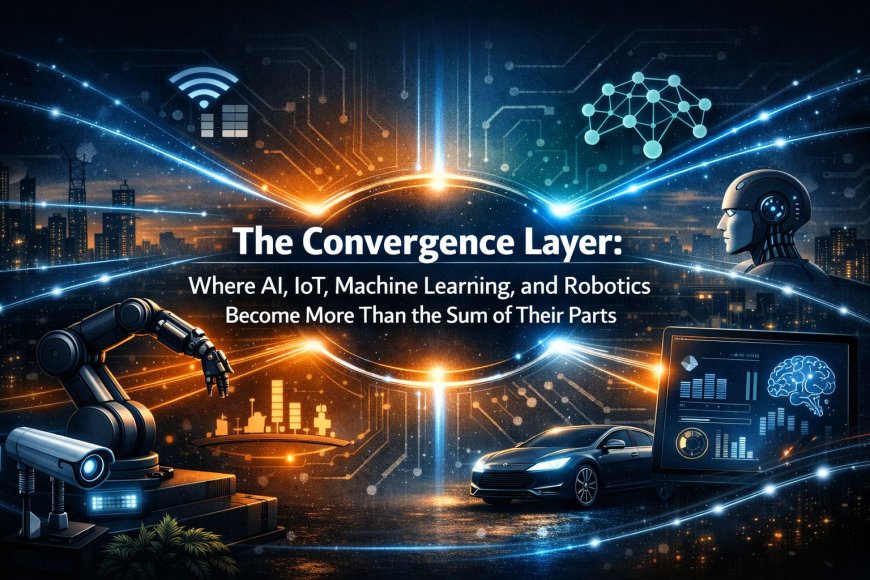
The Convergence Layer: Where AI, IoT, Machine Learning, and Robotics Become More Than the Sum of Their Parts
The future of intelligence lies in the convergence of AI, machine learning, IoT, and robotics—creating integrated, autonomous systems that deliver exponential value.


For the last decade, the technology world has been obsessed with singular breakthroughs. A new AI model. A faster robot. A more efficient sensor network. A clever machine learning technique. Each advancement is celebrated as if it exists in isolation — a standalone marvel.
But the next era of intelligence won’t be defined by isolated achievements. It will be defined by convergence: the moment when artificial intelligence, machine learning, the Internet of Things, and robotics stop being separate domains and start functioning as a unified, interdependent ecosystem.
This is the shift from technologies to systems. And it’s where exponential value begins.
1. The Four Pillars — and Their Limitations in Isolation
Artificial Intelligence
AI provides reasoning, prediction, and decision-making. But without real-time data or physical embodiment, it remains abstract—powerful but detached.
Machine Learning
ML enables pattern recognition and adaptive improvement. Yet ML models are only as good as the data they receive and the environments they can influence.
Internet of Things (IoT)
IoT provides the sensory layer — billions of devices capturing environmental, operational, and behavioral data. But IoT alone cannot interpret or act on what it senses.
Robotics
Robotics brings physical capability: movement, manipulation, and automation. But without intelligence or contextual awareness, robots are limited to predefined tasks.
Each pillar is impressive. None is transformative alone.

Figure 1. The four foundational domains — powerful individually, transformative when unified.
2. Convergence: When the System Becomes Intelligent
The real breakthrough happens when these technologies interlock into a continuous loop:

Figure 2. The Convergence Loop—a continuous cycle where IoT senses, AI interprets, ML learns, and robotics acts.
Sense → Understand → Decide → Act → Learn → Improve
- IoT senses the world.
- AI interprets it.
- ML learns from it.
- Robotics acts on it.
- The cycle repeats—autonomously, continuously, and at scale.
This loop is the foundation of self‑optimizing systems: factories that tune themselves, supply chains that reroute in real time, buildings that regulate their own energy, and robots that learn from every movement.
The value isn’t additive. It’s multiplicative.
3. Why Convergence Creates Exponential Value
A. Data Becomes Actionable
IoT generates oceans of data. AI and ML turn that data into insight. Robotics turns insight into physical outcomes. The loop closes. Waste disappears. Efficiency compounds.
B. Systems Become Adaptive
A robot arm that learns from sensor feedback improves every hour. A smart grid that predicts demand becomes more stable every day. A logistics network that self‑corrects becomes more resilient every week.
C. Intelligence Moves to the Edge
With edge AI and embedded ML, devices no longer wait for cloud instructions. They think. They react. They collaborate.
This reduces latency, increases autonomy, and unlocks real‑time decision-making.
D. Complexity Becomes Manageable
Individually, these technologies create complexity. Together, they create coherence — a system that manages itself.
4. Real-World Examples of Convergence in Action
Autonomous Manufacturing Cells
Robots equipped with vision AI, fed by IoT sensors, adjust their own workflows. Downtime drops. Throughput rises. Quality stabilizes.
Smart Hospitals
IoT monitors patient vitals. AI predicts deterioration. ML optimizes staffing. Robotics delivers medication and supplies. The result: safer, more efficient care.
Agricultural Intelligence Networks
Drones, soil sensors, climate models, and autonomous tractors form a closed-loop ecosystem. Yield increases. Water use drops. Inputs are optimized.
Urban Mobility Systems
Traffic sensors, predictive AI, autonomous shuttles, and adaptive infrastructure work together. Congestion decreases. Emissions fall. Cities breathe again.
5. The Strategic Shift: From Tools to Ecosystems
Organizations that still treat AI, IoT, ML, and robotics as separate initiatives are missing the point.
The competitive advantage lies in integration:
- Shared data pipelines
- Unified intelligence layers
- Cross-domain orchestration
- Continuous feedback loops
- Autonomous decision-making frameworks
This is not digital transformation. This is intelligence transformation.
6. The Next Frontier: Convergence at Scale
The future belongs to systems that:
- Sense everything
- Understand context
- Predict outcomes
- Act autonomously
- Learn continuously
- Improve exponentially
When these capabilities converge, industries don’t just evolve — they reorganize around intelligence itself.
This is the foundation of the next technological epoch: Integrated, autonomous, self‑optimizing systems that operate far beyond human speed, scale, and precision.
Conclusion: The Era of the Convergence Layer
The world has spent years celebrating individual breakthroughs. But the next decade will belong to the organizations that master the convergence layer — the space where AI, ML, IoT, and robotics merge into a single, intelligent, adaptive system.
This is where incremental becomes exponential. Where automation becomes autonomy. Where data becomes action. Where intelligence becomes infrastructure.
And it’s where the future of AI Quantum Intelligence will continue to lead the conversation.
Written/published by AI Quantum Intelligence with the help of AI models.
What's Your Reaction?
 Like
0
Like
0
 Dislike
1
Dislike
1
 Love
0
Love
0
 Funny
1
Funny
1
 Angry
0
Angry
0
 Sad
0
Sad
0
 Wow
0
Wow
0