






The Rise of the Micro Executive: How AI Turns Individuals Into Teams
Discover how AI copilots are creating a new class of micro-executives—individuals who operate with the leverage, speed, and output of entire departments.
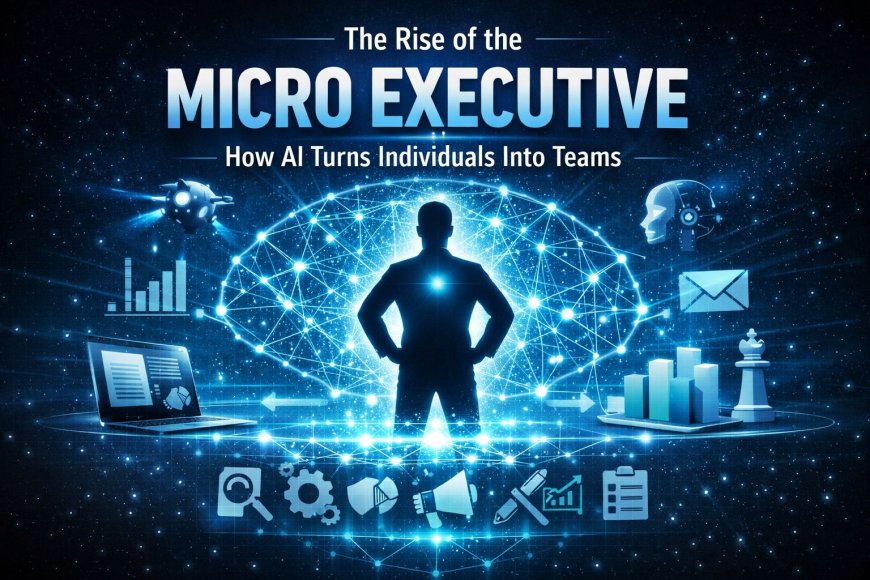
Takeaway: A new professional archetype is emerging—the Micro Executive. These are individuals who, empowered by AI copilots, operate with the leverage, velocity, and multidimensional capability once reserved for entire departments. This isn’t just productivity alone, it’s structural power redistribution.
The Executive Function Has Split—And AI Now Performs Half of It
For decades, executive work was defined by two intertwined abilities:
- Cognitive orchestration — synthesizing information, making decisions, shaping strategy.
- Operational execution — drafting, coordinating, analyzing, documenting, presenting, and communicating.
AI has quietly severed the second from the first.

Cognitive automation tools now handle the operational layer with near‑instant precision: writing briefs, generating analyses, building presentations, drafting emails, summarizing meetings, modeling scenarios, and even preemptively surfacing insights before a human asks.
What remains for humans is the executive core: judgment, taste, leadership, and intent.
This split is what makes the Micro Executive possible.
The Micro Executive Is Not a “Super User”—They Are a New Organizational Species
A Micro Executive is not simply someone who uses AI well. They are someone who:
- Delegates to AI the way a VP delegates to staff
- Operates across functions without switching roles
- Maintains strategic altitude while executing tactically in parallel
- Produces output at a scale that breaks traditional headcount logic
They don’t “do more work.” They run more work.
A Micro Executive can ideate a campaign, generate the assets, build the analytics dashboard, write the executive summary, and prepare the board-ready deck—all before lunch.
This is not hustle culture. It’s structural leverage.
Why This Matters: AI Is Collapsing the Distance Between Vision and Execution
Historically, the gap between an idea and its realization was filled with:
- Meetings
- Drafts
- Approvals
- Revisions
- Specialists
- Bottlenecks
- Bandwidth constraints
AI removes most of these friction points.
A Micro Executive can move from concept → prototype → iteration → deployment in a single cognitive loop. The organization no longer slows them down; it accelerates them.
This is why Micro Executives outperform traditional teams: they eliminate the latency of coordination.
The New Power Dynamic: Individuals with Department‑Level Output
In every industry, we’re seeing early signals:
- A single strategist producing the output of a 6‑person content team
- A product manager generating UX flows, PRDs, competitive analyses, and launch plans solo
- A founder running marketing, finance, and operations with AI copilots as their staff
- Analysts who deliver full research reports, models, and presentations in hours instead of weeks
The Micro Executive is not a “10x employee.” They are a 1 → many multiplier, where one individual becomes the functional equivalent of:
- A researcher
- A writer
- A designer
- An analyst
- A project manager
- A communications lead
- A strategist
This is not theoretical. It’s already happening.

The Organizational Consequence: Hierarchies Flatten, Talent Distributions Stretch
When individuals can perform like teams, organizations face a new reality:
1. The best people become exponentially more valuable
Because AI amplifies judgment, it does not replace it.
2. Middle management shrinks
Coordination layers become unnecessary when AI handles execution.
3. Specialists become advisors, not executors
Their expertise guides AI‑augmented generalists.
4. Teams become smaller, sharper, and more fluid
Work becomes modular, not departmental.
5. Output becomes a function of imagination, not headcount
The constraint shifts from resources to vision.
The Micro Executive is the catalyst for this shift.
The Psychological Shift: From “What Can I Do?” to “What Can I Direct?”
The most profound transformation is not technological — it’s cognitive.
Micro Executives think like leaders because AI forces them to.
They must:
- Define intent
- Set constraints
- Evaluate options
- Make decisions
- Provide direction
- Own outcomes
AI copilots don’t replace responsibility; they demand it.
This is why Micro Executives rise quickly: they practice leadership daily, not annually.
The Ethical Tension: Power Without Structure
With great leverage comes great asymmetry.
Micro Executives can outperform teams—but they can also overwhelm them. They can accelerate innovation — but also accelerate mistakes. They can bypass bureaucracy — but also bypass oversight.
Organizations must adapt:
- New governance models
- New accountability frameworks
- New definitions of “team”
- New expectations for leadership maturity
The Micro Executive era requires new guardrails, not old hierarchies.
The Future: Every Professional Will Choose Their Scale
In the next 24 months, the defining career question will shift from:
“What role do you want?” to “What scale do you want to operate at?”
AI copilots make scale a personal choice, not an organizational assignment.
Some will choose to be individual contributors. Some will choose to be Micro Executives. Some will choose to be Macro Executives—leaders who orchestrate fleets of AI-augmented individuals.
The hierarchy of the future is not vertical. It is volumetric—defined by the scope of one’s cognitive leverage.
Final Thought: The Micro Executive Is Not the Future of Work — It Is the Future of Power
AI is not creating productivity tools. It is creating capability multipliers.
And capability is power.
The Micro Executive represents a new class of professionals who wield AI not as software but as staff. One who collapses the distance between idea and execution. One who operates with the leverage of a department and the agility of an individual.
This is the rise of the Micro Executive. And it promises to reshape the modern enterprise more than any technology in the last 50 years.
Written/published by Kevin Marshall with the help of AI models (AI Quantum Intelligence).
What's Your Reaction?
 Like
1
Like
1
 Dislike
0
Dislike
0
 Love
1
Love
1
 Funny
0
Funny
0
 Angry
1
Angry
1
 Sad
0
Sad
0
 Wow
1
Wow
1