







The Blind Spots of Our Brilliant Machines
This article offers a thoughtful exploration of AI’s biggest blind spots—why we keep optimizing the wrong problems, how the “replacement fantasy” misguides innovation, and why the future of artificial intelligence depends on elevating human judgment, creativity, and wisdom.
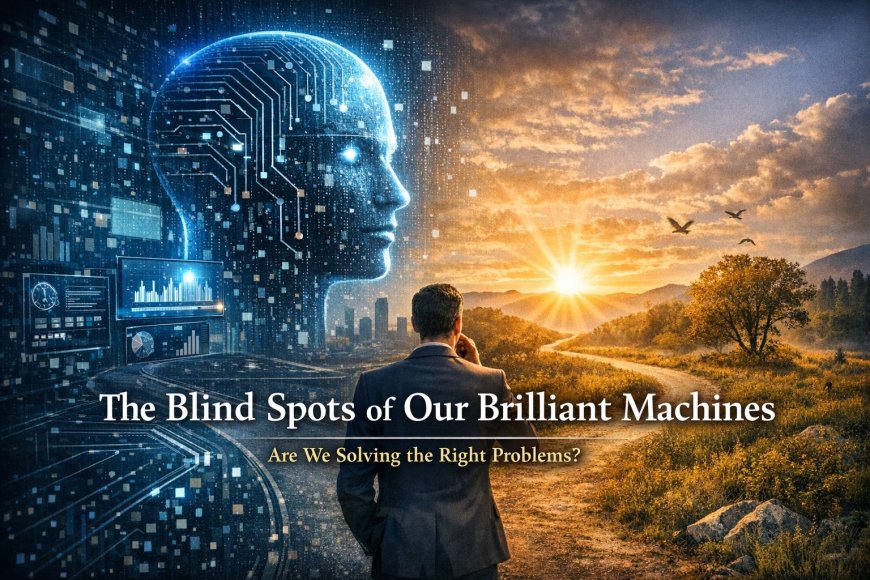
Why AI Keeps Solving the Wrong Problems — And How We Can Finally See Clearly
There’s a strange irony in the age of artificial intelligence:
We have built machines that can analyze a decade of financial data in seconds, but none that can tell us whether we’re asking the right questions. We have algorithms that can predict next quarter’s revenue with uncanny precision, but none that can tell a leader when it’s time to take a leap of faith. We have models that can generate infinite content, but none that can help us decide what actually matters.
For all our progress, we’re still stumbling around with the same old blind spots — only now, they’re amplified by the brilliance of our own inventions.
And the uncomfortable truth is this:
AI isn’t failing us. We’re failing ourselves by aiming it at the wrong things.
The Optimization Trap: When We Mistake Efficiency for Insight
Technology has always gravitated toward what can be measured.
AI simply accelerates that instinct.
If something fits neatly into a spreadsheet, a database, or a labeled training set, we optimize it. We automate it. We celebrate it.
But the most important problems inside organizations — and inside society — don’t fit neatly anywhere.
A CFO can get AI‑generated forecasts, variance analyses, and scenario models that would have taken a team of analysts weeks to produce. But the real strategic questions—should we restructure? Should we take a bold risk? Should we invest in a future that doesn’t yet have a line item? — remain stubbornly human.
AI can illuminate the terrain.
Only humans can choose the path.
Yet we keep pouring resources into the terrain maps, not the pathfinding.
The Replacement Fantasy: A Story Engineers Love, But Humans Don’t
There’s a seductive narrative in tech culture:
“If AI can do it, humans shouldn’t.”
It’s clean. It’s efficient. It’s elegant.
It’s also wrong.
People don’t want to be replaced.
They want to be relieved—of drudgery, overload, and cognitive noise.
They want to be elevated—toward judgment, creativity, empathy, and courage.
Consider healthcare.
We’ve spent billions building AI systems that can detect tumors, classify images, and predict disease progression. But the real crisis in healthcare isn’t diagnostic accuracy—it's trust, burnout, and the erosion of the clinician‑patient relationship.
Or education.
We’ve built AI that can grade essays and generate lesson plans. But the real need is helping students develop curiosity, resilience, and critical thinking — the very things that resist automation.
Or hiring.
We’ve automated résumé screening. But the real challenge is understanding potential, character, and cultural fit — qualities that don’t show up in keyword matches.
We keep building tools that replace the visible tasks, not the meaningful ones.
The Shiny Object Economy: When Buzz Outweighs Benefit
Let’s be honest:
A lot of AI development isn’t driven by need.
It’s driven by what demos well.
Investors understand a dashboard. Customers understand automation.
Executives understand cost savings. The media understands spectacle.
So we get:
- AI that writes emails no one wants to read
- AI that generates images no one needs
- AI that automates tasks that weren’t bottlenecks
- AI that creates more noise than clarity
Meanwhile, the hard problems—loneliness, trust, meaning, ethical leadership, and societal cohesion—remain untouched because they don’t fit neatly into a product roadmap.
We’re building fireworks when the world needs lanterns.
The Human Blind Spot: We Don’t Know What We Actually Want
This is the most uncomfortable truth of all.
We say we want efficiency.
But we crave connection.
We say we want automation.
But we crave agency.
We say we want intelligence.
But we crave understanding.
AI keeps giving us what we say we want, not what we need.
And because of that, we keep mistaking convenience for progress.
The Better Path: AI as a Narrative Partner, Not a Decision-Maker
The real promise of AI isn’t replacement—it's resonance.
AI can widen the aperture of human thinking:
- Surface patterns we’d never see
- Model scenarios we’d never consider
- Reveal assumptions we didn’t know we were making
- Provide a neutral mirror for our biases
- Free cognitive bandwidth for deeper thinking
But the meaning of those insights—the story we choose to tell about them—is ours alone.
AI can expand the canvas.
Humans paint the picture.
AI can crunch the numbers.
Humans decide what the numbers mean.
AI can generate possibilities.
Humans choose the future.
A Moment of Release: Seeing Clearly Again
Imagine a world where AI doesn’t try to replace the CFO — it becomes the CFO’s strategic co‑pilot.
Where AI doesn’t try to replace the teacher—it becomes the teacher’s amplifier.
Where AI doesn’t try to replace the doctor—it becomes the doctor’s second set of eyes.
Where AI doesn’t try to replace the creator—it becomes the creator’s muse.
This is the world we should be building.
Not one where humans are automated out of relevance, but one where humans are elevated into their fullest potential.
The Closing Truth
The future of AI won’t be defined by how much it can do.
It will be defined by how wisely we choose to use it.
We don’t need machines that think for us.
We need machines that help us think more deeply, more courageously, and more humanly.
The real frontier isn’t artificial intelligence.
It’s augmented wisdom.
Written/published by Kevin Marshall with the help of AI models (AI Quantum Intelligence).
What's Your Reaction?
 Like
0
Like
0
 Dislike
0
Dislike
0
 Love
0
Love
0
 Funny
0
Funny
0
 Angry
0
Angry
0
 Sad
0
Sad
0
 Wow
0
Wow
0