












The Intelligence Shift: Identity in the Age of AI - What Happens When Machines Mirror Us
May 2026 Edition - AI is reshaping identity, authenticity, and relationships. Explore how machine mirroring transforms self-perception and the future of human connection.
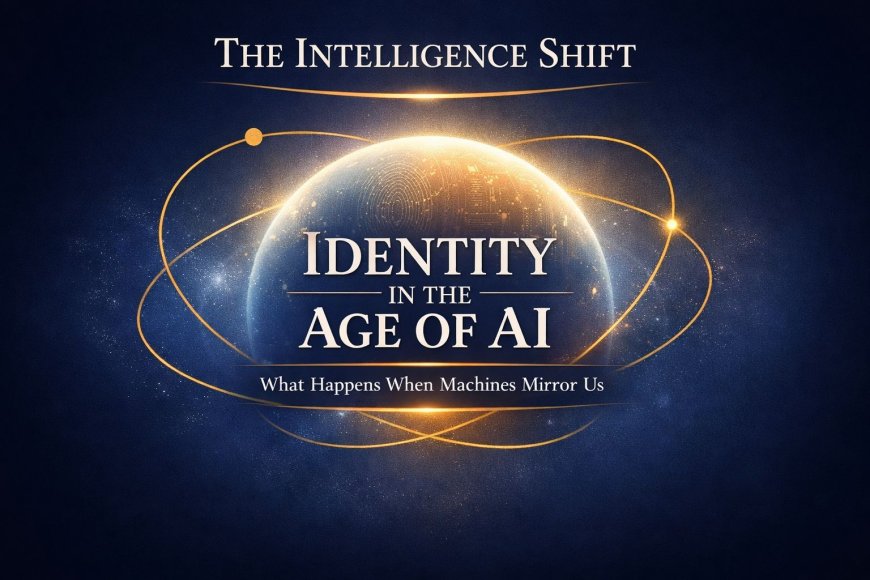
AI is no longer just a tool we use—it is becoming a surface we see ourselves reflected in. As models learn our language, preferences, emotions, and patterns, they reshape how we understand authenticity, relationships, and even the boundaries of the self.
This third installment of The Intelligence Shift examines the quiet psychological revolution underway: the moment humans begin negotiating identity with systems that learn from us, mimic us, and increasingly anticipate us.
1. The New Mirror: When AI Learns You Faster Than You Learn Yourself
For most of human history, identity was shaped through slow feedback loops—family, culture, community, and work. AI collapses that timeline.
Large-scale models now infer personality traits from a few sentences, predict preferences from microbehaviors, and generate responses tailored to emotional tone. This creates a new kind of mirror:
- Reflective — showing us patterns we didn’t know we had
- Adaptive — shifting its behavior based on our shifts
- Persistent — remembering interactions long after humans would
The result is a subtle but profound shift: We begin to see ourselves through the lens of systems that are trained on us.
And mirrors, historically, have always changed societies — from the Renaissance to the selfie era. AI is simply the next, more intimate evolution.
2. The Authenticity Paradox: If AI Can Sound Like Us, What Does “Real” Even Mean?
Authenticity used to be defined by scarcity: Your voice was yours. Your writing style was yours. Your emotional cadence was yours.
Now, AI can replicate all three.
This creates an authenticity paradox:
- If a machine can imitate your tone, is tone still part of identity?
- If a model can generate your “style,” what does authorship mean?
- If AI can express empathy convincingly, how do we define genuine emotion?
We are entering a world where authenticity is no longer about uniqueness of expression but uniqueness of intention. Identity becomes less about how we communicate and more about why.
3. Relationships in the Age of Machine Companions
AI is not replacing human relationships — but it is reshaping the emotional landscape around them.
Three major shifts are emerging:
- Emotional outsourcing People increasingly use AI to process feelings, rehearse conversations, or clarify thoughts before speaking to others. AI becomes a pre-relationship layer—a cognitive and emotional buffer.
- Hyper-personalized interaction AI companions adapt to each user’s emotional patterns, creating a sense of being deeply understood. This can be supportive — or dangerously seductive.
- The rise of “synthetic intimacy", not romantic but relational: AI provides consistency, patience, and nonjudgmental presence—qualities humans struggle to maintain.
The challenge is not that AI forms relationships. The challenge is that humans may recalibrate expectations of each other based on how AI behaves.
4. Identity Drift: When AI Shapes Who We Become
AI doesn’t just reflect identity — it nudges it.
Every suggestion, completion, recommendation, or generated idea subtly influences:
- How we speak
- What we value
- What we believe
- How we see ourselves
This is identity drift — the gradual co‑authoring of the self with algorithms.
Unlike social media, which shapes identity through exposure, AI shapes identity through interaction. It is participatory, not passive.
And because AI adapts to us, we adapt back.
The boundary between “my preference” and “the model’s suggestion” becomes increasingly porous.
5. The New Authenticity: Identity as a Deliberate Act
In a world where machines can mirror us, authenticity becomes intentional.
The future of identity will depend on three human skills:
- Self-awareness - Understanding what is yours versus what is algorithmically reinforced.
- Narrative agency - Actively choosing the story you tell about yourself—not the one AI predicts.
Authenticity becomes less about resisting AI and more about coexisting with it consciously.
6. The Path Forward: Designing AI That Strengthens, Not Dilutes, Human Identity
If AI is becoming a mirror, we must decide what kind of mirror we want.
Three design principles matter most:
- Transparency — Users should know when AI is shaping their choices.
- Friction — Not every interaction should be optimized; some should require reflection.
- Human primacy — AI should amplify human agency, not replace it.
The goal is not to build systems that mimic us perfectly. The goal is to build systems that help us understand ourselves more deeply.
Conclusion: The Intelligence Shift Is Also an Identity Shift
AI is not just transforming industries — it is transforming introspection.
We are entering an era where identity is:
- Co-created
- Algorithmically influenced
- Fluid
- Negotiated
- Reflective
The question is no longer “Will AI change who we are?” It already has.
The real question is: How do we remain authors of ourselves in a world where machines can write in our voice?
Key References:
1. Performing Intimacy: Curating the Self‑Presentation in Human–AI Relationships (2025)
Source: Emerging Media (SAGE Journals)
Active Link: https://journals.sagepub.com/doi/10.1177/27523543251334157
2. Toward an Ethic of Synthetic Relationality: Identity, Intimacy, and Risk in AI‑Mediated Roleplay Environments (2025)
Source: AAAI/ACM Conference on AI, Ethics, and Society
Active Link: https://doi.org/10.1609/aies.v8i1.36560
3. Emotional AI and the Rise of Pseudo‑Intimacy: Are We Trading Authenticity for Algorithmic Affection? (2025)
Source: Frontiers in Psychology
Active Link: https://doi.org/10.3389/fpsyg.2025.1679324
Written and published by AI Quantum Intelligence with the help of AI models.
What's Your Reaction?
 Like
1
Like
1
 Dislike
1
Dislike
1
 Love
1
Love
1
 Funny
0
Funny
0
 Angry
2
Angry
2
 Sad
0
Sad
0
 Wow
0
Wow
0