











Automation Using AI: 5 Game-Changing Examples You Can Implement Today
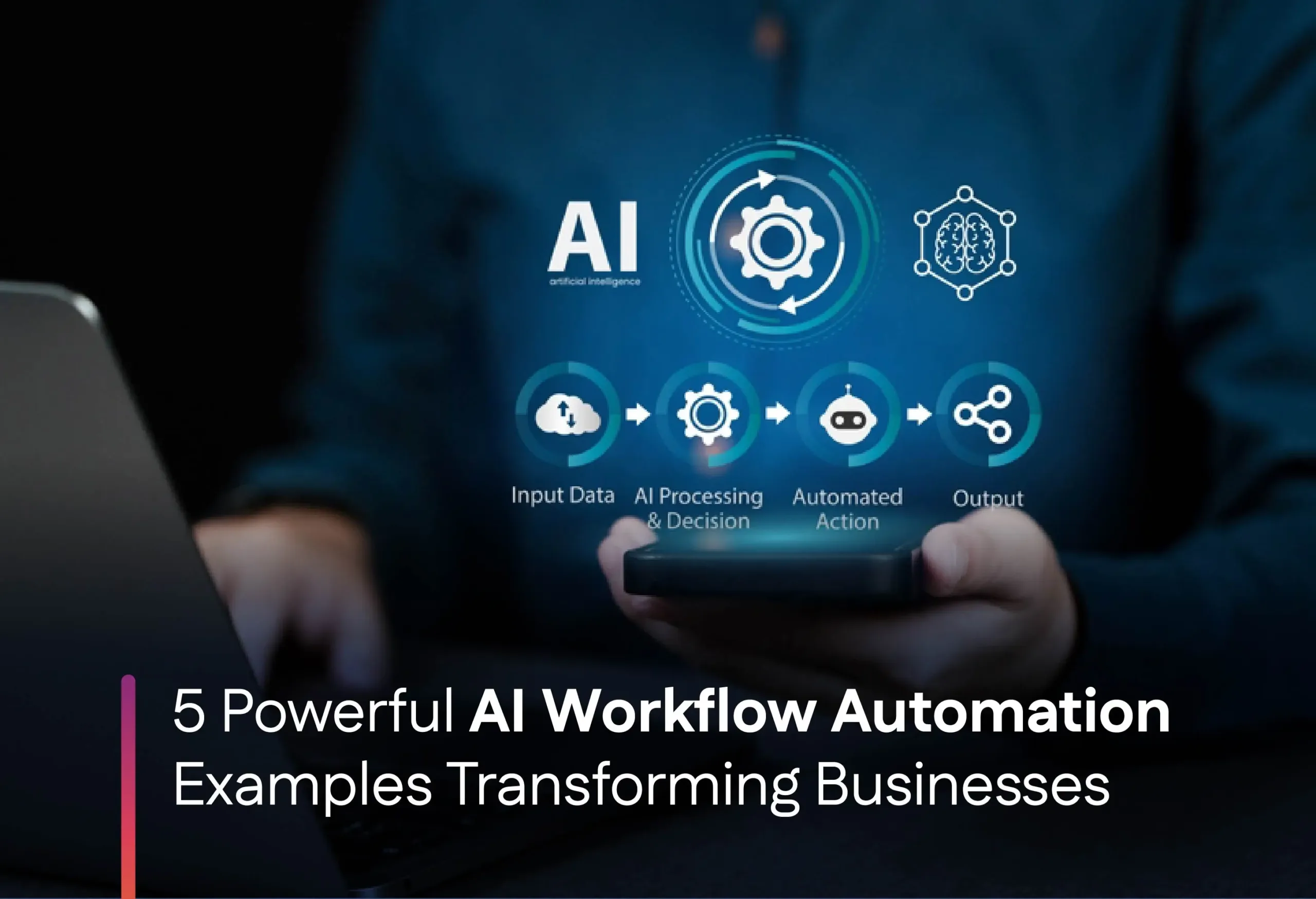
AI has moved from being a support tool to becoming the core engine of business operations. It now handles customer queries, processes invoices, detects fraud, and removes manual work from everyday tasks. With automation using AI, companies are shifting from basic rule-based systems to smart, self-running workflows that learn and improve on their own.
Instead of waiting for human inputs, AI workflow automation uses machine learning, NLP, and predictive intelligence to analyze data, make decisions, and complete tasks automatically, helping organizations work faster, smarter, and more efficiently.
This blog explains what automation using AI means, its benefits, and five real-world intelligent automation examples across industries. You’ll learn how companies use AI to improve speed, accuracy, customer experience, compliance, and cost efficiency. You’ll also see the best AI automation tools for businesses and a simple guide on how to automate tasks with AI for your organization.
Key Article Takeaways
- AI workflow automation turns repetitive manual processes into intelligent, self-running workflows that learn and improve over time.
- AI-powered tools like chatbots, invoice automation, and fraud detection drastically cut operational effort and human errors.
- Businesses get faster processing, higher accuracy, better compliance, and improved customer experience with AI automation.
- AI + automation together enable smarter decision-making by combining rule-based actions with machine learning intelligence.
- Companies adopting AI automation now gain a major competitive advantage over those relying on traditional manual workflows.
What Is Automation Using AI?
Automation using AI combines artificial intelligence with automation technologies to automate business processes that normally require human judgment.
Unlike rule-based automation, which follows strict rules, AI-powered automation can understand context, learn from data, and make independent decisions. With AI in automation, companies are shifting from static workflows to intelligent systems and are rapidly adopting AI process automation across HR, finance, IT, customer service, operations and showing how AI transforms businesses by learning, adapting, and acting autonomously.
AI automation typically uses:
- Natural Language Processing (NLP) to understand text and conversations
- Machine learning to detect patterns and predict outcomes
- Computer vision to extract information from documents and images
- Intelligent agents to plan, decide, and execute multi-step workflows
The result is faster processes, fewer errors, real-time insights, and a more scalable workforce.
Did you know?
- 70% faster claims settlement and 30% lower costs through AI-driven fraud detection and intelligent document processing.
- AI cuts loan underwriting from days to minutes and reduces default rates by 15%.
- AI-driven KYC automation reduces onboarding time by 50% while improving compliance accuracy.
- AI risk models predict high-risk clients with 85% accuracy and reduce claims payouts by 20%.
- 75% of insurers and banks use AI chatbots, reducing call-center workload by 60% and improving resolution time by 40%.
5 Real-World AI Workflow Automation Examples
Here are the five most impactful intelligent automation examples reshaping business operations today.

-
Customer Service Chatbots
Agentic AI chatbots deliver instant, 24/7 customer support, eliminating long wait times and guiding users to the right information or agent without delay. These intelligent chatbots act autonomously, handling conversations with speed and accuracy.
Unlike basic FAQ bots, agentic AI chatbots can verify user identity, track orders, update customer details, process refunds, create support tickets, and escalate issues with full context. They understand intent and act, not just provide answers.
With AI-driven process automation, agentic chatbots seamlessly connect with CRM, ITSM, billing, and communication platforms. This reduces manual workload, improves response times, and significantly enhances customer satisfaction across service operations.
Explore AI chatbots that resolve customer issues autonomously. Learn more.
-
Invoice Processing Automation
Manual invoice review slows down finance teams and increases the risk of costly errors. Agentic AI transforms invoice processing by acting autonomously across the entire workflow, from data capture to validation and posting.
Using OCR and intelligent document processing, agentic AI reads invoices, extracts key fields such as vendor name, invoice amount, and due date, and validates them against purchase orders and delivery data. It can automatically flag duplicates, detect mismatches, and identify potential fraud.
With seamless ERP integration, agentic AI creates accounting entries without manual effort. This makes invoice processing faster, more accurate, and one of the most impactful AI automations use cases for finance teams, accelerating vendor payments while reducing operational risk.
-
Loan Underwriting Using Agentic AI
Banks and lenders are moving away from slow, manual underwriting and adopting agentic AI models that assess creditworthiness in seconds. These intelligent systems operate autonomously, enabling faster and more consistent lending decisions.
Agentic AI analyses income data, spending behaviour, credit history, employment stability, and alternative data such as transaction patterns to predict repayment ability with higher accuracy. It understands risk in context rather than relying on static rules.
With AI workflow automation, agentic AI doesn’t just evaluate risk, it triggers actions automatically, such as generating risk scores, recommending loan amounts and interest rates, flagging high-risk applicants, routing complex cases to underwriters, and pre-populating loan documents. This accelerates approvals, reduces bias, strengthens compliance, and delivers a smoother credit experience for customers.
-
HR Onboarding Automation
HR teams spend significant time coordinating onboarding tasks such as document verification, background checks, training assignments, and policy communication. Manual coordination across systems often leads to delays, errors, and inconsistent employee experiences.
Use of Agentic AI in HR simplifies onboarding by autonomously managing the entire employee journey. It collects and verifies documents, completes background checks, creates user accounts, grants system access, and sends personalized onboarding schedules. Based on the employee’s role, agentic AI also assigns relevant training modules automatically.
By using AI automation for HR, organizations eliminate tool switching and manual follow-ups. The result is a smooth, personalized, and error-free onboarding experience that improves employee satisfaction from day one while reducing HR workload.
-
AI in Fraud Detection
Banks and fintech companies rely on agentic AI to monitor financial transactions in real time and detect unusual patterns instantly. These autonomous systems continuously learn from behaviour, enabling faster and more accurate fraud detection without manual intervention.
Agentic AI identifies suspicious activities such as rapid small withdrawals, unusual geographic or IP access, high-risk merchant behaviour, and identity mismatches. It understands context, not just thresholds, which helps reduce false positives.
Once a risk is detected, agentic AI-driven workflows automatically act by freezing accounts, sending alerts, creating compliance tickets, and escalating cases to investigators. This makes fraud detection one of the most critical intelligent automations use cases, protecting institutions from financial losses while maintaining customer trust.
Pro Tip for Leaders: Choose AI workflows that directly affect revenue, compliance, or customer experience these deliver the fastest ROI.
If you’d like to explore how AI can transform your banking workflows, our experts are ready to guide you.
Benefits of AI Automation for Businesses
AI automation goes beyond simple task automation—it transforms entire workflows, enabling organizations to work faster, smarter, and more efficiently. By combining artificial intelligence with automation, businesses gain actionable insights, reduce errors, and free employees to focus on strategic tasks.
Key benefits include:
- Faster process execution with minimal human intervention
- Higher accuracy and fewer operational errors
- Lower operational costs and improved ROI
- Better compliance and risk management
- Enhanced customer experience through real-time responses
- Scalable operations without proportional headcount growth
By leveraging AI process automation strategies, companies not only optimize daily operations but also unlock new opportunities for growth and innovation.
How to Automate Tasks with AI
Many organizations assume AI adoption is complex, but the process is straightforward when broken into clear steps.
- Identify repetitive, rule-based processes
- Map workflows end-to-end
- Choose the right AI automation tools
- Train models with your business data
- Integrate AI with existing systems
- Deploy automation and monitor performance
- Scale to other departments
The goal is not just to speed up processes but to build self-running AI workflows that continuously learn and improve.
Leadership Tip: Track metrics like turnaround time, accuracy, cost per process, and employee effort AI success must be measurable.
Best AI Automation Technologies for Businesses
While choosing AI automation technologies and tools for businesses, focus on platforms that offer:
- Intelligent workflow automation
- Natural language understanding
- Agentic AI capabilities
- Integrations with ERP, HRMS, CRM, ITSM, and banking systems
- Low-code or no-code setup
- Scalable architecture
- Enterprise-grade security
At AutomationEdge we provide end-to-end support for AI process automation, from document extraction and chatbot automation to multi-step autonomous workflows.
Discover how HDFC Life unlocked breakthrough speed and efficiency with AutomationEdge.
This case study reveals how one of India’s leading insurers used RPA bots to accelerate core processes, achieving dramatic reductions in turnaround time and major gains in customer engagement.
AI vs Automation What’s the Difference?
AI and automation are often mentioned together, but they’re not the same. Automation follows predefined rules and performs tasks exactly as instructed, while AI learns from data, understands patterns, and makes decisions on its own. When combined, they create intelligent, adaptive workflows that can think, respond, and improve over time functioning more like digital teammates than basic tools.
Example of Automation:
A bank bot automatically sends an OTP every time a customer logs in no learning, just a fixed rule.
Example of AI:
An AI model analyses a customer’s spending patterns to predict when they might need a credit-limit increase.
AI + Automation:
A fraud system that flags suspicious transactions (automation) and continuously learns new fraud patterns to make smarter decisions.
Future Trends in AI Automation
- Rise of agentic AI managing end-to-end workflows
- Hyperautomation combining AI, RPA, and process mining
- Predictive & Prescriptive automation driven by real-time analytics
- Increased adoption of AI governance and compliance automation
- Expansion of AI automation into revenue-generating processes
- Smarter Human-AI Collaboration
Organizations that invest in these trends today can stay ahead of competition, scale smarter, and future-proof their operations.
Conclusion
Automation using AI is reshaping how organizations work by turning manual, repetitive processes into autonomous workflows that deliver accuracy, speed, and intelligence at scale. From customer service and HR onboarding to predictive maintenance and fraud detection, AI-driven automation is proving to be the backbone of modern digital enterprises.
As companies embrace ai process automation, they reduce operational effort, improve employee productivity, enhance customer experience, and build resilient, future-ready operations. Businesses that adopt AI automation today will stay ahead those that delay will struggle to compete in an AI-first world. AutomationEdge helps organisations adopt AI automation faster and enabling them to streamline operations, cut costs, and scale with ease.
Frequently Asked Questions
The post Automation Using AI: 5 Game-Changing Examples You Can Implement Today appeared first on AutomationEdge.
What's Your Reaction?
 Like
0
Like
0
 Dislike
0
Dislike
0
 Love
0
Love
0
 Funny
0
Funny
0
 Angry
0
Angry
0
 Sad
0
Sad
0
 Wow
0
Wow
0