














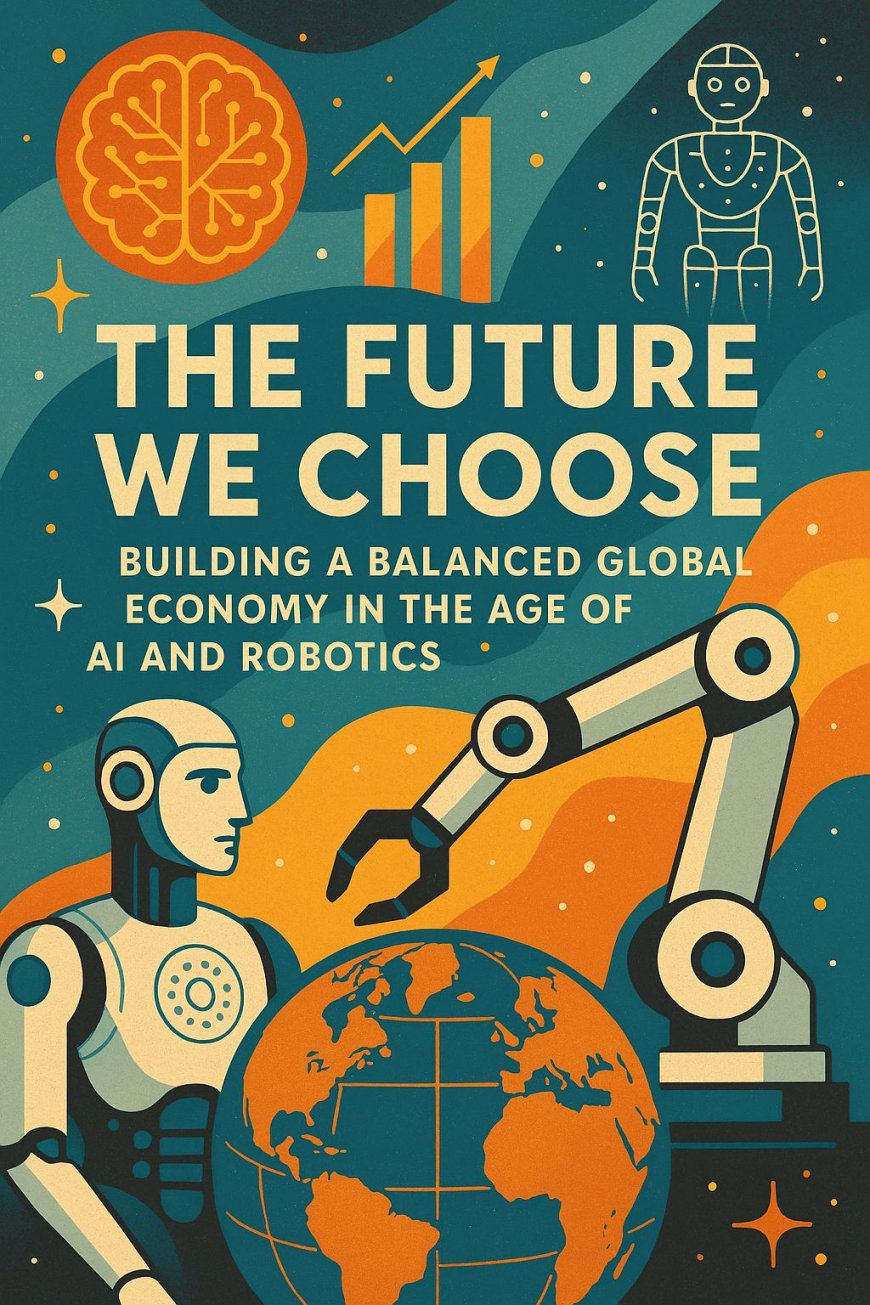
The Future We Choose: Building a Balanced Global Economy in the Age of AI and Robotics
A deep exploration of how artificial intelligence, open AI technologies, and robotics can reshape the global economy. This article outlines strategies for equitable growth, shared technological ownership, ethical governance, and human centered automation—offering a roadmap for maximizing human benefit in an increasingly automated world.
Artificial intelligence and robotics are no longer speculative technologies—they’re the engines reshaping global productivity, labour markets, and geopolitical power. As machine learning models grow more capable and robots take on tasks once reserved for human hands, the world faces a pivotal question: How do we ensure these technologies maximize human benefit rather than deepen inequality or concentrate power?
This isn’t a purely technical challenge. It’s an economic, political, and moral one. And the choices we make now will determine whether AI becomes a shared global asset—or the next great divider.
This article explores the structural levers, governance models, and real-world scenarios that can guide us toward a balanced global economy powered by open AI technologies and human-centered automation.
1. Rewriting the Economic Rules for an Automated World
AI and robotics dramatically increase productivity. But without intentional design, the benefits flow overwhelmingly to capital owners, not workers. Historically, major technological shifts—from industrialization to digitization—have widened inequality before societies caught up with new policies.
To avoid repeating that pattern, we need to rethink how value is created and shared.
Broad-Based Ownership of AI Infrastructure
Imagine a world where citizens own shares in national AI compute clusters, public data trusts, or automation funds. Instead of wages being the only income stream, people receive dividends from the very systems that automate work.
This could take the form of:
- Publicly owned AI models and compute resources
- Community data trusts that share revenue from data use
- Universal Basic Capital programs tied to automation-driven profits
This shifts the narrative from “robots are taking our jobs” to “robots are paying our dividends.”
Tax Systems That Reflect a Post-Labour Economy
As automation reduces the need for human labour in certain sectors, tax systems must evolve.
A balanced approach includes:
- Lower taxes on labour
- Higher taxes on capital gains, automated production, and high-margin AI services
- Revenue reinvested into social programs, retraining, and innovation
This ensures that productivity gains translate into societal gains.
Active Labour Market Policies
Automation doesn’t eliminate work—it transforms it. But transitions can be brutal without support.
Effective strategies include:
- Wage insurance for displaced workers
- Subsidized retraining in high-demand fields
- Job transition programs tied to emerging industries
Countries that invest in human adaptability will thrive. Those that don’t will face social fragmentation.
2. Making AI a Global Public Good, Not a Geopolitical Weapon
Right now, AI capacity is concentrated in a handful of countries and corporations. Without intervention, the gap between AI “haves” and “have-nots” will widen dramatically.
Shared Global AI Infrastructure
Think of a CERN for AI—internationally funded compute centers, open research labs, and shared datasets accessible to all nations.
This would:
- Reduce dependency on a few dominant players
- Enable innovation in emerging economies
- Foster global standards and collaboration
Open Innovation as a Default
Open-source models, open datasets, and transparent benchmarks democratize access and accelerate innovation. They also reduce the risk of monopolistic control over foundational technologies.
Capacity Building for the Global South
AI shouldn’t be something that happens to developing nations—it should be something they co-create.
This requires:
- Education and training programs
- Local AI research hubs
- Infrastructure investments
- Policy support for ethical and sustainable deployment
A balanced global economy depends on balanced global capability.
3. Governance With Teeth: Building Global Rules for Global Technologies
AI governance today is fragmented, voluntary, and dominated by wealthy nations and corporations. To maximize human benefit, governance must be inclusive, enforceable, and globally coordinated.
International Standards and Certification
Just as aviation and nuclear energy have global oversight, AI needs:
- Safety standards
- Transparency requirements
- Mandatory reporting for high-risk systems
Voluntary guidelines are not enough.
Representation for Marginalized Regions
Global AI governance must include:
- Emerging economies
- Indigenous communities
- Labour organizations
- Civil society groups
Without this, AI will reflect the priorities of the powerful, not the needs of humanity.
Guardrails Against Weaponization
AI-enabled cyberattacks, autonomous weapons, and large-scale manipulation pose existential risks to global stability. International agreements must limit these uses before they become entrenched.
4. Robots as Partners, Not Replacements
Robots excel at tasks that are dangerous, repetitive, or require superhuman precision. But if automation is deployed solely to cut costs, it can hollow out communities and destabilize economies.
Prioritize High-Impact, High-Benefit Use Cases
Examples include:
- Disaster response
- Hazardous manufacturing
- Deep-sea or space exploration
- Precision surgery
- Semiconductor fabrication
These are areas where robots don’t just replace labour—they expand human capability.
Human–Robot Collaboration
The future of work isn’t humans versus robots—it’s humans with robots.
Cobots, exoskeletons, and AI copilots can:
- Reduce workplace injuries
- Increase productivity
- Enable older workers to stay active longer
- Shift workers into supervisory and creative roles
Local Development Strategies
Automation should be paired with:
- Regional investment
- New industry creation
- Retraining pipelines
This ensures that communities evolve rather than collapse.
5. Lifecycle Accountability: Ethics as Infrastructure
Ethics cannot be an afterthought. AI and robotics must be accountable from design to deployment.
Impact Assessments
Every major system should undergo:
- Bias analysis
- Safety evaluation
- Societal impact review
Continuous Monitoring
AI systems evolve. Oversight must evolve with them.
Data Rights and Consent
People deserve control over how their data is used—and how value from that data is shared.
Closing Thoughts: The Future Isn’t Automated—It’s Designed
AI and robotics will reshape the global economy whether we prepare for it or not. The real question is whether we build a future where:
- Productivity gains are shared
- Nations collaborate rather than compete
- Workers transition into safer, more meaningful roles
- AI becomes a public good rather than a private empire
Our view is simple: technology alone doesn’t determine the future—policy, governance, and collective will do. If we pair rapid innovation with equally ambitious social design, AI can become the greatest equalizer humanity has ever created.
If we don’t, it may become the greatest divider.
The future is still ours to choose.
Written/published by Kevin Marshall with the help of AI models (AI Quantum Intelligence).
What's Your Reaction?
 Like
0
Like
0
 Dislike
0
Dislike
0
 Love
1
Love
1
 Funny
0
Funny
0
 Angry
0
Angry
0
 Sad
0
Sad
0
 Wow
1
Wow
1