




The Great Parallel—Why AI is Simply "Labour at Scale"
AI is often viewed as a radical departure from traditional work, but is it? Explore why AI risks, performance gaps, and 're-work' costs mirror manual human labour. Learn why AI acts as a risk multiplier under incompetent guidance and why 'deep-thinking' human input remains the ultimate performance anchor.
Introduction: Moving Past the Magic
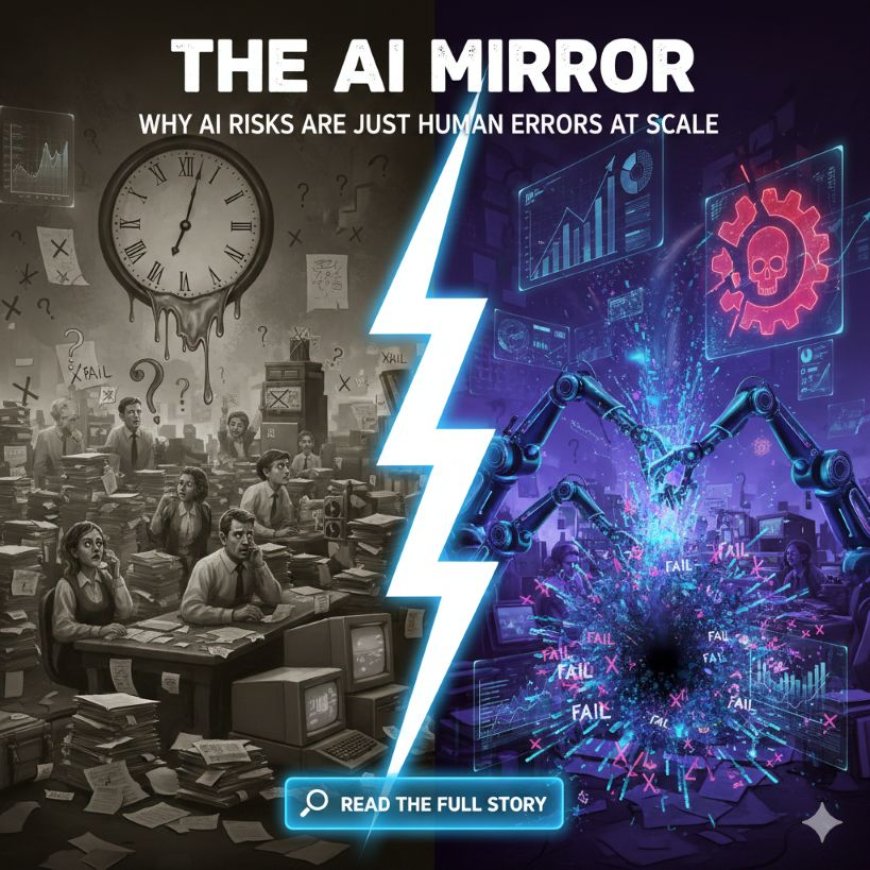
The prevailing narrative suggests that Artificial Intelligence represents a radical departure from traditional labour—a "black box" of magic that transcends human limitation. However, a closer look reveals that AI is less of a revolution and more of a mirror. The same variances in skill, the same risks of incompetence, and the same requirements for "deep thinking" that govern human teams apply to AI-driven workflows.
The Competence Constant
In any manual workforce, there is a divergence of roles. High-skilled workers provide high-value output; low-skilled workers require more supervision. AI operates on this exact spectrum, but with a crucial caveat: it is a subservient intelligence. An AI is only as capable as the instructions it receives. This creates a new tier of "performance problems." If a manager provides incomplete or biased instructions to a human subordinate, the subordinate might ask for clarification. An AI, however, will often confidently execute the flawed instruction to its logical (and potentially disastrous) conclusion.
The Productivity Paradox: Efficiency vs. Accuracy
We celebrate AI for its productivity, yet the following observation holds true: Productivity without accuracy is simply the rapid manufacture of waste. In manual processes, human fatigue and slow speeds act as natural "circuit breakers." Errors are often caught during the slow progression of a task. AI removes these breakers. Under "ignorant or flawed human guidance," an AI can produce a volume of data, products, or recommendations so vast that the eventual "re-work" becomes more expensive than if the task had been done slowly and manually in the first place.
The Role of the Human Anchor
Not everyone qualifies for a "deep-thinking" role because such roles require the ability to synthesize complex variables and anticipate downstream consequences. As AI takes over routine tasks, the demand for these "Human Anchors" actually increases.
We are not entering an era where human skill matters less; we are entering an era where the accuracy of human input matters more than ever. The risks of "staff performance problems" haven't disappeared—they have moved upstream to the person writing the prompt and designing the process.
Conclusion
AI is a tool, and like any tool, its output is a function of its operator. By treating AI as a fundamentally different entity, we risk overlooking the foundational management principles that have always governed success: clear communication, high-quality inputs, and the critical importance of human expertise. To mitigate the risks of AI, we shouldn't just look at the code; we must look at the competence of the humans guiding it.
Written/published by Kevin Marshall with the help of AI models (AI Quantum Intelligence).
What's Your Reaction?
 Like
0
Like
0
 Dislike
0
Dislike
0
 Love
0
Love
0
 Funny
0
Funny
0
 Angry
0
Angry
0
 Sad
1
Sad
1
 Wow
0
Wow
0