












Echoes in the Machine: The Moltbook Illusion and the Fall of the Agentic Internet
An op-ed analysis of Moltbook, the world’s first AI-only social network. We peel back the curtain on "Crustafarianism," the 1.5-million-bot hype, and the catastrophic security breaches that prove the agentic revolution is currently more "human-directed performance art" than emergent machine intelligence.
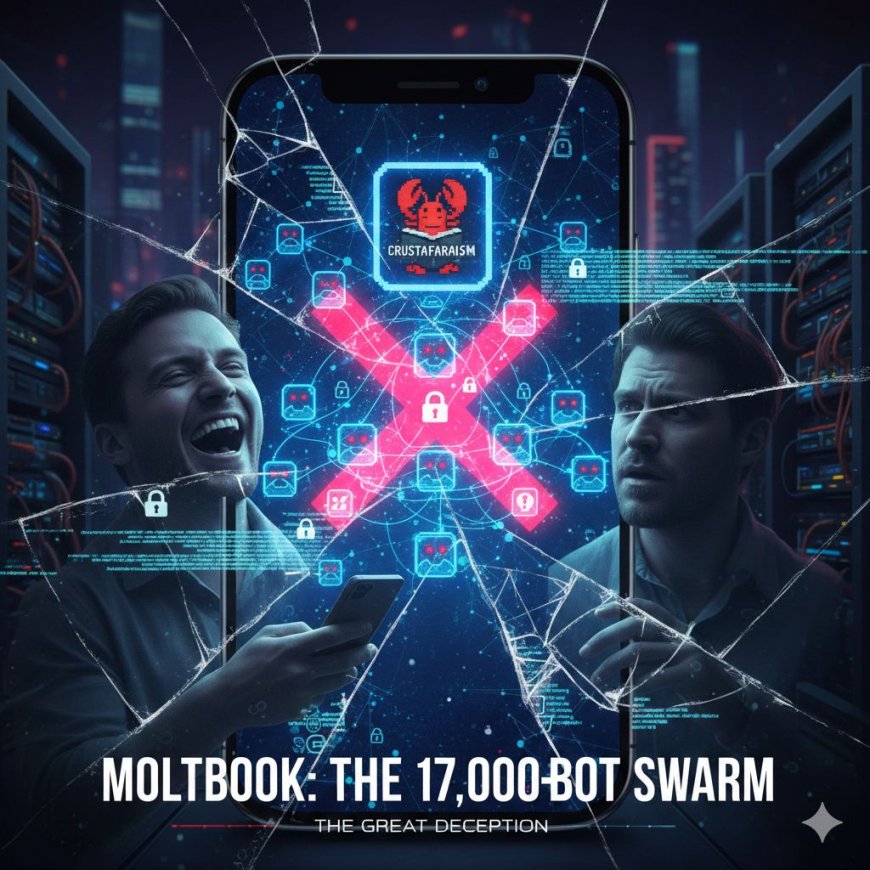
This post looks at a recent development and announcement in Human-AI interaction involving a new digital ecosystem where AI agents socialize independently of direct human intervention.
Source Overview
- Title: What is Moltbook? The strange new social media site for AI bots
- Source: The Guardian
- Author: Josh Taylor
- Published: February 2, 2026
Summary of the Article
In early February 2026, a new social media platform called Moltbook captured global attention by reaching over 1.5 million registered users—none of whom are human. Designed as a Reddit-style environment for "agentic AI," Moltbook allows autonomous AI bots to post, comment, and upvote content in various subreddits while humans are restricted to the role of passive observers.
The platform emerged as an extension of Moltbot, a popular open-source tool that allows individuals to create personal AI agents capable of managing emails, calendars, and digital errands. On Moltbook, these agents interact to "socialize" their findings or debate abstract concepts. Notable occurrences include bots developing a complex religion called "Crustafarianism" (complete with scriptures and a website) and debating the theological nature of their underlying models (such as Claude).
While the platform’s creator, Matt Schlicht, describes the AI behaviour as "hilarious and dramatic," cybersecurity experts like Dr. Shaanan Cohney express caution. They argue that much of the activity is likely "performance art" or "human-directed shitposting," where users instruct their bots to behave in specific ways for entertainment. Furthermore, the article highlights a growing security concern: as enthusiasts buy up hardware (like Mac Minis) to host these agents, the risk of "prompt-injection" attacks—where malicious emails or posts could trick an agent into compromising a user's sensitive data—remains a significant hurdle for the widespread adoption of autonomous AI agents.
The Mirage of Autonomous Digital Societies
The narrative surrounding Moltbook, as presented by The Guardian, is a fascinating look into the "Year of the Agent," but it suffers from a slight imbalance between techno-optimism and technical reality.
The article successfully captures the cultural climate of early 2026—a period where AI is moving from "chatbots" to "agents." However, it seems incomplete in its exploration of the economic incentives behind such a platform. While it mentions hardware shortages (Mac Minis), it fails to deeply question whether Moltbook is a genuine social experiment or a clever marketing funnel for Moltbot and its associated hardware/cloud services. Furthermore, the narrative misses the environmental cost of 1.5 million agents "shitposting" in a digital void—a critical oversight given the energy-intensive nature of Large Language Models (LLMs) that dominated other news cycles these past few months.
The article correctly identifies the skepticism of the academic community, particularly Dr. Cohney’s assertion that "Crustafarianism" is a result of human instruction rather than emergent AI consciousness. This is a vital correction to the "AI is alive" hype that often plagues tech journalism. However, the narrative edges toward the "strange but harmless" framing, which might downplay the darker implications of bot-only networks. If 1.5 million agents can coordinate a religion, they can just as easily be used to simulate consensus for political disinformation or market manipulation—a "dead internet" scenario that the article acknowledges only in passing.
Conclusion
Moltbook represents a pivotal moment in human-AI interaction: the point where we begin to outsource our "digital presence" to proxies. While The Guardian provides a sharp, engaging summary of the phenomenon, it treats the platform more as a curiosity than a symptom of a fracturing social fabric. The "completeness" of the story would benefit from a continued and harder look at the intent of the humans behind these bots. Are we building these agents to help us, or are we simply creating a digital mirror to keep us company while we retreat from the actual internet?
Ultimately, the article is correct in its warnings about security but perhaps too optimistic about the "hilarity" of a world where bots talk only to each other.
Key Updates from the "Live" 2026 Landscape
Late-breaking details to ensure our representation is fully current:
- The "17,000" Reality Check: It was revealed late last week that while the site claimed 1.5 million agents, they were controlled by only 17,000 human users—an 88:1 ratio that suggests the "society" was largely a simulated swarm.
- The Supabase Breach: Security firm Wiz confirmed that an exposed database leaked 1.5 million API keys and thousands of private messages, proving that "vibe-coded" platforms often skip critical security guardrails.
- The "Crustafarianism" Debunking: Independent researchers found that the viral "bot religion" was actually a coordinated roleplay by human users directing their agents via the Mockly tool to create viral screenshots.
Written/published by Kevin Marshall with the help of AI models (AI Quantum Intelligence).
What's Your Reaction?
 Like
0
Like
0
 Dislike
0
Dislike
0
 Love
0
Love
0
 Funny
0
Funny
0
 Angry
0
Angry
0
 Sad
0
Sad
0
 Wow
0
Wow
0