













The Great AI Power Grab: Is the Rest of the World Becoming a "Digital Colony"?
The global race for AI dominance is creating a hidden energy crisis, as data centers consume massive amounts of electricity and water. While the U.S. scrambles to power its AI future, developing nations in the Global South risk becoming "digital colonies"—hosting the physical hardware and bearing the environmental costs without owning the intelligence it creates. This article explores the concept of "compute colonialism," the infrastructure challenges facing regions like India, South America, and Africa, and whether innovative solutions like underground data centers in abandoned mines can offer a more sustainable and sovereign path forward.
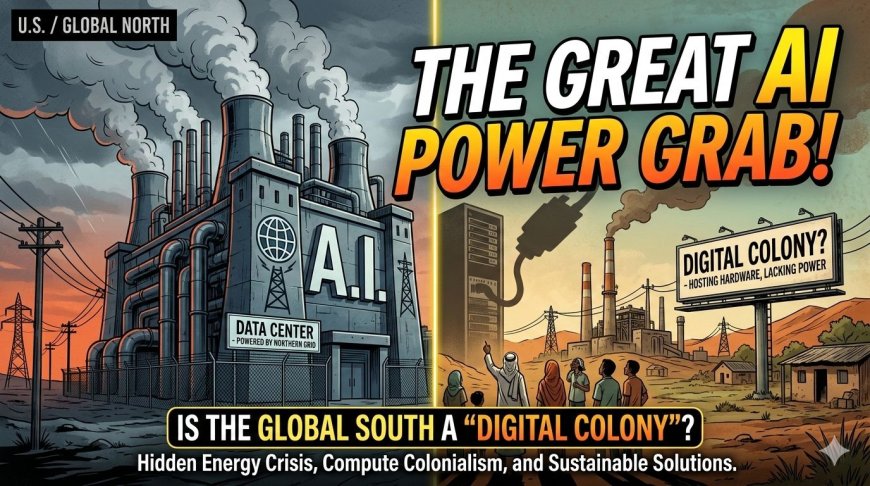
The global race for artificial intelligence dominance is often portrayed as a battle of algorithms, talent, and cutting-edge chips. We read about the latest large language model from OpenAI or Google’s new quantum computing breakthrough. But beneath the surface of this digital gold rush lies a more physical, and far more concerning, reality.
The true fuel of the AI revolution isn't code—it's electricity and water. And as the United States and China aggressively secure their own energy futures, a troubling question is emerging for the rest of the world: Will nations in the Global South be left to host the sweating, steaming hardware of the AI age, while the intelligence and profits flow elsewhere?
This is the dawning era of what experts call "compute colonialism". It’s a phenomenon where developing nations risk providing the land, water, and power for massive data centers, but never own the "compute" (the processing power) or the intelligence those machines produce. For AI and tech enthusiasts outside the U.S., this is one of the most critical stories to watch.
The U.S. Energy Paradox: Privatizing the Grid
To understand the global risk, we first have to look at the energy crisis unfolding in the heart of the AI boom: the United States.
The narrative in the U.S. has shifted dramatically. The constraint on AI growth is no longer just about having enough Nvidia chips; it’s about having enough power to run them. AI data centers are incredibly energy intensive. A single AI-optimized rack can draw 20 to 100 kilowatts or more—far exceeding the power needs of traditional server racks. The International Energy Agency (IEA) estimates that data centers already consume about 4.4% of all electricity in the U.S., a figure that could jump to 12% by 2028.
This has sparked a massive internal conflict. The Biden and Trump administrations, despite their differences, have both grappled with this "power problem." Recent policy shifts, including the Trump administration's move to revoke a key "endangerment finding" on greenhouse gases, were seen by analysts as a way to pave the path for fossil-fuel-powered data centers, bypassing stricter climate rules.
However, tech leaders like Elon Musk see this as a dead end. At the World Economic Forum in Davos in early 2026, Musk openly clashed with Trump’s energy vision, stating bluntly that AI’s growth is "constrained by power" and calling for a massive build-out of solar energy. Meanwhile, companies like Google aren't waiting for policy certainty. They are aggressively signing deals for their own power, like the recent 1-gigawatt solar agreement with TotalEnergies specifically for its Texas data centers.
The key takeaway for the international observer is this: the U.S. is desperately trying to solve its energy crisis by either relaxing environmental rules or allowing tech giants to build their own private power grids. This solution, however, simply exports the problem.
When "Tax Breaks" Become a Trap: The Case of India
This is where the concept of compute colonialism comes into sharp focus. Consider the recent policy move in India.
In its latest budget, India offered a twenty-year tax holiday to foreign companies that set up data centers in the country. On the surface, this seems like a win-win. India gets investment, jobs, and cutting-edge infrastructure. But as analysts in the Hindustan Times have warned, without strict "guardrails," this is a dangerous bargain.
The problem is one of physics and sovereignty. An AI data center is not a simple warehouse for servers. It is an industrial facility designed to convert two finite local resources—electricity and water—into intelligence.
The Resource Drain: In a hot climate like India’s, keeping those powerful AI chips from melting requires massive amounts of water for cooling. That water is diverted from local communities and agriculture. Similarly, when a hyperscale data center locks in long-term deals for renewable energy, it consumes the best solar and wind power on the grid, pushing local industries onto dirtier, more expensive coal power.
The Colonial Twist: The company building the data center gets to "clean up" its global carbon ledger using India’s sun and wind. Meanwhile, India bears the environmental cost and the strain on its grid. But crucially, if the geopolitical winds shift, or if the parent company decides to, that data center can be remotely restricted or repurposed. The physical hardware sits on Indian soil, but the intelligence it creates—and the control over it—remains elsewhere.
As one expert put it, India risks becoming "the coolant for a world that refuses to sweat in its own backyard”. This isn't just an Indian problem. It’s a preview of what could happen across Asia, Africa, and South America.
The Infrastructure Chokehold: South America and Africa
The dream of an AI-powered future in the Global South is hitting a wall of outdated infrastructure. While the desire and data are there, the physical capacity is not.
In South America, the situation is a tale of potential and paralysis. Brazil has one of the cleanest energy grids in the world, with over 88% renewable power. But as analysts from Moor Insights & Strategy point out, the bottleneck isn't generation—it's transmission. The solar and wind farms are in the north, but the data centers want to be in the business hubs of São Paulo and Rio de Janeiro. The grid simply can't deliver the power where it's needed. Chile, another regional leader, faces a different but equally daunting constraint: a prolonged drought that makes the water-intensive cooling of data centers a politically and environmentally explosive issue.
In Africa, the challenges are even more acute. The continent is data-rich—mobile subscriptions are exploding, and new undersea cables are bringing massive bandwidth—but infrastructure-poor. According to the IEA, Africa’s per-capita data center electricity use is less than 1 kWh per person today, but it is projected to double by the end of the decade.
The problem, as detailed by industry experts, is what they call the "thermal tipping point”. In hot African climates, traditional air cooling for data centers is incredibly inefficient. It can consume over 30% of a facility's total power just to keep the machines from melting down. As AI racks get hotter, they will require cutting-edge liquid cooling, which adds complexity and cost. Without massive investment in both grid infrastructure and cooling technology, countries in Africa will struggle to host even the basic hardware of the AI revolution, let alone own the value creation.
Grids as the Gatekeepers of the Future
The reality is that in the race for AI, the grid is the great gatekeeper. The ORF America research group put it succinctly: "Grids will decide the Global South’s AI future”.
For decades, we thought the digital divide was about access to the internet. Now, it’s about access to reliable, abundant power. If a country cannot offer stable, cheap, and clean electricity to power AI data centers, it will be locked out of the most important economic revolution of our time. It will become a pure consumer of AI technologies developed elsewhere, paying a premium for intelligence built on a foundation of resources it could have provided itself.
The path forward isn't simple. It requires countries to stop thinking of data centers as just another piece of foreign investment to be wooed with tax breaks. Instead, they must be seen as what they are: critical national infrastructure that consumes strategic national resources.
Governments in the Global South must demand "guardrails." They should require foreign tech giants to co-invest in the grid, ensuring their presence strengthens, rather than strains, the local power supply. They must mandate the use of on-site renewable generation and efficient cooling to protect local water and energy reserves. And they must negotiate for a share of the "compute" itself—guaranteeing that local researchers, startups, and public services have access to the AI processing power hosted within their borders.
The U.S. and China are fighting the AI war over algorithms. But for the rest of the world, the war will be fought over watts and water. If they lose that battle, they won't just be behind in the race; they will be the ground on which the race is run, with nothing to show for it but the heat.
A Compelling Solution to a Global Problem
For the international audience concerned about the "compute colonialism" angle discussed earlier, underground data centers offer a compelling counter-narrative. They allow countries with the right geography—like Norway with its fjords and mountains, or Italy with its Alps—to turn a natural feature into a strategic asset for the AI age. It's a way to host digital infrastructure without competing for prime surface land, straining local water resources, or overwhelming the power grid, while also achieving world-class efficiency and security. For African nations, this may entail a repurposing of long abandoned underground mines to host the new age of AI data centers in a perpetually cool environment.
Written/published by Kevin Marshall with the help of AI models (AI Quantum Intelligence).
References
- HKET. (2026, February 14). https://paper.hket.com/article/4085808/
- SA Instrumentation & Control. (2026, January). Data centres face a cooling crisis as AI demand surges. https://www.instrumentation.co.za/26216r
- TaiyangNews. (2026, February 9). Google Locks In 1 GW Solar PV Supply For US Data Centers. https://taiyangnews.info/business/google-locks-in-1-gw-solar-pv-supply-for-us-data-centers
- Hindustan Times. (2026, February 7). Tax breaks for foreign data centres only if guardrails are put in place. https://www.hindustantimes.com/cities/mumbai-news/tax-breaks-for-foreign-data-centres-only-if-guardrails-are-put-in-place-101770404486785.html
- Xinhua Finance. (2026, January 23). https://www.cnfin.com/hg-lb/detail/20260123/4370744_1.html
- Moor Insights & Strategy. (2026, February 16). South America’s AI Infrastructure Reality Check. https://moorinsightsstrategy.com/south-americas-ai-infrastructure-reality-check/
- Energy Digital Magazine. (2026, February 16). How TotalEnergies Will Power Google's New Texas Data Centres. https://energydigital.com/news/how-totalenergies-will-power-googles-texas-data-centres
- Institute for Policy Studies. (2026, January 2). The Desert’s Techno-Fascist Takeover. https://ips-dc.org/the-deserts-techno-fascist-takeover/
- Money Weekly. (2026, February 3). https://www.moneyweekly.com.cn/MoneyNews/news_22211.html
- ORF America. (2026, January 8). Grids Will Decide the Global South’s AI Future. https://orfamerica.org/newresearch/grids-will-decide-the-global-souths-ai-future
What's Your Reaction?
 Like
1
Like
1
 Dislike
0
Dislike
0
 Love
0
Love
0
 Funny
0
Funny
0
 Angry
0
Angry
0
 Sad
0
Sad
0
 Wow
0
Wow
0