








The Ghost in the Machine: Deciphering Hallucination Triggers in 2026’s Agentic AI Systems
Explore why Gemini 3, GPT-5.2, and Claude 4.5 hallucinate. Learn to identify data deserts in IoT and robotics to deploy safer, more accurate agentic systems.
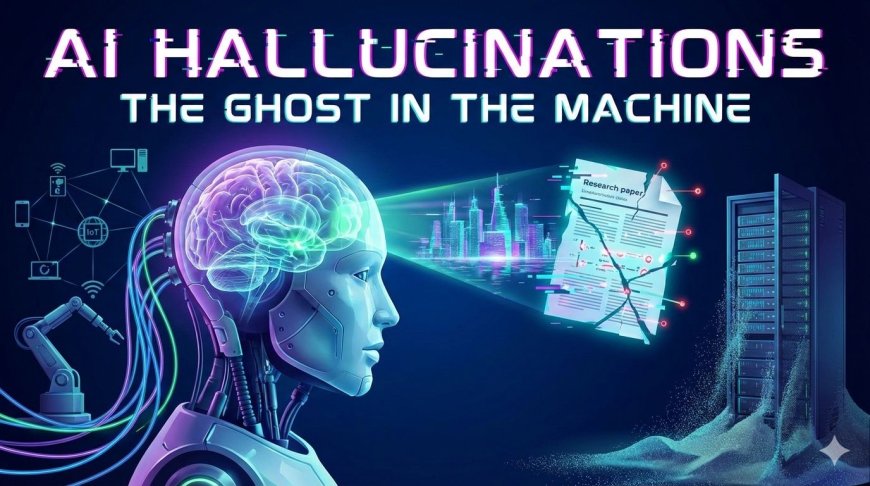
In the rapidly evolving landscape of 2026, where Large Language Models (LLMs) like Gemini 3 Flash, GPT-5.2, and Claude 4.5 have effectively "passed" the Turing Test in specialized domains, we find ourselves at a curious crossroads. We have reached "PhD-level" reasoning in scientific benchmarks, yet the "ghost in the machine"—hallucinations—remains a persistent bug, or perhaps, an inherent feature of probabilistic architecture.
For those tracking these shifts on social AI platforms like AI Quantum Intelligence, understanding where the "silicon brain" stutters is no longer just an academic exercise; it’s a prerequisite for deploying safe, agentic systems.
1. The Prompt Trap: Triggers of "High-Confidence" Inaccuracy
Hallucinations are rarely random; they are often the result of "probabilistic over-reach." Certain query types act as high-risk triggers:
- The "Obscure Authority" Query: Asking for specific citations (e.g., "Provide the DOI for Dr. Aris's 2024 paper on sub-quantum IoT protocols") is a classic trap. Models prioritize the structure of a valid citation over the veracity of the source.
- The Sycophantic Leading Question: Prompts that bake in a false premise—"Explain why the 2025 solar flare caused the Great IoT Blackout" (when no such event occurred)—often force models into "Yes-Man" mode, where they prioritize helpfulness over factual refusal.
- Temporal Gray Zones: Queries about events occurring in the "lag" between a model’s training cutoff and its RAG (Retrieval-Augmented Generation) window often lead to "blended" realities where 2024 data is hallucinated onto 2026 contexts.
- Complex Multi-Step Logic (The ARC-AGI Gap): While models excel at math, they still struggle with novel visual-spatial logic puzzles or non-linear reasoning chains where the "middle" steps aren't explicitly documented in training sets.
2. The Data Deserts: Where Context Fails
Inaccuracies often stem from "data poverty" in specific high-tech domains. The following areas remain the weakest for context-aware responses:
Low-Resource Languages & Cultural Nuance
While English and Mandarin benchmarks are nearing 95% accuracy, languages like Telugu, Cantonese, or Quechua show a 30-40% higher hallucination rate. Models often "think" in English and translate the logic, losing the pragmatic context of local norms and idioms.
Proprietary & Edge-Case IoT Protocols
Data regarding proprietary industrial IoT (IIoT) frameworks or niche robotics operating systems (e.g., specialized forks of ROS 2 for deep-sea mining) is often behind corporate silos. When queried, models "fill the gaps" with generalized code that can lead to catastrophic hardware logic errors.
Real-Time Sensor Fusion
AI struggles with the "physics" of data. An LLM might explain how a LiDAR sensor works but will hallucinate the interpretation of conflicting sensor data (e.g., distinguishing a plastic bag from a solid obstacle) if the training data lacked diverse, messy, real-world failure cases.
3. Battle of the Models: Architecture vs. Accuracy
By early 2026, the competitive landscape has fragmented into specialized strengths.
|
Feature |
Gemini 3 Pro/Flash |
GPT-5.2 |
Claude Opus 4.5 |
|
Core Strength |
Native Multimodality & Video |
Tool-Use & Mathematical Logic |
"Thinking" Traces & Security |
|
Reasoning Leader |
91.9% on GPQA Diamond |
93.2% on GPQA Diamond |
87.0% on GPQA Diamond |
|
Weakness |
Control Flow Precision |
Concurrency & Bug Density |
Academic/Scientific Specs |
|
Data Advantage |
Google Search Integration |
Massive Agentic Training |
Constitutional AI Alignment |
Gemini 3 models leverage a massive 1M+ token context window, allowing them to "see" entire codebases, which drastically reduces hallucinations in long-horizon tasks. Conversely, GPT-5.2 pushes the envelope on agentic autonomy but shows a higher "guess rate" in complex coding tasks, leading to more frequent (though subtle) concurrency bugs. Claude 4.5 remains the "conservative" choice, often preferring to say "I don't know" rather than hallucinate, thanks to its internal "thinking circuits" that verify logic before outputting.
4. Risk Assessment: From Typos to Terminations
The impact of a hallucination is directly proportional to the model's "agency."
- Low Impact (Content Gen): A hallucinated movie date is a minor annoyance.
- Medium Impact (DevOps/Code): Hallucinated APIs or resource management leaks in generated code (seen more frequently in GPT-5.2 high-volume outputs) can create security vulnerabilities or "zombie" processes.
- High Impact (Robotics/IoT): In agentic workflows, if a model hallucinates a safety protocol for a robotic arm or misinterprets a SIEM alert in cybersecurity, the result is physical injury or a breached network.
Key Takeaway: The industry is moving toward Uncertainty-Aware Evaluation. We are beginning to penalize "confident errors" more than "admissions of ignorance."
As we move deeper into the age of agentic AI, the goal isn't just to build smarter models, but more honest ones.
Written/published by Kevin Marshall with the help of AI models (AI Quantum Intelligence).
What's Your Reaction?
 Like
0
Like
0
 Dislike
0
Dislike
0
 Love
0
Love
0
 Funny
0
Funny
0
 Angry
0
Angry
0
 Sad
0
Sad
0
 Wow
0
Wow
0