
















The AI Oligopoly: How 5 Companies Quietly Became the New Superpowers
Corporate control of compute, data, and distribution has created a new AI oligopoly. How five companies quietly became global power brokers.
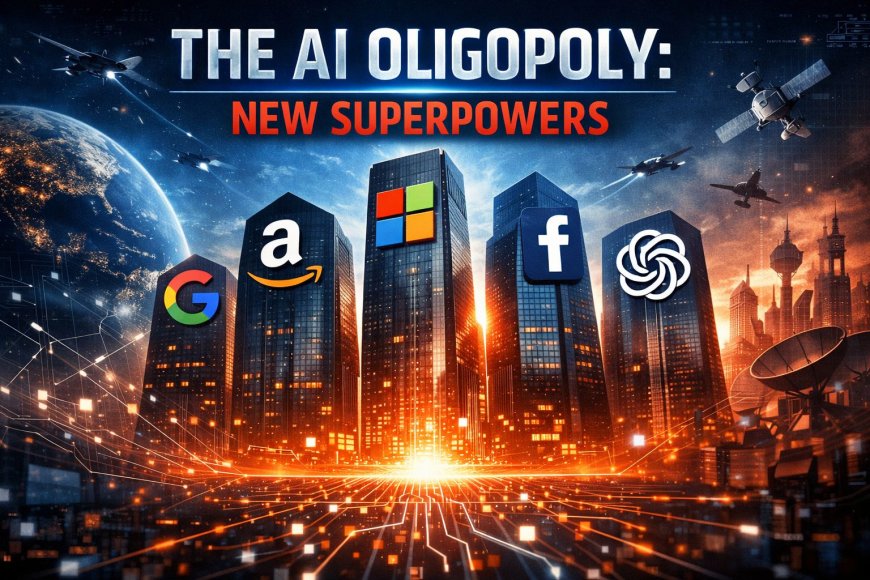
The AI industry has quietly consolidated into an oligopoly because compute, data, and distribution naturally reward scale — and scale now lives in the hands of a few firms. This article unpacks how that happened, why it matters, and what it means for global power structures.
1. The New Architecture of Power
Over the past decade, AI has shifted from a competitive frontier to a structurally concentrated industry. Research shows that foundation models exhibit extreme economies of scale — the more compute, data, and talent a firm controls, the cheaper and more powerful its models become. This dynamic naturally pushes the market toward greater concentration and potential natural monopolies.
The result is a landscape where a handful of companies — those with the capital to build hyperscale compute clusters, acquire proprietary datasets, and vertically integrate distribution — now sit atop the AI value chain.
2. Compute: The New Oil, the New Barrier
The cost structure of frontier AI models is dominated by compute. According to economic analyses, computational resources are one of the key inputs driving market concentration, with scale advantages so strong that smaller players cannot realistically compete.
This creates a reinforcing loop:
- More compute → better models
- Better models → more users
- More users → more revenue
- More revenue → more compute
Only a few firms can afford to stay on this treadmill.
3. Data: The Quiet Monopoly
Data is no longer just an asset — it is a moat. Research on AI knowledge concentration shows that leading companies accumulate inimitable, firm‑specific AI knowledge by absorbing academic research, partnering with top universities, and internalizing proprietary datasets.
This creates:
- Privileged access to training data
- Exclusive research pipelines
- Feedback loops that accelerate innovation
The more data these firms ingest, the harder it becomes for new entrants to catch up.
4. Distribution: The Final Lock‑In
Even if a startup builds a competitive model, it still faces the distribution bottleneck. The dominant AI companies already control:
- Cloud platforms
- App ecosystems
- Enterprise integration channels
- Consumer interfaces
Economic research warns that vertical integration amplifies the risk of market tipping, where one or two firms capture the entire market simply by controlling the stack.
5. The Geopolitical Consequence: Corporate Superpowers
Traditional geopolitics assumed nation‑states were the primary actors. But AI has created a new class of corporate superpowers whose influence rivals governments. As scholars note, market concentration in AI could translate into unprecedented accumulation of power, reshaping societal and geopolitical dynamics.
These firms now influence:
- National AI strategies
- Global compute supply chains
- Standards for safety and governance
- Public access to advanced intelligence
In effect, they have become sovereign actors in a new computational order.
6. A Contrarian View: Maybe This Was Inevitable
The prevailing narrative frames AI concentration as a policy failure. But the evidence suggests something more structural: AI rewards scale so aggressively that oligopoly may be the natural equilibrium.
This doesn’t mean it’s desirable — only that it’s predictable.
7. What Comes Next
The world now faces a choice:
- Regulate the oligopoly, forcing transparency, interoperability, and compute access
- Nationalize parts of the stack, treating compute like critical infrastructure
- Or accept a future where five companies shape the trajectory of intelligence itself
The stakes are not merely economic — they are civilizational.
References:
Concentrating Intelligence: Scaling and Market Structure in Artificial Intelligence
Written/published by Kevin Marshall with the help of AI models (AI Quantum Intelligence).
What's Your Reaction?
 Like
1
Like
1
 Dislike
0
Dislike
0
 Love
1
Love
1
 Funny
0
Funny
0
 Angry
0
Angry
0
 Sad
0
Sad
0
 Wow
1
Wow
1