












9 IT Process Automation Examples
Introduction
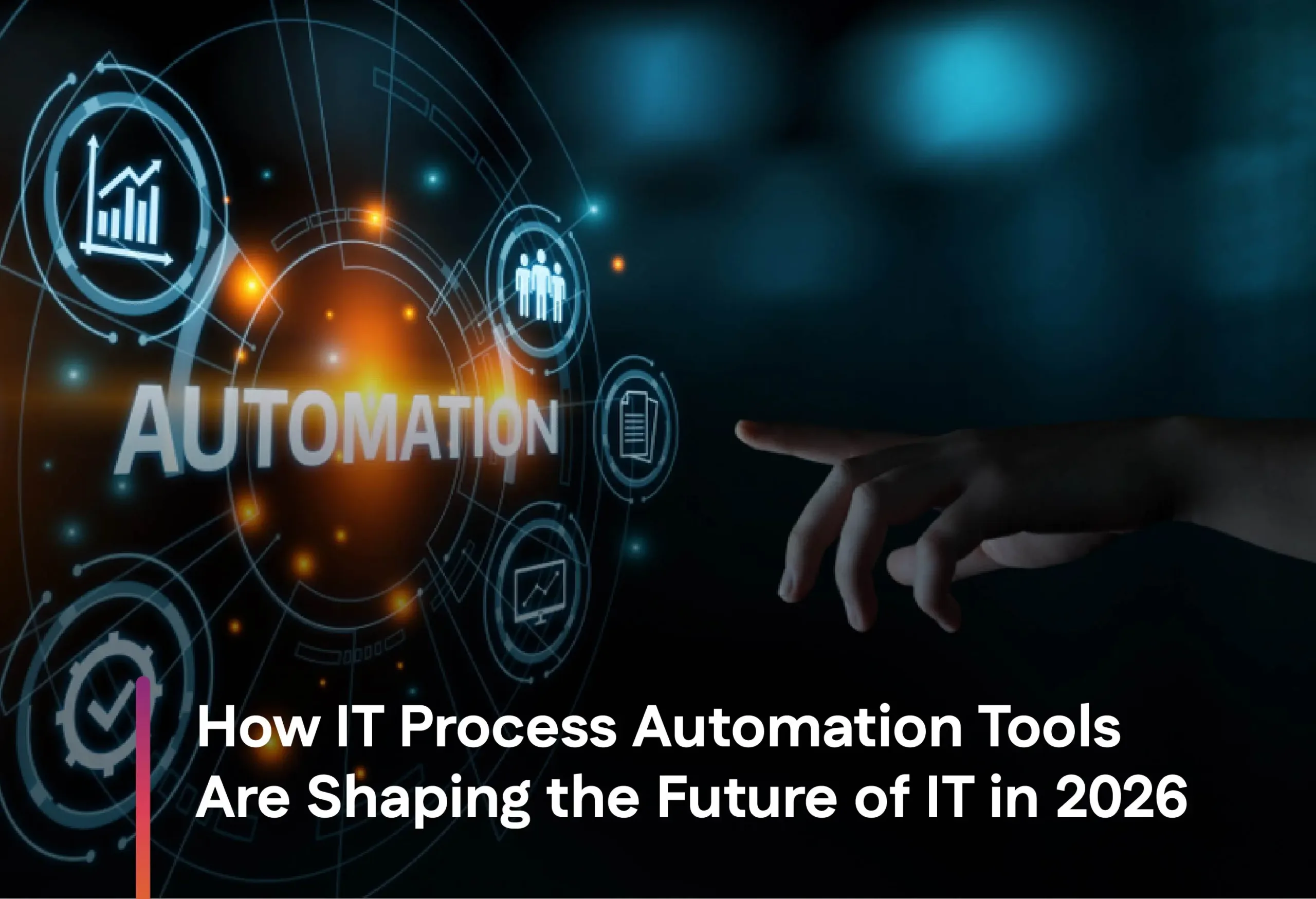
IT process automation (ITPA) is redefining how enterprises manage their digital operations. From help desk workflows to system monitoring, IT automation eliminates repetitive manual tasks, enhances reliability, and ensures faster service delivery.
In fact, according to recent market reports, the global IT process automation solution market is projected to grow by USD 23.15 billion driven by increasing digital transformation and business agility needs. By deploying the right IT process automation tools, organizations can automate critical workflows for IT incident resolution, improve compliance, and empower teams to focus on innovation rather than firefighting.
Key Article Takeaways
- IT process automation reduces manual workloads, errors, and downtime.
- AI-powered bots accelerate tasks like password resets and access provisioning.
- Automated monitoring enhances security and business continuity.
- Future-ready IT operations rely on hyperautomation and AI-first strategies.
Why IT Process Automation Matters
IT teams across industries are expected to ensure uptime, security, and compliance yet much of their time is spent handling routine tasks. These inefficiencies increase costs and slow innovation. Implementing workflows for IT process automation helps organizations automate repetitive processes like ticket management, onboarding, and system diagnostics resulting in improved accuracy, faster resolutions, and higher employee satisfaction.
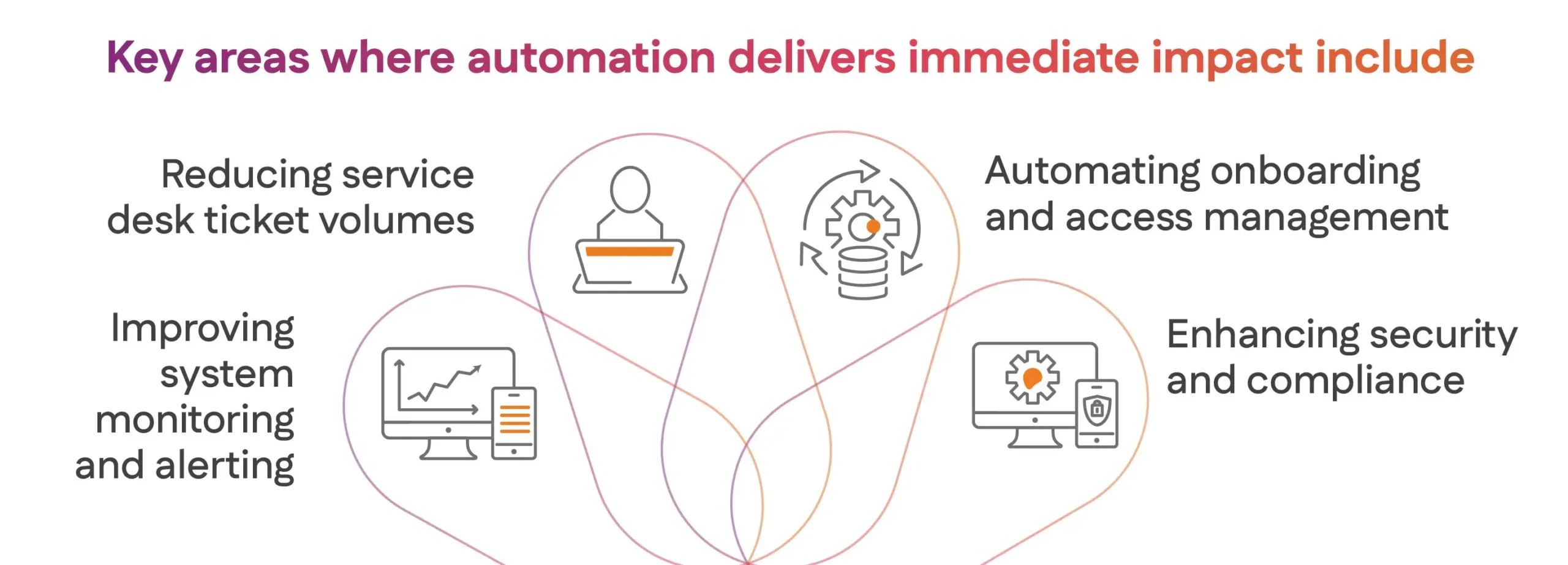
AutomationEdge delivers impact across key IT operations:
- Streamlines Service Desk Operations – AutomationEdge reduces ticket volumes by resolving repetitive issues through intelligent bots and self-service automation.
- Simplifies Onboarding & Access Management – It automates user creation, access provisioning, and approvals, ensuring quick and secure employee onboarding.
- Enhances System Monitoring & Alerts – AI-driven monitoring detects anomalies early and triggers automated fixes to maintain uptime.
- Strengthens Security & Compliance – AutomationEdge enforces consistent security policies, manages audit trails, and automates compliance checks to minimize risk.
9 Powerful IT Automation Use Cases
In today’s fast-moving world, IT teams are expected to do more than just keep systems running they’re driving speed, security, and reliability across every operation. By automating routine, time-consuming tasks, organizations can reduce errors, boost efficiency, and give their IT experts the freedom to focus on innovation and business growth.
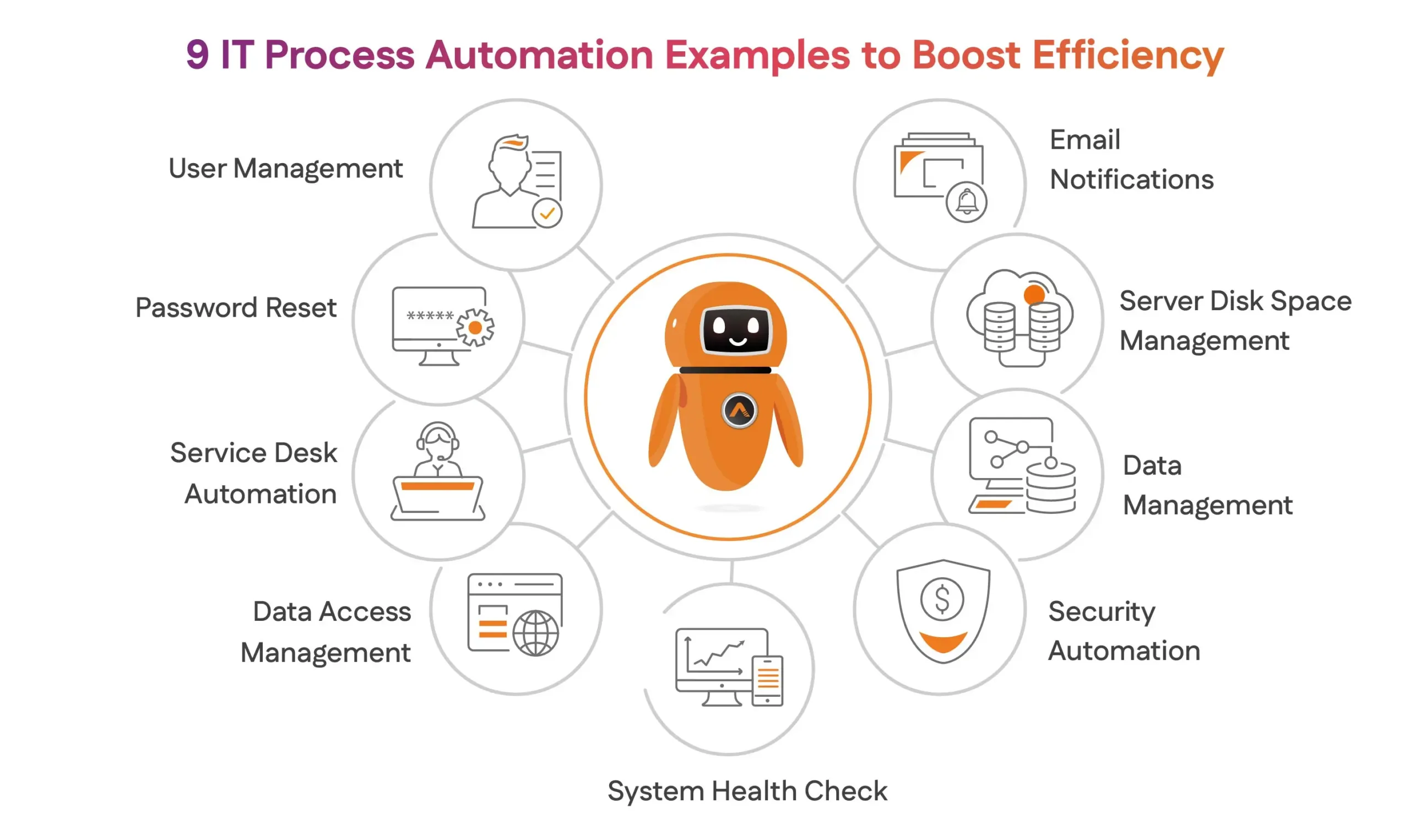
Here are nine key automation use cases transforming IT operations:
-
User Management
Automating user onboarding saves hours of manual work and ensures compliance. Bots can instantly create accounts, assign permissions, and send access credentials—without human intervention.
Example: A leading bank reduced onboarding time from two days to under 20 minutes using an automation bot integrated with HRMS and Active Directory.
-
Password Reset
Nearly 30% of IT help desk tickets are password-related, costing thousands annually. Automating this process through AI chatbots enables employees to securely reset passwords anytime, anywhere.
Example: An insurance company implemented a Teams chatbot for password resets, reducing IT tickets by 25% in one quarter.
-
Service Desk Automation
Manual ticket triage slows IT operations. AI-driven service desks automatically categorize, prioritize, and assign tickets, speeding up resolution times.
Example: A financial services firm used AI-driven ticket routing and reduced turnaround time for common issues like VPN or email access.
-
Data Access Management
Access provisioning and revocation are compliance critical. Automating this ensures role-based access and instant deactivation during employee exits, protecting data and maintaining audit trails.
Example: A credit card company linked access provisioning to HR events, eliminating unauthorized access and improving audit readiness.
-
System Health Check
Continuous system monitoring is essential to prevent downtime. AI-powered automation tools conduct health checks and trigger alerts before disruptions occur.
Example: A payment gateway reduced downtime incidents by implementing automated system diagnostics every 15 minutes.
-
Email Notifications
Manually handling thousands of customer communications creates inconsistencies. Automation ensures timely, accurate notifications for account alerts or approvals.
Example: A global bank automated customer notification, improving response time and satisfaction rates.
-
Server Disk Space Management
Monitoring and maintaining disk space prevents data loss and crashes. Automated scripts detect low storage and trigger cleanup tasks proactively.
Example: A data centre automated disk management for 2,000+ servers, preventing outages and optimizing resource usage.
-
Data Management
AI and OCR-based automation eliminate manual data entry errors.
Example: An insurance provider used OCR to digitize claim forms, ensuring faster and more accurate data processing.
-
Security Automation
Cybersecurity threats require real-time detection and response to prevent data breaches and minimize business disruption. Automation helps identify anomalies, block threats, and enforce compliance automatically helping safeguard the entire IT ecosystem. By implementing security automation, organizations can strengthen defences and maintain continuous protection.
Example: A stock exchange implemented AI-based malware detection, reducing threat response time from hours to seconds.
Key IT Challenges and Process Automation Benefits

| IT Challenge | Automation Solution | Business Benefit |
|---|---|---|
| High volume of manual service desk tickets | AI-driven service desk automation | Faster ticket resolution, improved employee productivity |
| Frequent password reset requests | Self-service AI chatbots | Reduced IT workload, lower operational costs |
| Slow user onboarding and access provisioning | Automated user management & access control | Faster onboarding, compliance with security policies |
| Manual monitoring of system health | AI-enabled system health checks | Proactive issue detection, reduced downtime |
| Repetitive data entry and processing | AI + OCR-based data automation | Higher data accuracy, faster decision-making |
| Security and compliance risks | Automated security monitoring & response | Minimized breaches, audit-ready systems |
Top IT Process Automation Trends for 2026
- AI-First Automation – IT operations are shifting from rule-based scripts to AI-driven decisions that predict issues and trigger self-healing actions.
- Hyperautomation Adoption – Combining RPA, AI, and analytics to automate complex end-to-end IT workflows for greater agility.
- AIOps Integration – AI-powered operations will dominate IT monitoring, enabling proactive incident management and faster root cause analysis.
- Low-Code Automation Platforms – IT teams will rely on low-code tools to build and deploy automations quickly without deep coding expertise.
- Security-Centric Automation – Automated threat detection and response will become central to protecting systems from evolving cyber risks.
Conclusion
IT process automation is now essential for scaling digital operations efficiently. From runbook automation to intelligent automation, these innovations redefine how enterprises manage infrastructure and service delivery.
By choosing the right IT process automation solution, organizations can enhance performance, ensure compliance, and build resilient IT ecosystems.
AutomationEdge enables this transformation through its unified AI, ML, and RPA-powered platform helping enterprises automate, accelerate, and evolve their IT operations.
Frequently Asked Questions
The post 9 IT Process Automation Examples appeared first on AutomationEdge.
What's Your Reaction?
 Like
0
Like
0
 Dislike
0
Dislike
0
 Love
0
Love
0
 Funny
0
Funny
0
 Angry
0
Angry
0
 Sad
0
Sad
0
 Wow
0
Wow
0