











The Organizational AI Performance Gap: Why Your Next Budget Request Needs a People Strategy
The real AI performance gap isn’t technical—it’s organizational. Discover why the most successful companies treat upskilling as core infrastructure and learn the 7-step blueprint to aligning your workforce with your AI investment for maximum ROI.
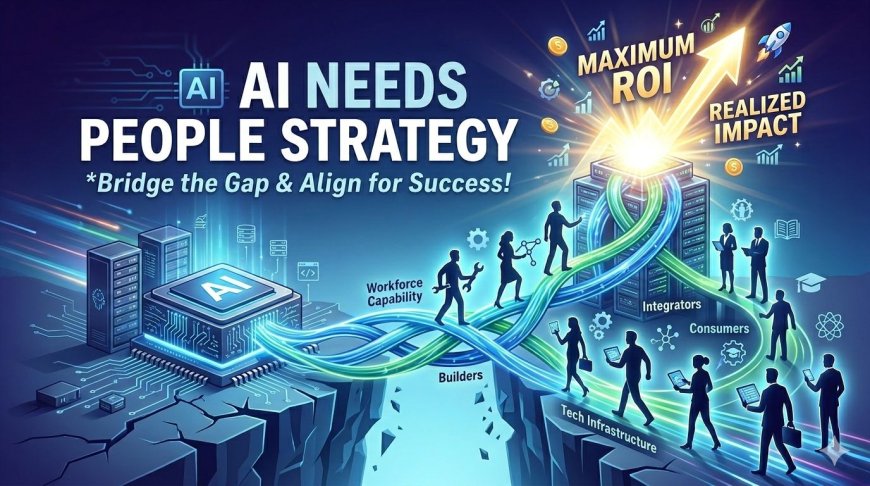
A common belief among AI enthusiasts is straightforward: to win the race, you need the fastest car. In the enterprise AI landscape, this often translates to a mad dash for more computing power, bigger datasets, and the latest foundation models. It’s an infrastructure-first mentality. We assume performance is a function of budget.
But as a quick review of recent and insightful LinkedIn posts by AI strategists and practitioners alike reminds us, this is a fallacy. The companies pulling ahead aren't just building faster cars; they are building a synchronized, skilled racing team and an optimized pit crew.
The Performance Gap Isn't About Models—It's About Management.
The hardest truth of AI transformation is that the constraint is rarely the algorithm. It is alignment. A high-performing model that no one knows how to use, or that doesn't solve a recognized business problem, generates exactly zero ROI. The dot-com boom and bust at the turn of the millennium showed a similar pattern—more features, more capabilities, and limited viable use cases or organizational adaptation and readiness for change.
The following provides a powerful example of a seven-point operating system for successful AI integration. We have synthesized these points into an integrated blueprint for organizational AI capability (pictured below). If you want to bridge the gap between technical possibility and business reality, you must align your workforce roadmap with your infrastructure roadmap from day one.
Here is how successful leaders can execute this transformation.
THE INTEGRATED BLUEPRINT FOR AI CAPABILITY
To illustrate these principles, we have visualized the required shifts in strategy, structure, and metrics.

1. Build Synchronized Pipelines
Zone 1: The Synchronized Pipelines (top-left) visualizes a foundational shift in thinking.
Most organizations build data pipelines. Leading enterprises build synchronized data and workforce capability pipelines.
-
Zone 1, Top Flow (Data & Tech): This is the well-understood engineering process: Collect data -> Clean and structure it -> Build or fine-tune the Model -> Deploy to production. This is the tech stack.
-
Zone 1, Bottom Flow (Workforce Capability): The leaders recognize a critical, parallel, and often invisible pipeline: MAP SKILLS at project inception (not just at launch), UPSKILL & ENABLE the team, APPLY IN WORKFLOW (not in a training sandbox), and then ADOPT & REITERATE.
The arrows in Zone 1 show interaction. You can't Clean data effectively without a Domain Expert who understands the data's meaning, and you cannot Deploy effectively if your frontline teams haven't adopted the new tool in their workflow. This highlights that workforce capability must be treated as a technical dependency—if it lags, your infrastructure is just stranded capital.
2. Invest in the Full Workforce Stack
Zone 3: The AI Workforce Stack (bottom-right) addresses the trap of misaligned investment.
The highest-leverage role in AI transformation isn’t necessarily another machine learning engineer. Successful organizations recognize they must activate three essential tiers. Many pundits seem to suggest that most (or too many) companies overinvest in Tier 1 (BUILDERS), the engineers and data scientists (often glowing and isolated in our visualization).
The true breakthrough requires focusing on the other tiers:
-
Tier 2: INTEGRATORS (Highlighted Connective Tissue): This is the high-leverage "Translator". They are the Product Managers, Analysts, and Domain Experts who speak both business and AI fluently. They take a model’s output (Tier 1 build) and connect it to a business operation (Tier 3 use case). Without Integrators, there is no value.
-
Tier 3: CONSUMERS: This is the base of the entire adoption pyramid: Business Leaders and Frontline teams. Success requires this foundation to be capable of using and trusting AI tools. If this tier doesn't adopt, the entire stack collapses.
3. Measure Capability Like System Performance
Zone 2: The Balanced AI Performance Dashboard (top-right) illustrates the necessary governance structure.
If you don't measure capability, you can’t manage it. Treat AI as an operating model redesign, not a tech rollout. To implement this, joint accountability must exist at the C-suite level, bridging the classic silo between the CTO and the CHRO.
The visualization shows a single, centralized gauge: REALIZED BUSINESS IMPACT. This impact is fueled by two equally important performance engines:
-
Technical Infrastructure (CTO Owned): The standard metrics you are already tracking: Model Accuracy, System Uptime, Deployment Velocity.
-
Workforce Capability (CHRO Owned): The essential metrics you probably are not tracking: Skill Gap Reduction, Adoption Depth (not just licenses sold), and the Capability ROI (how much business value is generated per dollar of upskilling investment).
As the visual shows, a 99% accurate model (excellent CTO performance) still yields a low business impact if the user adoption is 20% (poor CHRO performance). Real ROI requires both systems and people to perform.
The Board-Level Question
Before approving the next AI budget, leaders and board members are challenged to move past the promise of the algorithm and ask the organizational question:
→ Does our AI roadmap include a workforce capability roadmap with equal investment and governance?
The next 24 months won't be defined by a technical gap. It will be defined by an organizational gap. If your AI plan is all about infrastructure and not about people, you are funding stranded capital. The constraint is rarely the algorithm. It is alignment.
Written/published by Kevin Marshall with the help of AI models and inspired/informed by AI strategists and practitioners alike.
What's Your Reaction?
 Like
0
Like
0
 Dislike
0
Dislike
0
 Love
0
Love
0
 Funny
0
Funny
0
 Angry
0
Angry
0
 Sad
0
Sad
0
 Wow
0
Wow
0