



AI: A World-Changer, or a Trap for the Unready?
Explore whether artificial intelligence (AI) will level the playing field for all or leave behind those who are unprepared. This article breaks down AI’s potential as an equalizer in education, health, and opportunity—and its risks for the unaware, overconfident, and unready—in simple, relatable terms.
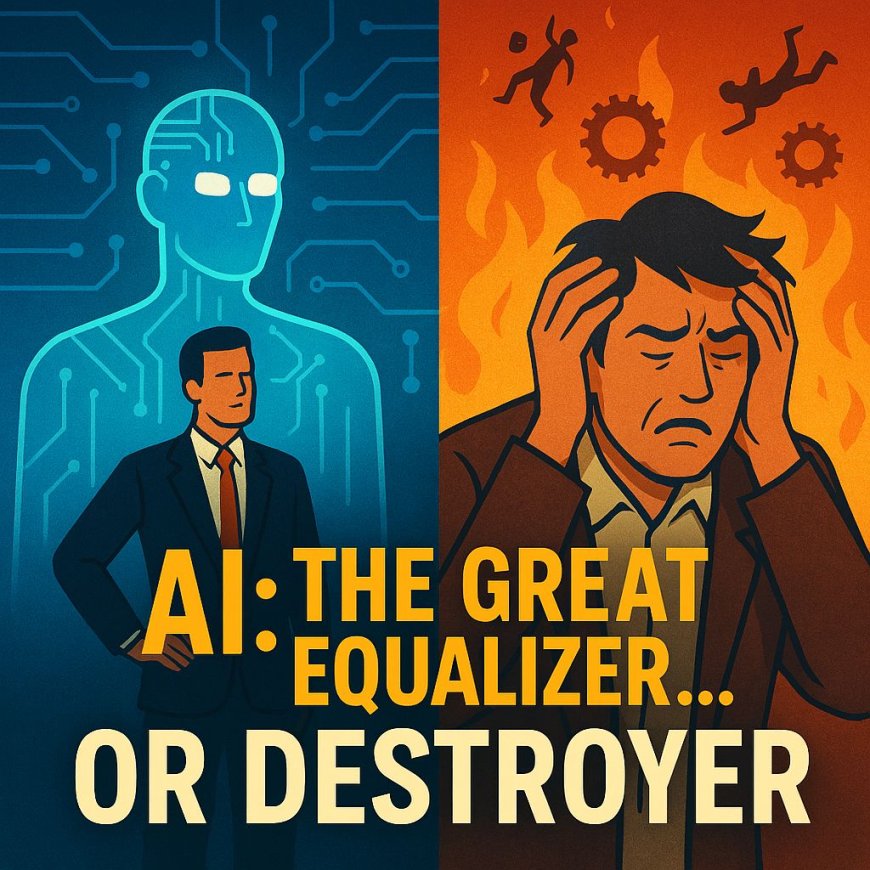
Let's explore the following statement - "AI, the great equalizer.. or the technology advancement that destroys the unprepared, the ignorant, the over-confident...".
You’ve probably heard people say AI will change everything. Some say it’s the “great equalizer”—a tool that can give everyone, everywhere, a fair shot. Others warn it could wreck the lives of those who aren’t ready for it: the unprepared, the unaware, the overconfident.
So which is it? The truth is, it could easily be both. What AI becomes depends less on the technology itself and more on us—how we learn about it, how we prepare, and whether we stay humble.
AI as the Great Equalizer
Think about what a “great equalizer” means. It’s something that gives people the same chances, no matter who they are or where they’re from.
AI can do that.
-
In healthcare, an AI tool could help a doctor in a small town spot diseases as well as a specialist in a big city hospital.
-
In school, an AI tutor could give one-on-one help to every student, adapting to how they learn best.
-
For people with disabilities, AI can power apps that describe images aloud or turn speech into text, helping them navigate the world more freely.
It can make expensive services—like legal advice or design—cheaper and more accessible. In this way, AI can level the playing field.
AI as a Trap for the Unready
But there’s another side. AI is moving fast, and it doesn’t help everyone equally.
The unprepared could be people in jobs that AI starts doing—like certain office tasks, analysis, or even some creative work. If you’re not learning new skills, you could get left behind.
The ignorant doesn’t mean stupid. It means not understanding what AI really is and what it can do. For example, not knowing that AI can make fake videos (deepfakes) or accidentally repeat unfair biases from its training data. If you don’t know how it works, you can’t use it wisely or protect yourself from its downsides.
The overconfident are those who think, “This won’t affect me,” or “I don’t need to learn that.” That could be a worker who thinks their job is safe forever, a company that ignores new tools, or a leader who thinks old rules will still work. Confidence is good, but overconfidence in the face of something this big is risky.
The Two Paths Are Happening Now
Here’s the thing: both of these futures are unfolding at the same time.
AI might give a student in a remote village an amazing tutor, while also making some jobs disappear in a city. It might help diagnose an illness in one country while making a few tech companies incredibly powerful.
The “equalizing” benefits might take time to spread to everyone. But the “destructive” side—lost jobs, confusion, and disruption—can happen quickly to people who aren’t ready.
What Do We Do About It?
We don’t have to just hope for the best. We can take action:
-
Keep Learning—For Life: This isn’t just about school. It’s about staying curious and adaptable. Learn how to use new tools. Work on skills AI can’t easily replace—like creativity, teamwork, and critical thinking.
-
Get AI Literate: You don’t need to be a coder, but you should know the basics: What can AI do? What can’t it do? How might it be biased? Knowing this helps you use it well and spot its mistakes.
-
Stay Humble and Alert: No one has all the answers with AI. It’s okay to ask questions and be cautious. Don’t assume you’re immune to change.
-
Push for Fair Rules: We should all expect companies and governments to build and use AI responsibly—making sure it helps people, not just profits.
The Bottom Line
AI isn’t magic. It’s a tool. And like any powerful tool—from electricity to the internet—it can be used to build up or to tear down. The quote is really asking: Will we be the ones guiding it, or will we be the ones stumbling because we didn’t pay attention?
The future isn’t fixed. It depends on what we learn, how we prepare, and whether we respect the power of the technology we’re creating. The choice is in our hands.
What's Your Reaction?
 Like
0
Like
0
 Dislike
0
Dislike
0
 Love
0
Love
0
 Funny
0
Funny
0
 Angry
0
Angry
0
 Sad
0
Sad
0
 Wow
0
Wow
0