











AI Chatbot in Banking- Accelerating Customer Engagement
Introduction
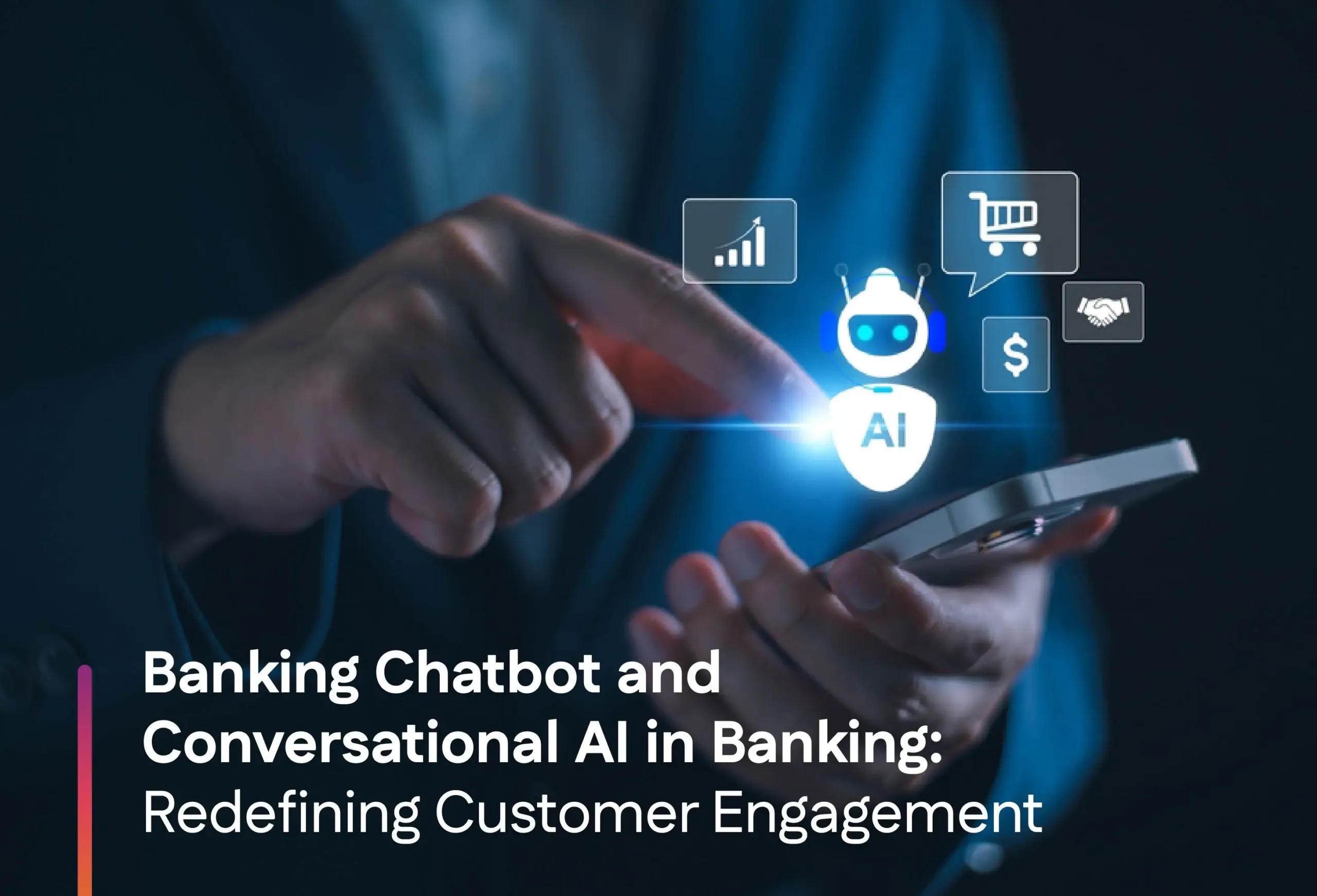
The banking industry is rapidly embracing digital transformation, and one of the most impactful innovations driving this change is the AI chatbot in banking. A banking chatbot acts as a virtual assistant, designed to simplify customer interactions, enhance service efficiency, and deliver seamless digital experiences 24/7.
By using conversational AI in banking, financial institutions can now provide intelligent, personalized, and secure support to millions of customers simultaneously without compromising accuracy or quality.
What is an AI Chatbot in Banking?
An AI chatbot in banking is an automated, conversational assistant that interacts with customers through voice or text. It helps with tasks like checking balances, transferring funds, tracking transactions, or resolving service queries.
Unlike traditional bots, an intelligent chatbot for banking systems uses AI, NLP (Natural Language Processing), and ML (Machine Learning) to understand customer intent and respond contextually creating human-like interactions.
These chatbots are now a key part of the banking chatbot solution ecosystem, reshaping how banks connect with customers digitally.
AI Experience Center
Discover our AI solutions your way. Access self-service video demos, and real implementation stories. Learn how AI can transform your business.
AI Experience Center
Discover our AI solutions your way. Access self-service video demos, and real implementation stories. Learn how AI can transform your business.
How Does an AI Chatbot Work in Banking?
AI chatbots in banking work by combining natural language understanding, machine learning, and secure data integration to handle customer queries in real time.
Instead of navigating through apps or waiting for human agents, customers simply type or speak about their requests, and the chatbot instantly processes, retrieves, and responds with accurate information just like a digital bank assistant.
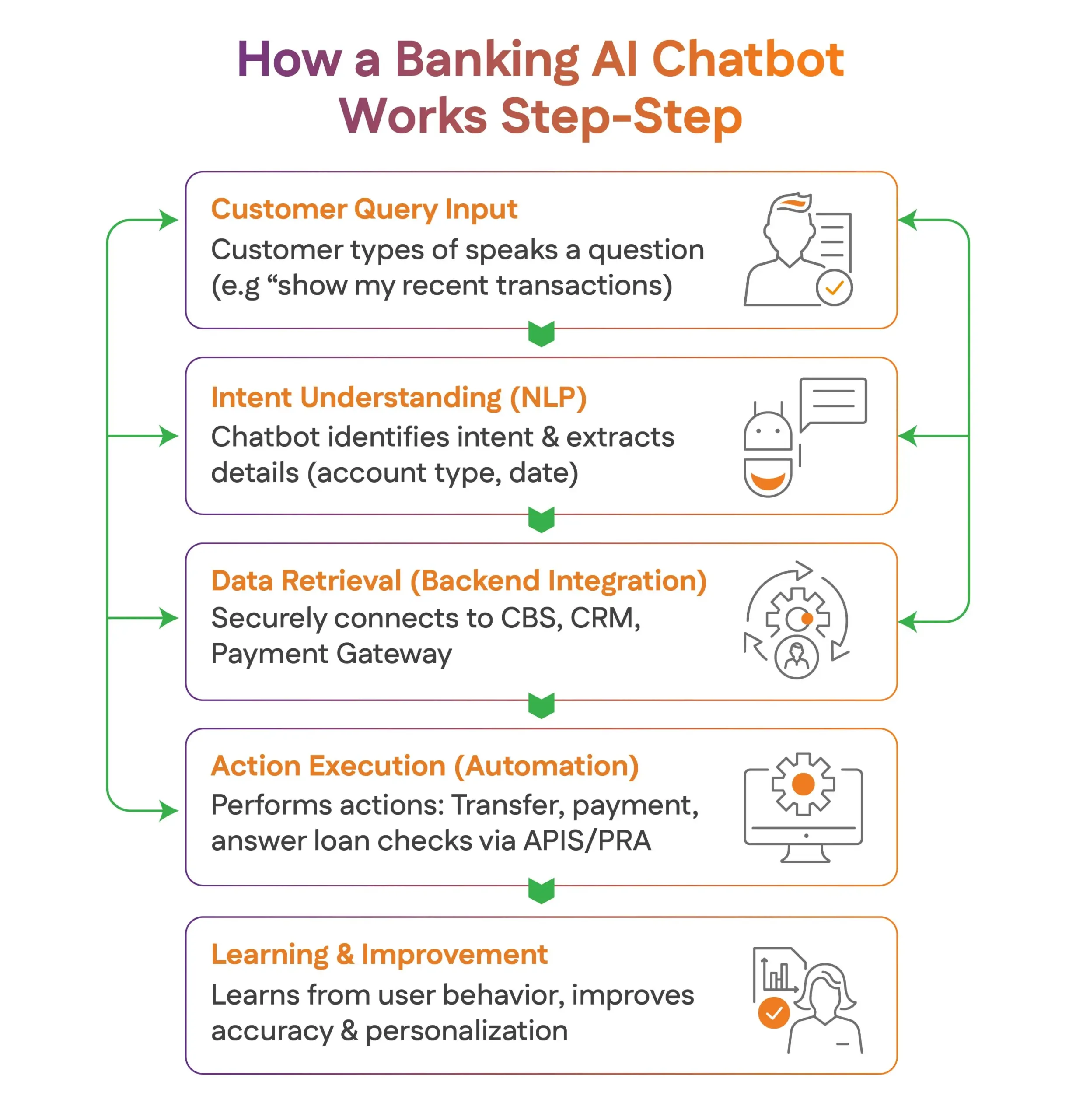
Here’s how an AI chatbot works in banking, step by step:
- Customer Query Input: The customer types or speaks a question (e.g., “Show my recent transactions”).
- Intent Understanding (NLP): The chatbot’s Natural Language Processing (NLP) engine identifies the intent and extracts key details like account type or date.
- Data Retrieval (Backend Integration): It securely connects to the core banking system (CBS), CRM, or payment gateway to fetch the relevant data in real time.
- Response Generation: The chatbot formulates a precise and contextual answer using Machine Learning (ML) models and displays it instantly.
- Action Execution (Automation): If required, it performs actions like fund transfers, bill payments, or loan eligibility checks through connected APIs or RPA bots.
- Learning & Improvement: Every interaction helps the chatbot learn from user behavior, improving accuracy and personalization over time.
Use cases of How AI Chatbots Are Changing Banking
-
CogniBot – AI Chatbot for Banking
Our flagship chatbot solution, CogniBot, is designed for banking platforms (web, mobile, messaging) and handles tasks such as checking account balances, transaction histories, card activations and credit-score queries.
-
WhatsApp & MS Teams Bank Bot Integration
AutomationEdge offers chatbots that integrate with platforms like WhatsApp and MS Teams to provide banks with 24/7 conversational support across channels. These bots enable tasks such as account inquiries, loan status checks and service requests within the chat interface.
-
Gen AI-powered Employee Support Automation with AutomationEdge
AutomationEdge provides ready-to-use chatbots that automate routine tasks and reduce employee workload. They easily connect with IT, HR, and finance systems to handle requests like password resets, leave applications, and expense approvals automatically.
These examples highlight how chatbots are enhancing the digital banking experience with AI chatbots that deliver speed, accuracy, and convenience.
What are the Benefits of AI Chatbot in Banking?
AI chatbots deliver a broad range of benefits to both customers and banks:
- 24/7 Instant Support: Always available for customer queries and transactions.
- Cost Efficiency: Automating routine queries can reduce operational costs by up to 60%.
- Personalized Service: Chatbots use customer data to provide customized financial advice and recommendations.
- Increased Engagement: Proactive notifications and reminders help maintain consistent customer interaction.
- Fraud Detection: AI-based monitoring systems can alert users about suspicious transactions in real time.
Manual vs Automated Banking Support
Before automation, traditional banking support depended on human agents, resulting in long wait times and higher operational costs. The comparison below shows how AI-powered chatbots outperform manual banking support in terms of efficiency, scalability, and customer satisfaction.
| Feature | Manual Banking Support | AI Chatbot Banking Support |
|---|---|---|
| Availability | Limited to working hours | 24/7 instant support |
| Query Resolution Time | Several minutes | Instant (seconds) |
| Personalization | Minimal | Data-driven and tailored |
| Operational Cost | High | Cost reduction |
| Error Rate | Human errors possible | Near-zero with automation |
| Scalability | Limited by staff | Unlimited simultaneous interactions |
Quick Tip:
When scaling customer support, start with AI chatbots for FAQs and repetitive queries it instantly reduces costs and frees up agents for high-value interactions.
Future Trends of AI Chatbots in Banking
AI chatbots in banking are evolving fast; chatbots are providing hyper-personalized customer experiences, voice-driven banking, and predictive financial insights powered by Gen AI. Chatbots will integrate more deeply with core banking systems, offering faster issue resolution and proactive fraud alerts.
Quick glance at what’s next:
-
Voice & Multilingual Chatbots:
Chatbots powered by Generative AI can now understand and respond in multiple languages, helping banks reach customers across regions while maintaining inclusivity.
-
Emotionally Intelligent Chatbots:
Next-generation chatbots will use sentiment analysis to detect a customer’s emotions — whether frustration or satisfaction — and tailor responses accordingly.
-
Predictive Conversations:
Using Generative AI and predictive analytics, they’ll recommend saving plans, loan options, or investment opportunities before customers even ask.
-
AI Chatbots for Risk and Compliance Management:
AI bots can instantly flag unusual transactions, assist in KYC verification, and help meet RBI and GDPR standards.
-
Hyper-Personalized Wealth Advisory:
Using customer data, market trends, and behavioral analytics, AI chatbots will act as virtual financial advisors, providing dynamic portfolio recommendations and investment insights customized to individual goals.
-
Integration with Open Banking and Fintech APIs:
Chatbots will evolve into smart banking hubs, connecting multiple services like insurance, investment, and digital lending under one conversational interface through Open Banking APIs.
-
AI-Driven Workforce Support for Bank Employees:
Beyond customers, chatbots will support employees by automating repetitive tasks, assisting with compliance queries, and providing instant access to data, improving operational efficiency.
What This Means for Banks:
The future of banking chatbots isn’t just about faster service it’s about predictive, personalized, and emotion-aware interactions that strengthen every customer relationship.
Did You Know?
- 98% of retail banks are actively using chatbots in customer service or onboarding processes in 2025.
- 66% of banks offering mortgage services employ chatbots for pre-qualification and FAQs in 2025.
- 52% of cooperative banks now rely on chatbot platforms for daily customer interaction in 2025.
- 48% of banks involved in cross-border services integrate multilingual chatbots in 2025
Source: Coinlaw
Challenges Banks May Face When Implementing AI Chatbots
While AI chatbots bring immense potential, banks must address challenges such as:
-
Data Security & Privacy:
Ensuring compliance with RBI and GDPR while maintaining user trust.
-
Integration Complexity:
Connecting chatbots with legacy core systems securely and efficiently.
-
Training & Maintenance:
Chatbots require continuous learning and data updates to remain effective.
-
Customer Adoption:
Encouraging users to shift from traditional to digital conversational support.
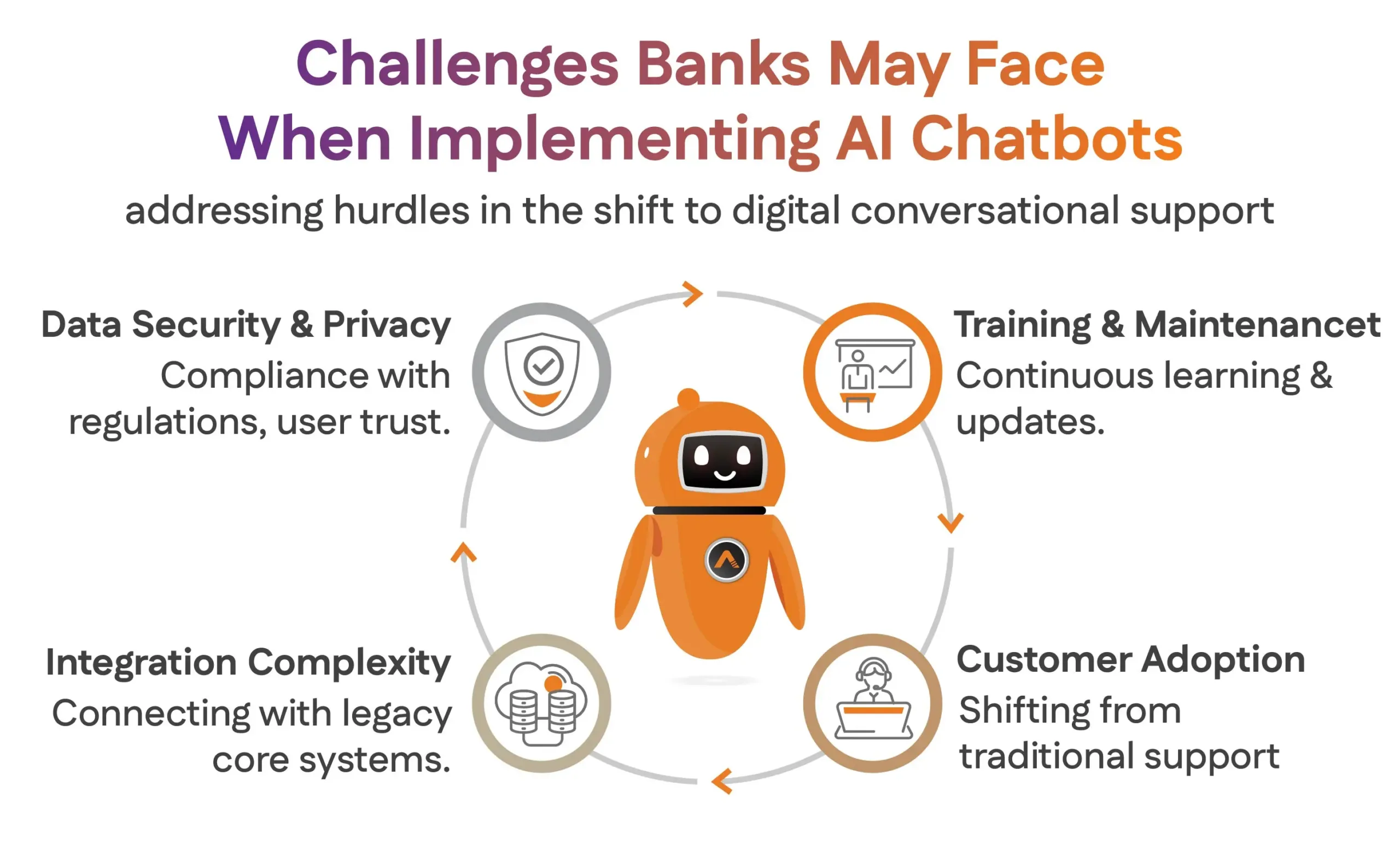
These challenges can be overcome by following banking chatbot implementation best practices, such as starting with pilot projects, prioritizing secure API integrations, and using AI platforms with robust compliance features.
How can Automationedge help you with AI chatbots in banking?
AutomationEdge offers a comprehensive banking chatbot solution powered by AI, RPA, and NLP. Our chatbots enable seamless conversational AI in banking by automating routine tasks, enhancing personalization, and integrating securely with core systems.
Whether it’s improving customer service, automating transactions, or assisting employees, AutomationEdge’s intelligent chatbot for banking systems ensures faster resolutions, higher engagement, and better compliance helping banks deliver a truly modern digital banking experience.
Frequently Asked Questions (FAQs)
The post AI Chatbot in Banking- Accelerating Customer Engagement appeared first on AutomationEdge.
What's Your Reaction?
 Like
0
Like
0
 Dislike
0
Dislike
0
 Love
0
Love
0
 Funny
0
Funny
0
 Angry
0
Angry
0
 Sad
0
Sad
0
 Wow
0
Wow
0