











AI in Marine Insurance: Future of Smarter Risk, Faster Claims & Safer Shipping
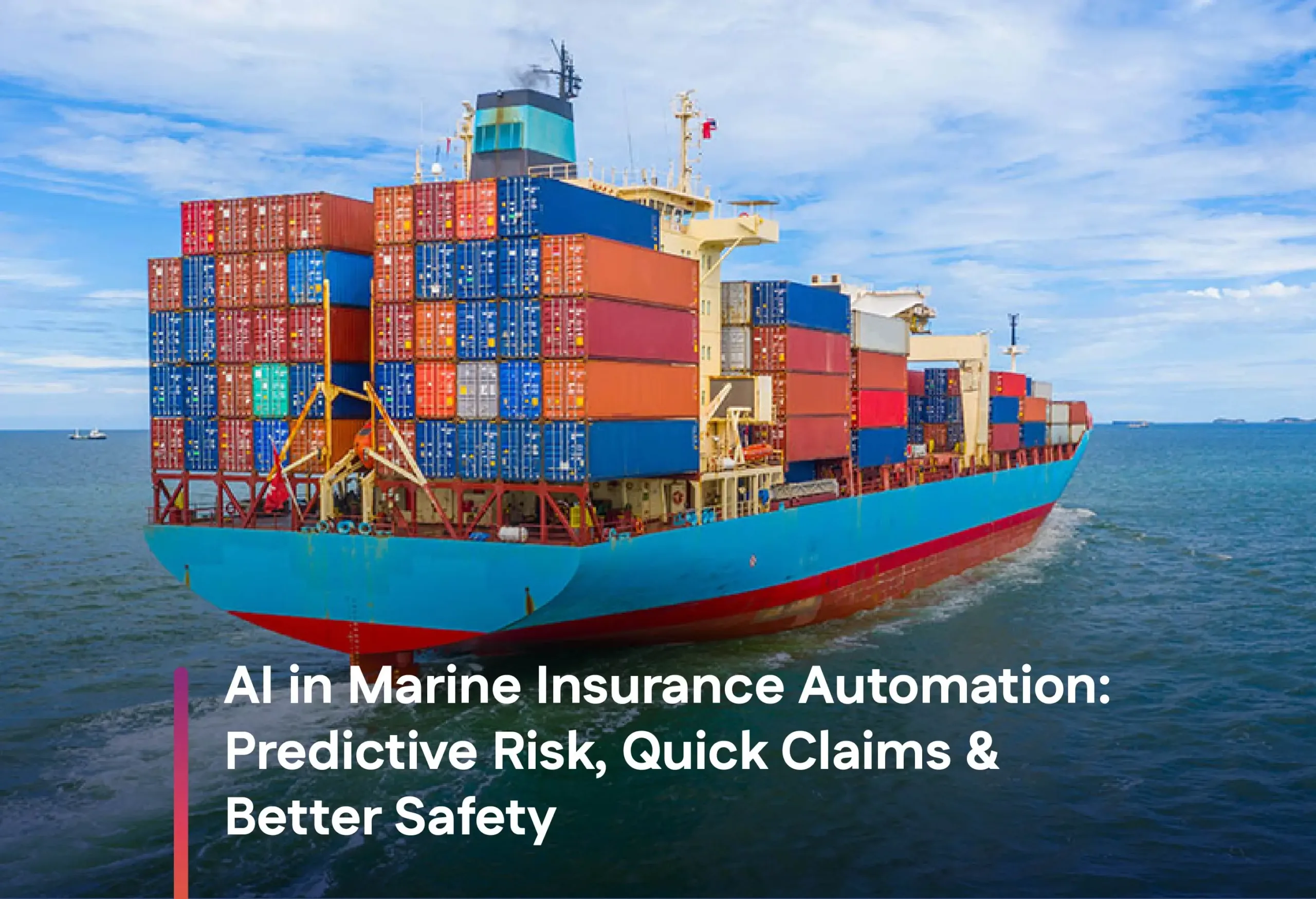
AI in marine insurance is transforming how risks are assessed, how claims are processed, and how underwriting decisions are made. By using real-time data from ship sensors, GPS, weather forecasts, historical logs, and cargo tracking, insurers can improve accuracy, reduce losses, and process claims faster. The global marine insurance market, boosted by AI for risk assessment, reached USD 35 billion in 2024 and is projected to hit USD 45.7 billion by 2033 at a 3% CAGR.
In this blog, you will learn how AI is transforming marine insurance by making risk assessment smarter, claims processing faster, and shipping operations safer. You’ll see how insurers use predictive analytics, vessel data, and weather intelligence to prevent losses, reduce fraud, and improve underwriting accuracy. Marine insurers are increasingly adopting AI for maritime risk assessment, AI for marine claims, computer vision for damage assessment, and predictive fraud alerts to drive efficiency and reduce claim cycle times.
Key Article Takeaways
- AI boosts underwriting accuracy with real-time vessel and weather insights.
- Claims become faster and touchless through automation and computer vision.
- Predictive risk monitoring helps prevent losses before they occur.
- AI reduces fraud by detecting abnormal patterns and documenting inconsistencies.
- Marine insurers gain higher efficiency, lower costs, and better customer satisfaction.
What is AI in Marine Insurance?
AI in marine insurance means applying machine learning, automation, predictive analytics, and computer vision across underwriting, risk assessment, and claims processing to improve marine insurance efficiency. The insurance journey that once depended purely on historical judgment now leverages real-time intelligence.
It analyzes and optimizes:
- Weather patterns
- Automatic Identification System route data
- Vessel IoT condition readings
- Maintenance logs
- Cargo temperature sensors
- Historical claim behavior
This allows insurers to make data-backed dynamic decisions, instead of relying solely on manual processes.
Why Marine Insurance Needs AI Today?
Marine insurance operations are data-heavy and require assessment across thousands of parameters. Manual processing leads to inaccurate pricing, delayed claims, and inability to detect fraud.
AI solves challenges like:
- Underwriting losses from incomplete risk understanding
- Weeks-long claims processing due to document review
- Missed fraud due to lack of historical pattern insights
- Lack of real-time visibility into vessel health and cargo safety
Modern shipping produces massive amounts of data that humans alone cannot process. AI processes this continuously, creating predictive intelligence, reducing underwriting losses, and avoiding claim disputes.
Tip for Leadership: Adopt an AI-first decision framework, aligning underwriting, claims, and customer operations KPIs, to measurable business outcomes (loss ratio, turnaround time, fraud reduction).
Core AI-Driven Processes Transforming Marine Insurance
AI is reshaping marine insurance across underwriting, real-time risk monitoring, fraud detection, claims assessment, and complete claims automation. Each capability improves accuracy, reduces losses, and accelerates service outcomes.
Here are some examples of how AI delivers measurable impact:
-
How AI Improves Underwriting Accuracy in Marine Insurance
Underwriting marine risk is complex, vessel age, previous voyages, route danger, weather severity, port congestion, and maintenance issues. AI brings accuracy by analyzing historical and live data, generating risk scoring models that help insurers price risk better.
AI-powered underwriting enables:
- Smart coverage decisions
- Automated risk categorization
- Dynamic premium pricing
- Customized insurance products
This results in a less loss ratio, fewer mispriced policies, and improved profitability.
Key Underwriting Advantages with AI:
- AI-based Hull & Machinery underwriting
- Real-time risk analytics for routes
- Automated reserve estimations
- Data-driven pricing decisions
-
Real-Time Risk Management With AI
Marine risk is dynamic. Traditional systems only react after damage occurs, leading to costly claims. AI predicts risk before damage happens.
AI evaluates:
- Weather anomalies
- Sea traffic density
- Engine vibration and overheating
- Port disruption signals
- Cargo health parameters
This makes operations safer, reduces loss frequency, and allows insurers to offer proactive risk guidance to customers.
Benefits include:
- Avoid route delays
- Prevent cargo spoilage
- Reduce mechanical failures
- Lower number of claims filed
-
AI-Powered Fraud Detection in Marine Insurance
Fraudulent claims cost marine insurers millions. Fraud often comes disguised as accidental damage, false documentation, or misreported loss (“location-time mismatch”).
AI flags fraud early by:
- Detecting abnormal patterns
- Reviewing historical claim similarities
- Checking weather and timestamp inconsistencies
- Analyzing document anomalies
This reduces fraud exposure and makes claim settlements fair and transparent.
AI-driven fraud detection helps with:
- Predictive fraud alerts
- Network-based fraud correlation
- Automated document integrity checks
-
Computer Vision for Faster Marine Claims Assessment
Marine claims need physical inspection of vessel dents, cargo spoilage, container breakage, and hull corrosion. Traditional inspections are slow and expensive. AI computer vision processes claim photos, drone images, or satellite visuals, providing instant assessment.
It highlights damaged areas, scores of severity, and estimates cost with high accuracy.
Uses of computer vision in marine claims:
- Cargo damage scoring
- Hull corrosion identification
- On-dock visual inspections
- Drone-based vessel scans
This reduces inspection delays, simplifies reporting, and speeds of payout.
-
End-to-End Claims Automation for Marine Insurers
Claims in marine insurance are complex because multiple data sources must be examining cargo logs, route history, photos, sensor data, shipping documents, and maintenance records. AI creates touchless, automated claims workflows.
Automation applies to:
- FNOL intake
- Document verification
- Image-based assessment
- Cross-referencing vessel history
- Claims amount recommendation
Outcomes:
- Shorter settlement time
- Lower administrative effort
- Fewer disputes
- Better documentation quality
Insurers shift from manual request-follow-up cycles to seamless claims flow.
Did You Know?
- The Marine Insurance market will grow from USD 32.31B in 2024 to USD 46.13B by 2032, driven by digital adoption.
- 42% of marine insurers already use AI to speed up claims and catch fraud more accurately.
- 38% of insurers use real-time cargo tracking powered by IoT + AI to prevent loss and detect anomalies.
- AI-based tools help insurers monitor vessel health, route deviations, and safety risks to reduce operational breakdowns.
- Deloitte reports that AI can cut underwriting costs by up to 50%, thanks to advanced pattern recognition and predictive modeling.
Benefits of AI for Underwriting, Claims & Risk Management
AI is not just speed; it brings accuracy, transparency, and proactive oversight.
Overall benefits include:
- Faster claims settlement
- Reduction in underwriting losses
- Real-time preventive risk monitoring
- Lower premium leakage and fraud
- Better pricing with data-driven actuarial inputs
- Improved customer satisfaction
This leads to stronger profitability and minimal operational friction.
Tip for Leadership: Start small with claims automation, prove ROI, then scale to underwriting and fraud.
AutomationEdge Advantage — Turning AI Into Real Outcomes
AutomationEdge provides AI and automation solutions tailored to marine insurers. It brings together workflow automation, computer vision, predictive analytics, and generative AI decision support into one platform.
With AutomationEdge, marine insurers can:
- Automate FNOL and claims intake
- Run computer vision-based cargo assessments
- Implement predictive risk scoring
- Detect fraudulent intent early
- Boost underwriting accuracy
- Engage in end-to-end claims automation
The result is smarter risk assessment, quicker claims settlement, and reduced process costs.
Conclusion
AI is pushing marine insurance into a new era, where underwriting is predictive, claims processing is automated, fraud detection is proactive, and risk monitoring is real-time.
As ships become data-rich platforms, insurers who adopt AI gain a strong competitive edge. With AutomationEdge, insurers can apply AI confidently and scale across underwriting, claims, and risk achieving smarter decisions, faster settlements, and safer shipping.
Frequently Asked Questions
Computer vision analyzes images of damaged vessels, hulls, and cargo, detects issues that humans may miss, and gives accurate severity scores for claims processing.
The post AI in Marine Insurance: Future of Smarter Risk, Faster Claims & Safer Shipping appeared first on AutomationEdge.
What's Your Reaction?
 Like
0
Like
0
 Dislike
0
Dislike
0
 Love
0
Love
0
 Funny
0
Funny
0
 Angry
0
Angry
0
 Sad
0
Sad
0
 Wow
0
Wow
0