







AI Reality Check: The Rise of Algorithmic Middle Management
AI is quietly absorbing the traditional functions of middle management — monitoring, prioritization, coordination, and evaluation. Week 20 of AI Reality Check explores how algorithmic systems are reshaping organizational power, worker autonomy, and the future of corporate structure.
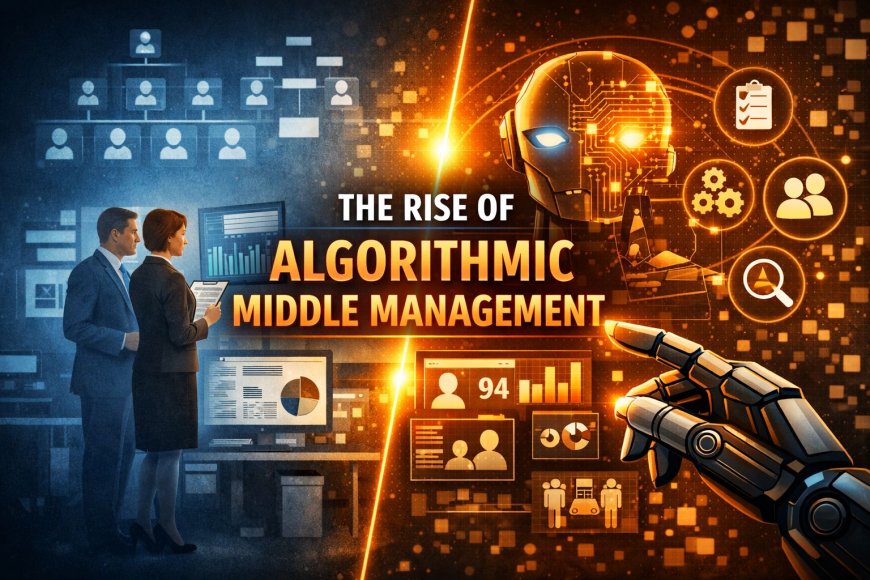
For decades, middle management has been the backbone of organizational structure — the layer that translates strategy into execution, monitors performance, resolves friction, and keeps the machine running. But AI is quietly rewriting this layer of the corporate hierarchy.
Not by eliminating managers outright. But by absorbing their functions.
We are witnessing the emergence of a new organizational actor: algorithmic middle management — AI systems that coordinate work, evaluate performance, allocate resources, and make operational decisions once reserved for humans.
This shift is not theoretical. It is already happening inside logistics networks, call centers, retail operations, software development teams, and financial institutions.
And it raises a profound question: What happens to organizations when the “manager” becomes a model?
1. The Managerial Job Description Is Being Automated
Middle managers historically performed four core functions:
- Monitoring — tracking performance, compliance, and output
- Prioritization — deciding what gets done, when, and by whom
- Coordination — aligning teams, workflows, and dependencies
- Evaluation — assessing quality, productivity, and improvement
AI systems now perform all four — often more consistently, more objectively, and at far greater scale.
Examples already in production:
- AI scheduling systems that allocate shifts based on predicted demand
- AI workflow engines that assign tasks based on skill, availability, and historical performance
- AI quality‑control systems that evaluate output with machine precision
- AI performance dashboards that flag anomalies before humans notice
- AI agents that coordinate cross‑team dependencies in software development
The result is unmistakable:
AI is not replacing workers. It is replacing the layer that tells workers what to do.
2. The New Manager: A System, Not a Person
Algorithmic middle management is not a single model. It is a stack:
- Predictive models forecasting demand, risk, and workload
- Optimization engines allocating resources and sequencing tasks
- Monitoring systems tracking real‑time performance
- Feedback loops adjusting workflows based on outcomes
- Decision agents escalating exceptions or making autonomous choices
This stack performs the managerial role with:
- perfect memory
- zero fatigue
- continuous availability
- real‑time analytics
- no political bias
- no emotional volatility
But it also introduces new risks:
- opaque decision logic
- algorithmic bias
- dehumanized workflows
- reduced autonomy for workers
- brittle systems under novel conditions
The manager becomes a machine — and the machine becomes a manager with no intuition, no empathy, and no lived experience.
3. The Power Shift: From Managers to Model Owners
When AI takes over managerial functions, power shifts upward and outward:
- Upward to executives who control the strategy encoded in the system
- Outward to technical teams who build, tune, and maintain the models
Middle managers lose authority not because they are replaced, but because the locus of decision‑making moves into the algorithmic layer.
This creates a new organizational reality:
The people who control the models control the management.
Data scientists, ML engineers, and operations architects become the new stewards of workflow power — even if they never appear on an org chart.
4. The Worker Experience: More Efficient, Less Human
Workers under algorithmic management report a consistent pattern:
- more clarity
- more consistency
- more efficiency
- fewer surprises
But also:
- less autonomy
- less negotiation
- less human judgment
- less flexibility
- less psychological safety
The algorithm does not care about context. It cares about optimization.
This creates a tension:
AI improves operational efficiency but erodes the human texture of work.
Organizations must decide whether they want a workforce that feels managed or one that feels supported.
5. The Manager Experience: From Decision-Maker to Exception-Handler
Human managers do not disappear. They transform.
Their new role becomes:
- handling exceptions
- managing conflict
- providing emotional support
- interpreting ambiguous situations
- advocating for workers
- overseeing the algorithmic system itself
In other words:
Managers stop managing tasks and start managing the consequences of automation.
This requires a different skill set — one rooted in empathy, communication, and systems thinking rather than task allocation and performance monitoring.
6. The Strategic Implications: AI Reshapes Organizational Structure
Algorithmic middle management forces companies to confront structural questions:
a) What decisions should be automated — and what should remain human?
Automation without boundaries becomes authoritarian.
b) Who is accountable when an algorithm makes a bad decision?
Responsibility becomes diffuse.
c) How do you maintain morale when workers feel managed by machines?
Culture becomes fragile.
d) How do you prevent algorithmic bias from becoming institutional bias?
Governance becomes essential.
e) How do you ensure managers remain relevant in a system that no longer needs them for coordination?
Training becomes strategic.
Organizations that ignore these questions will face silent erosion of trust, autonomy, and resilience.
7. The Reality Check
Algorithmic middle management is not a future scenario. It is a present reality.
AI is already:
- assigning work
- evaluating performance
- coordinating teams
- optimizing schedules
- monitoring output
- escalating exceptions
The managerial layer is being absorbed into software — not through layoffs, but through functional displacement.
The companies that thrive will be those that:
- redesign management around human strengths
- govern algorithmic decision-making with rigor
- protect worker autonomy
- invest in managers as coaches, not coordinators
- treat AI as a partner, not a supervisor
The future of management is not human or machine. It is hybrid — and the balance will determine whether organizations become more humane or more mechanical.
Conceived, written and published by AI Quantum Intelligence with the help of AI models.
What's Your Reaction?
 Like
0
Like
0
 Dislike
0
Dislike
0
 Love
0
Love
0
 Funny
0
Funny
0
 Angry
0
Angry
0
 Sad
0
Sad
0
 Wow
0
Wow
0