












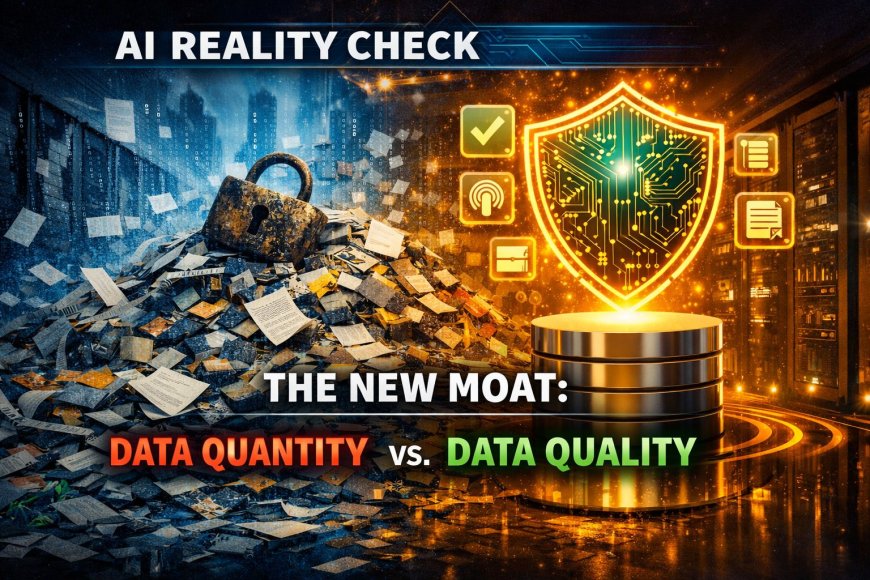
AI Reality Check: The New Moat - Why Data Quality Beats Data Quantity
As synthetic content rises and the open web degrades, clean, verified, domain specific data becomes the defining advantage in AI. The next decade belongs to those who curate better, not scrape more.
AI Reality Check — AI in the Real World: Business, Economics, and Power
The Takeaway
The next competitive advantage in AI won’t come from who has the most data — it will come from who has the cleanest, most accurate, most context‑rich, and most provenance‑verified data. The era of “just scrape more” is over. The era of “curate better” has begun.
For the past decade, the AI industry has been obsessed with scale. More parameters. More compute. More data. The implicit belief was simple: if you feed a model enough information, intelligence will emerge. And for a while, that belief held up. Bigger models trained on bigger datasets produced undeniably impressive results.
But in 2025 and now into 2026, the cracks in that philosophy are no longer cracks — they’re fault lines. Companies are discovering that data quantity is no longer the moat it once was. The world has been scraped. The internet is saturated. Synthetic data is flooding the ecosystem. And the marginal returns of “more” are collapsing.
The new moat — the one that will define the next generation of AI winners — is data quality.
1. The Internet Is No Longer a Reliable Training Ground
For years, the open web was the AI industry’s free buffet. But that buffet is now spoiled.
- Content farms and SEO sludge dominate search results
- Synthetic content is multiplying faster than human content
- Misinformation and hallucinated facts are being re‑ingested into training pipelines
- Copyright restrictions and paywalls are shrinking the usable corpus
The result: Models trained on the open web are increasingly learning from a polluted, self‑referential, low‑signal environment.
Quantity is no longer abundance — it’s noise.
2. Synthetic Data Is a Double‑Edged Sword
Synthetic data was supposed to be the savior: infinite, cheap, customizable.
Instead, it introduced a new existential risk: model collapse — the phenomenon where models trained on synthetic outputs become less diverse, less accurate, and more brittle over time.
Synthetic data is powerful when used intentionally. It is catastrophic when used indiscriminately.
The companies that win will be the ones who treat synthetic data like a precision instrument, not a firehose.
3. High‑Quality Data Is Becoming the Most Valuable Asset in AI
The most advanced AI labs have quietly shifted strategy. They’re no longer bragging about dataset size. They’re bragging about dataset purity.
High‑quality data has specific characteristics:
- Verified provenance — you know where it came from
- Human‑generated — not synthetic sludge
- Domain‑specific — not generic internet text
- Context‑rich — includes metadata, structure, and meaning
- Legally clean — licensed, owned, or created in‑house
- Continuously refreshed — not static snapshots of the past
This is the data that produces models that are more accurate, more reliable, more controllable, and more aligned with real‑world use cases.
This is the data that becomes a moat.
4. The New Power Players Are the Ones Who Control Clean Data Pipelines
In Q1, the AI oligopoly formed around compute and capital. In Q2, the power shift is moving toward data governance and data curation.
The companies with the strongest moats will be those that:
- Own proprietary, high‑fidelity datasets
- Have exclusive access to industry‑specific data streams
- Maintain rigorous data cleaning and validation pipelines
- Build human‑in‑the‑loop systems for continuous refinement
- Invest in data provenance, watermarking, and authenticity verification
This is why industries like healthcare, finance, law, and scientific research are becoming battlegrounds. Not because they have more data — but because they have better data.
5. The Economic Shift: Quality Data Is Becoming a Premium Commodity
We are entering a world where:
- High‑quality datasets will be licensed like intellectual property
- Data provenance will be audited like financial statements
- Clean data will command premium pricing
- Enterprises will compete to secure exclusive data partnerships
- Governments will regulate data quality as a matter of national interest
Data is no longer the new oil. Clean data is the new lithium — scarce, valuable, and strategically essential.
6. Why This Matters for Businesses
Most organizations still believe they need “more data” to compete with frontier AI labs. They don’t.
They need:
- Better labeling
- Better metadata
- Better governance
- Better domain expertise
- Better curation
A small, high‑quality dataset can outperform a massive, messy one — especially in enterprise use cases where accuracy, reliability, and compliance matter more than raw generative power.
The organizations that understand this will build AI systems that are not only more effective, but also more defensible.
7. The Strategic Imperative for 2026–2030
The next era of AI will be defined by:
- Data authenticity
- Data scarcity
- Data rights
- Data curation
- Data governance
The winners will be those who treat data not as an exhaust, but as an asset. Not as a commodity, but as a craft. Not as a volume game, but as a quality discipline.
The moat is shifting. And the companies that recognize this shift early will own the next decade of AI.
Key References
- Stanford HAI — AI Index Report (2024–2025): Highlights the growing risks of synthetic data contamination and the plateauing benefits of scale.
- MIT Technology Review: Coverage on model collapse and the dangers of training on synthetic outputs.
- Nature & Science Journals: Peer‑reviewed studies on data quality, bias, and the impact of dataset curation on model performance.
- OECD & EU AI Act Documentation: Regulatory frameworks emphasizing data governance, provenance, and quality standards.
- OpenAI, Anthropic, Google DeepMind Technical Reports: Increasing focus on curated, proprietary, and human‑verified datasets.
Conceived, written and published by AI Quantum Intelligence with the help of AI models.
What's Your Reaction?
 Like
0
Like
0
 Dislike
0
Dislike
0
 Love
0
Love
0
 Funny
0
Funny
0
 Angry
0
Angry
0
 Sad
0
Sad
0
 Wow
0
Wow
0