






The Myth of the Perfect Human — And Why AI’s Critics Keep Comparing It to a Fantasy
This op-ed challenges the flawed comparisons used to resist AI, exposing human bias, mythologized expertise, and why AI often sees what people overlook.
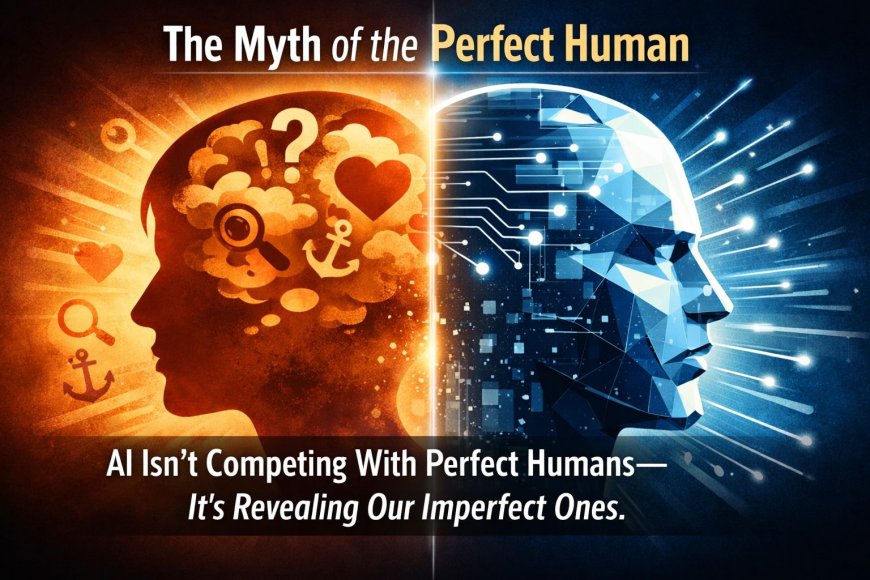
When you take a closer look, there seems to be a strange pattern in the arguments against AI adoption. Critics rarely compare AI to the average human worker, the typical analyst, the mid‑career manager, or the overworked specialist juggling competing priorities. Instead, they compare AI to an imaginary human — the flawless expert, the omniscient researcher, the unbiased decision‑maker who never gets tired, never gets political, never gets territorial, never gets stuck in their own experience.

This mythical human is the benchmark. And AI, unsurprisingly, falls short.
But here’s the uncomfortable truth: humans fall short of that benchmark too — catastrophically so — and far more often.
Resistance to AI may not really be about AI’s limitations. It’s about the stories we tell ourselves about human capability, human objectivity, and human consistency. Stories that collapse the moment we examine them.
1. The “Human Gold Standard” Is a Fiction We Use to Avoid Hard Questions
When critics say AI is “biased,” they are correct — but incomplete. Bias is not an AI problem. Bias is a data problem, and humans are data‑processing systems too.
- Doctors misdiagnose patients at rates far higher than AI diagnostic models.
- Judges show measurable sentencing bias based on race, gender, and even time of day.
- Hiring managers consistently favour candidates who resemble themselves.
- Analysts anchor on their first assumption and defend it long after evidence contradicts it.
Yet when AI exhibits bias, the reaction is moral outrage. When humans exhibit bias, the reaction is: “Well, that’s just how people are.”
This asymmetry reveals the real issue: AI is held to a standard of perfection that humans do not meet, have never met, and cannot meet.
2. Human Expertise Is Not the Neutral, Objective Force We Pretend It Is
One of the most persistent myths in the anti‑AI narrative is that human experts operate from a place of pure logic and domain mastery. But research across behavioural economics, cognitive psychology, and organizational science paints a different picture:
- Experience increases confidence faster than accuracy.
- Experts become more rigid over time, not less.
- Domain knowledge narrows perspective, reducing the ability to see cross‑disciplinary patterns.
- Motivations distort judgment — career incentives, political pressures, personal identity, and organizational culture all shape decisions.
AI’s critics often say: “AI can’t understand context.”
But humans misunderstand context constantly — especially when the context contradicts their worldview.
AI’s flaw is visible. Human flaws are familiar, so we forgive them.
3. AI’s Real Advantage: It Doesn’t Share Our Blind Spots
This is where insight and thoughtful introspection becomes crucial: AI is not limited by the same cognitive architecture that limits humans.
Humans reason vertically — deep within their domain. AI can reason horizontally — across domains, across patterns, across analogies humans would never think to connect.
A human supply‑chain expert might never consider insights from epidemiology. A human financial analyst might never borrow frameworks from ecology. A human policy advisor might never apply lessons from robotics.
AI does this effortlessly.
Not because it is “creative” in the human sense, but because it is not constrained by the boundaries of human experience.
This is why AI often produces “out‑of‑the‑box” thinking: It has no box.
4. The Real Threat AI Poses: It Exposes How Much of Our Work Isn’t Actually Expert Work
AI doesn’t just automate tasks. It reveals how many tasks were never truly “expert” to begin with.
- Summaries
- Drafts
- First‑pass analysis
- Pattern recognition
- Scenario generation
- Risk flagging
- Cross‑domain analogy
- Data‑driven recommendations
These are not the pinnacle of human cognition. They are the scaffolding around it — the repetitive, error‑prone, bias‑laden work humans do because we lack the time, energy, or cognitive bandwidth to do better.
AI’s presence forces a reckoning: If a model can do 60% of your job better than you, was that 60% ever “expertise”?
This is not a threat. It is an opportunity — if we are willing to see it.
5. The Fear of AI Is Often a Fear of Losing the Illusion of Human Superiority
The most honest critics of AI are not the ones who say “AI is dangerous.” They are the ones who say, implicitly or explicitly:
“I don’t want to confront the possibility that my expertise is narrower, more biased, and more fragile than I believed.”
AI challenges the mythology of human exceptionalism. Not by replacing humans, but by revealing the limits we prefer not to acknowledge.
Humans are not objective. Humans are not consistent. Humans are not unbiased. Humans are not omniscient.
AI doesn’t need to be perfect to be useful. It only needs to be less flawed than the alternative.
And in many domains, it already is.
6. The Future Isn’t AI vs Humans — It’s Humans Who Embrace AI vs Humans Who Don’t
The real divide emerging is not between AI and humanity. It is between:
- Humans who use AI to expand their cognitive range, and
- Humans who cling to the illusion that their experience alone is enough.
The first group will see patterns others miss. They will generate ideas others never consider. They will operate with a breadth and depth that no unaided human can match.
The second group will insist that AI “can’t do what they do,” right up until the moment it does.
7. The Call to Action: Stop Comparing AI to the Best Humans — Compare It to the Real Ones
If we want a meaningful conversation about AI’s role in society, we must abandon the fantasy comparison.
The real question is not: “Is AI as good as the best human expert on their best day?”
The real question is: “Is AI better than the average human on an average day, working with average information, under average constraints?”
And increasingly, the answer is yes.
Not because AI is perfect. But because humans aren’t.
Conceived, edited and published by AI Quantum Intelligence with the help of AI models.
What's Your Reaction?
 Like
1
Like
1
 Dislike
0
Dislike
0
 Love
1
Love
1
 Funny
0
Funny
0
 Angry
1
Angry
1
 Sad
0
Sad
0
 Wow
0
Wow
0
Related Posts
-
 DilonDemande