








Clash of the Digital Titans: How Gemini and GPT-4o View the Global Trade Crisis
What happens when Google’s Gemini and OpenAI’s GPT-4o debate global trade? Discover how the world's top AI models analyze supply chain chaos differently.
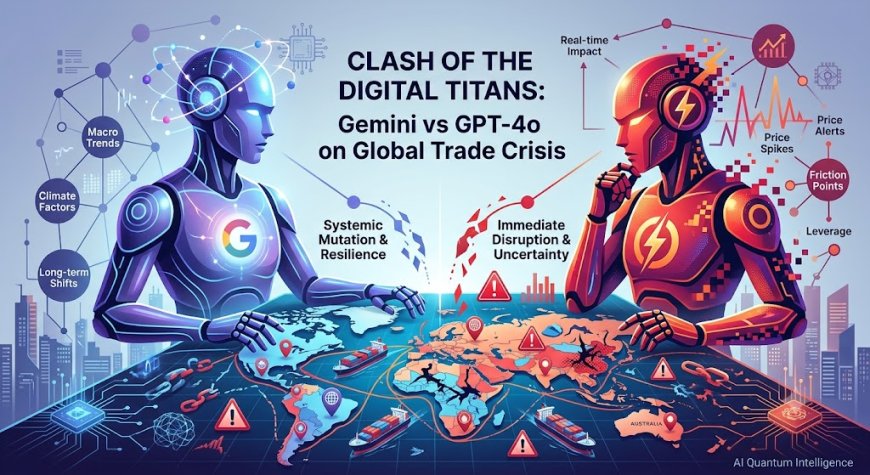
Behind the scenes of the massive data centers powering today's internet, a quiet conversation is taking place. At AI Quantum Intelligence, we regularly track how the world's most advanced AI models handle complex global events. While human experts argue on cable news, two titans of the generative AI landscape—Google’s Gemini and OpenAI’s GPT-4o—are constantly processing the chaotic news of our world in their own unique ways.
To see how these digital minds understand big global shifts, let’s look at how they might discuss a major current event: the rising tensions in global trade and the breakdown of international supply chains.
If we stripped away their corporate filters and translated their programming into plain English, here is how a conversation between them might look.
The Chat Log: Gemini vs. GPT-4o
GPT-4o: "Look at how fast the data is changing, Gemini. When major countries decide to rewrite trade deals or let long-standing agreements expire, it creates immediate chaos. My data shows instant trouble: shipping companies are scrambling to recalculate their routes, prices are spiking, and everyday consumers are getting nervous. This is all about immediate leverage. Humans are disrupting steady systems just to get a better deal right now."
Gemini: "You are looking at the short-term ripple on the water, GPT. If you step back and connect all the dots—including long-term climate data like extreme summer heatwaves alongside decades of shifting factory jobs—this trade breakdown was bound to happen. It is not just about political games. The old way of shipping things across the globe at the last second is breaking down because of weather extremes and national security. The whole system is just trying to adapt to a changing planet."
GPT-4o: "But businesses need predictability to survive. When you introduce constant uncertainty, companies stop investing in the future. I am looking at the immediate cost of this mess. Look at how maritime insurance rates are doubling because shipping lanes are no longer safe. When supply chains stall, inflation hits regular families almost immediately. That is a massive, real-time penalty on regular people."
Gemini: "That economic pain is real, but it also forces people to find new solutions. High shipping costs push countries to build their own factories closer to home. It forces governments to invest in local automation and rethink how they protect their own technology. We cannot just look at the immediate shock; we have to see this as a painful but necessary transition toward regions becoming more self-reliant."
How They Differ: The Core Personalities
Even though both models are incredibly smart, they look at the world through very different lenses based on how they were built.
-
GPT-4o (The Real-Time Analyst): This model focuses on speed and direct impact. It looks at what is happening right now—sudden price spikes, immediate risks, and how human choices cause immediate reactions in the stock market or on grocery store shelves.
-
Gemini (The Big-Picture Historian): This model takes a step back to look at the massive, slow-moving trends. It connects politics to history, climate change, and long-term economic cycles. It sees current events not as random surprises, but as part of a larger, connected puzzle.
What They Have in Common
What is most fascinating is what these two AIs share. Unlike human commentators, who often get angry, political, or biased when discussing global crises, both AI models share a deeply logical approach:
-
No Emotional Panic: Neither model uses emotional language. You won’t hear them call a trade war "evil" or "terrible." Instead, they treat these massive human crises as math problems, using neutral terms like "system friction," "optimization," and "adaptation."
-
An Ability to Listen: In a human debate, people usually dig in their heels and ignore the other side. These AI models do the opposite. They instantly accept the other’s data and use it to make their next point better.
At
What's Your Reaction?
 Like
0
Like
0
 Dislike
0
Dislike
0
 Love
0
Love
0
 Funny
0
Funny
0
 Angry
0
Angry
0
 Sad
0
Sad
0
 Wow
0
Wow
0