















Cost Savings by RPA in Accounting: Why Enterprises Are Automating Finance
Why Accounting Teams in 2026 Cannot Rely on Spreadsheets Anymore!
Accounting teams manage higher data volumes, tighter close timelines, and stricter compliance requirements. Yet spreadsheets are still widely used for core accounting tasks. As per the IMA report, around two-thirds of financial analysts say heavy reliance on spreadsheets increases both reporting time and the risk of inaccurate results.
With changing accounting standards, complex cell linking, frequent input errors, and manual reconciliation challenges, spreadsheet-based accounting has become risky and outdated. This is why RPA in accounting and AI-powered accounting automation are no longer optional in the future; they are essential.
In this blog, we will discuss how RPA and AI are transforming accounting operations by automating high-volume, rule-based processes such as
- Account payable/receivable
- Journal Entry
- Account Reconciliation
- Financial Closure
You’ll learn why spreadsheet-driven accounting is no longer sustainable, how RPA and Agentic AI unlock speed and accuracy, key use cases delivering measurable ROI, and emerging trends shaping accounting automation.
Key Article Takeaways
- AI-powered automation accelerates month-end close and strengthens audit readiness.
- Automated AP and AR improve cash flow visibility and reduce operational bottlenecks.
- Agentic AI enables intelligent, self-correcting accounting workflows.
- End-to-end automation delivers scalable finance operations without heavy IT effort.
How RPA and Agentic AI Transform Accounting Workflows
The implementation of Robotic Process Automation (RPA) and the emerging Agentic AI in accounting can significantly enhance end-to-end efficiency. Unlike humans affected by fatigue or workload fluctuations, RPA bots operate with consistent accuracy and maintain peak performance, driving operational excellence in finance and accounting.
This ensures:
- Predictable and error-free output
- Standardized accounting workflows
- Faster accounting and close cycles
- More accurate financial forecasting
With AI-powered accounting automation, RPA bots can now understand context, extract unstructured data, and make assisted decisions, freeing accountants to focus on strategic, value-driven work.
How to Unlock Maximum Value from Accounting Automation
To get real ROI from RPA in accounting, companies must move beyond task-level automation. Unlocking maximum value from accounting automation involves automating repetitive tasks like accounts payable and reconciliation to boost efficiency, cut costs, and enable strategic focus.
Agentic AI also contributes by using smart, autonomous agents that reason, adapt, and decide, like detecting fraud patterns or applying tax rules in real-time, elevating RPA from rigid bots to dynamic systems that slash close times by up to 50% and improve accuracy.
When deployed through an orchestration engine like AutomationEdge, AI agents act like virtual project managers—intelligently coordinating actions across systems, teams, and technologies for judgment-intensive workflows in month-end close, accounts payable, accounts receivable, and more.
AI agents can scan ledgers, flag human errors, and spot unusual transactions that might otherwise go unnoticed—accelerating close times by 30-50% and turning the month-end close into a faster, more value-driven activity.
Accounting AI agents can also handle complex tasks such as intercompany eliminations, multi-entity consolidations, and currency conversions, continuously learning from historical data and working alongside APIs and bots to reduce risk and improve accuracy.
Key Steps to Maximize ROI from Accounting Automation:
- Mapping existing accounting processes
- Identifying high-volume, rule-based activities
- Integrating RPA with ERP and finance systems
- Adding intelligence using AI/ML or Agentic AI
- Building a phased automation roadmap
Quick Stat: Over 70% of finance errors come from spreadsheet dependency. RPA eliminates this by automating data entry, validation, and reconciliation.
Key RPA Use Cases in Accounting
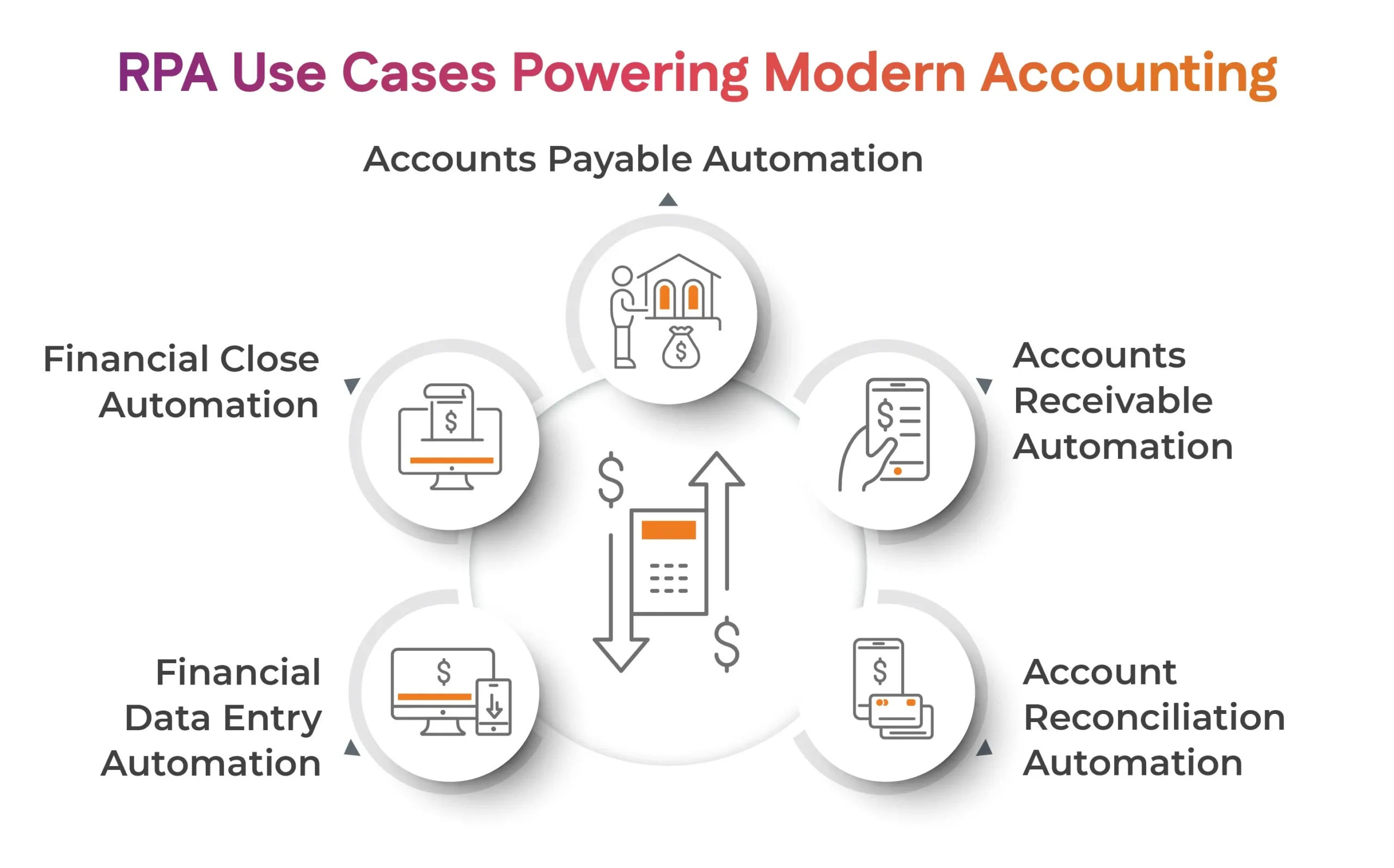
Accounting teams deal with repetitive, time-consuming tasks that demand high accuracy. Robotic Process Automation (RPA) helps automate these activities, improve efficiency, and reduce operational costs. Below are practical examples of how RPA simplifies core accounting processes.
Key RPA Use Cases in Accounting
-
Accounts Payable (AP) Automation:
RPA automates invoice receipt, data extraction, purchase order matching, and payment processing. Using OCR, bots capture vendor details, invoice amounts, and due dates, reducing paperwork and ensuring timely payments.
Want to Streamline the Accounts Payable Processing? Read Here!
-
Accounts Receivable (AR) Automation:
RPA streamlines invoice generation, approval routing, payment tracking, and customer notifications. This improves billing accuracy, speeds up collections, and reduces manual follow-ups.
-
Account Reconciliation Automation:
Bots automatically compare invoices, bank statements, and transaction records as part of account reconciliation automation. RPA highlights mismatches in real time, reducing spreadsheet dependency and reconciliation errors.
-
Financial Data Entry:
RPA extracts and validates data from emails, spreadsheets, and legacy systems, then updates ERP systems instantly. This eliminates manual data entry and improves data consistency.
-
Financial Close Automation:
RPA automates data consolidation, checklist validation, variance checks, and reporting. This shortens the financial close cycle and improves reporting accuracy.
How Companies Should Approach Accounting Automation
-
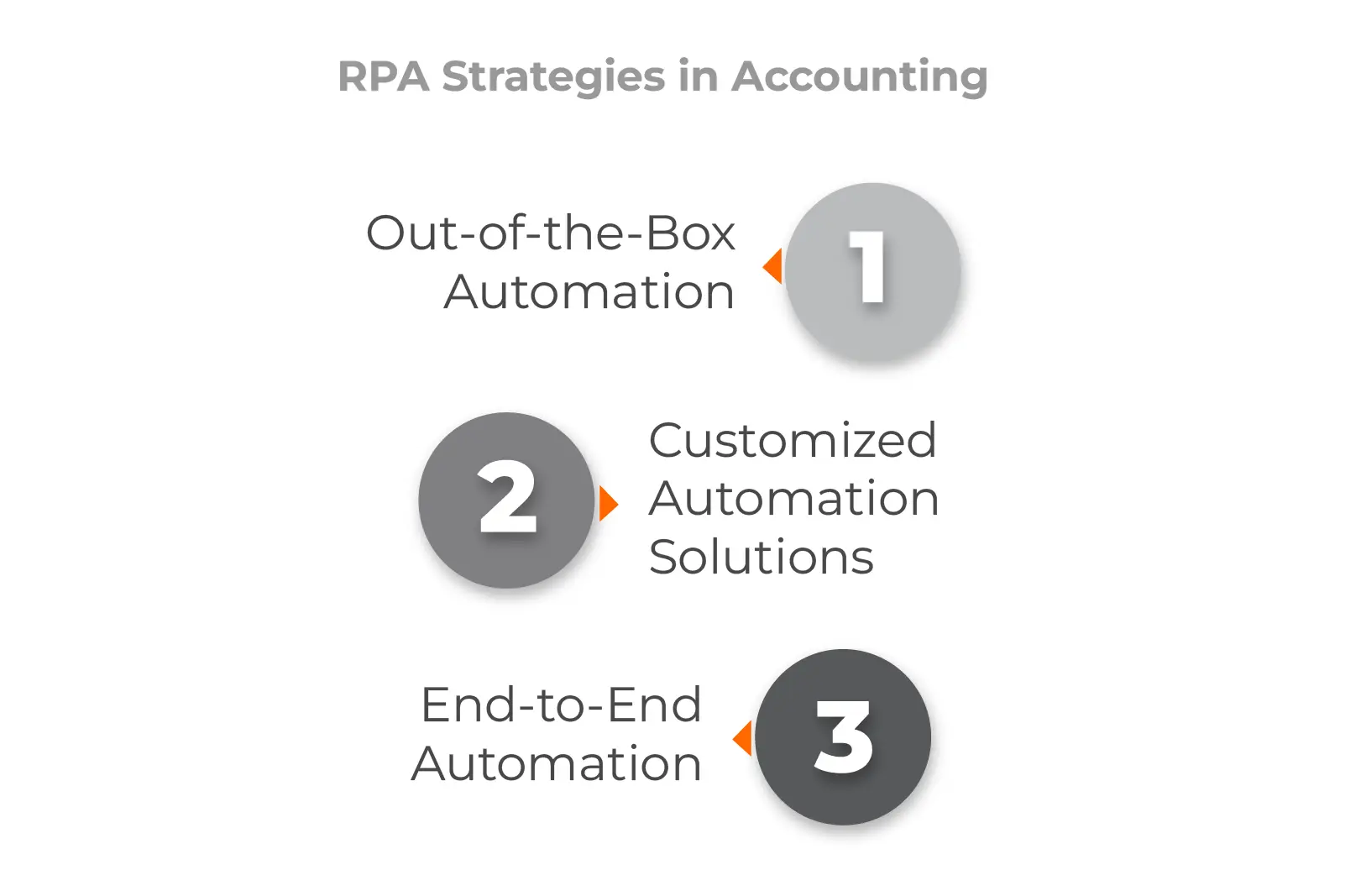
Out-of-the-Box Automation:
Rule-based RPA handles high-volume tasks efficiently. When combined with AI, automation can understand context, assist decisions, and generate reports automatically.
-
Customized Automation:
With RPA-as-a-Service (RPAaaS), organizations can deploy tailored automation without high upfront costs, ensuring flexibility and predictable pricing.
-
End-to-End Automation:
Successful automation starts small and scales. An end-to-end approach includes readiness assessment, solution design, change management, and roadmap creation.
Execution Tip: Start with out-of-the-box RPA for quick wins, then layer AI and Agentic AI for decision-making, and scale through RPA-as-a-Service with a clear end-to-end roadmap to maximize ROI and long-term automation maturity.
Benefits of RPA in Accounting
-
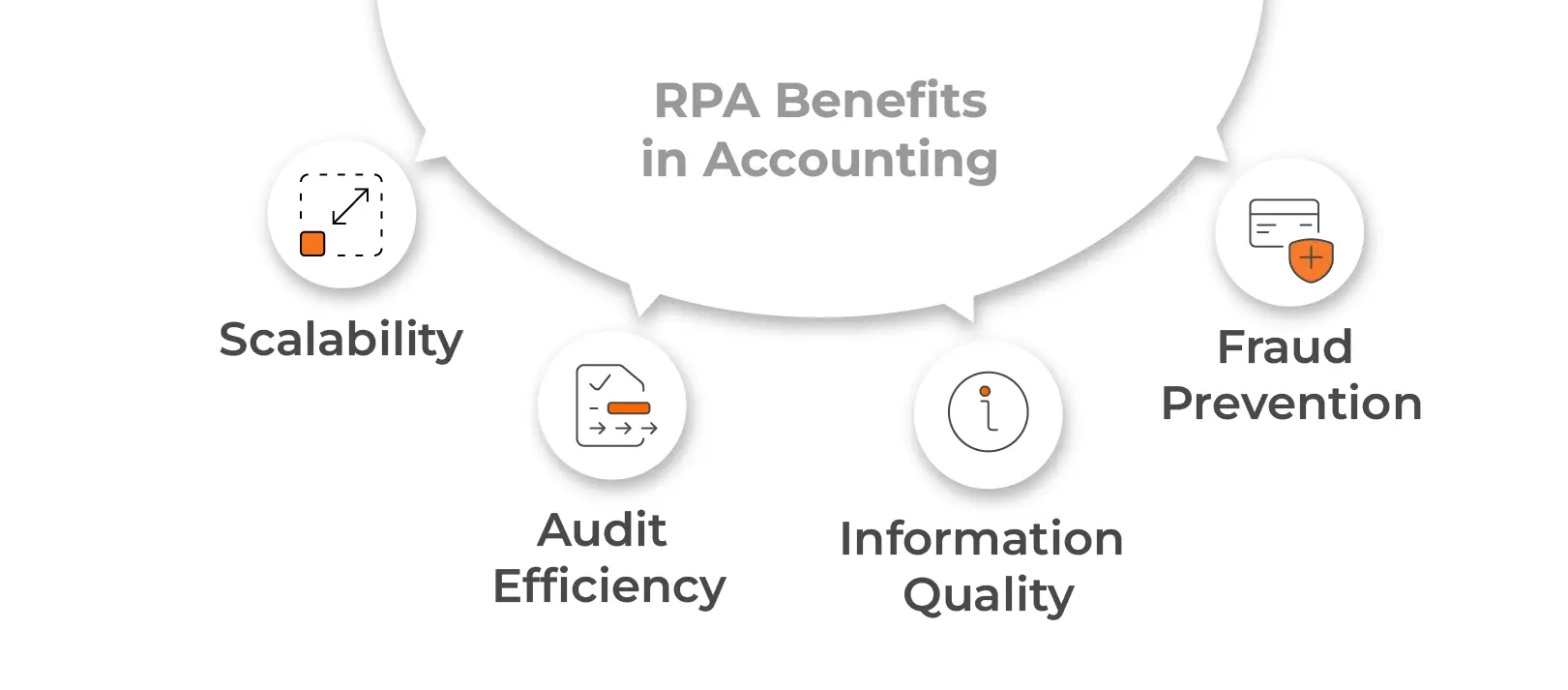
Reduced Fraud Risk:
RPA combined with AI detects unusual or suspicious transactions early, strengthening fraud prevention.
-
Higher Data Accuracy:
Automation eliminates manual errors and provides real-time, reliable financial data.
-
Faster Audits:
Bots collect and organize audit data automatically, improving audit speed and transparency.
-
Scalable Operations:
By handling repetitive tasks, RPA frees teams to focus on strategic finance work and supports business growth.
Leadership Tip: Move beyond task automation by deploying Agentic AI bots that can plan, decide, and self-correct, enabling finance teams to proactively detect risks, adapt to exceptions, and run truly autonomous accounting workflows.
How RPA Improves Accuracy in Accounting Processes
RPA boosts accounting accuracy by eliminating manual errors and enforcing consistent, rule-based execution. Operating up to 745% faster than humans, RPA bots extract invoice data, match it with purchase orders, and process payments with precision—no rekeying, no guesswork. By automating high-volume, repetitive tasks, RPA delivers cleaner financial data, stronger compliance, and frees accountants to focus on higher-value, strategic work.
Future RPA Trends in Accounting: What’s Next?
The next phase of RPA in accounting will be shaped by AI, agentic automation, autonomous workflows, and real-time financial intelligence. Below are the key RPA trends accountants should prepare for.
Key trends to watch:
| Future RPA Trend in Accounting | What It Means | Business Impact |
|---|---|---|
| Agentic AI Accounting Bots | Bots that can plan, reason, act, and self-correct autonomously | Higher automation maturity with minimal human intervention |
| Hyperautomation in Finance | Combined use of RPA, AI, OCR, iPaaS, and workflow tools | Faster, end-to-end finance processes with fewer handoffs |
| Autonomous Financial Close | AI-driven, end-to-end month-end close automation | Shorter close cycles and improved reporting accuracy |
| Predictive Cash Flow Automation | Bots predict AR collections and AP cycles in advance | Better cash visibility and proactive risk management |
| Touchless Accounting | Fully hands-free processing of invoices, receipts, and reconciliations | Lower costs and near-zero manual errors |
| AI-driven Risk & Fraud Monitoring | Continuous real-time monitoring of financial anomalies | Early fraud detection and stronger compliance |
| Conversational Accounting Assistants | AI chatbots answering real-time finance queries | Faster decision-making for finance leaders |
| RPA-as-a-Service for SMEs | Subscription-based automation without heavy ERP investments | Faster adoption and scalable automation |
| RPA + Blockchain for Audits | Tamper-proof financial records and ledgers | Improved audit readiness and fraud prevention |
What Makes AutomationEdge Ideal for RPA in Accounting?
AutomationEdge offers an intelligent automation platform that combines RPA, generative AI, OCR, machine learning, and IT Automation to automate accounting workflows from end to end. Finance teams use AutomationEdge to automate high-volume accounting processes like invoice processing, vendor management, reconciliation, and financial close without redesigning existing systems.
Key capabilities include:
- Pre-built finance bots for AP, AR, journal entries, reconciliation, and financial close
- AI-driven data extraction from invoices, PDFs, and scanned documents
- End-to-end workflow automation from data capture to ERP posting
- Conversational AI for accounting and finance queries
- Seamless ERP integrations (SAP, Oracle, NetSuite, QuickBooks, Zoho)
- Proactive fraud detection and compliance monitoring
Why AutomationEdge for accounting automation?
- Reduces invoice processing time by up to 80%
- Cuts manual work and errors by 70–90%
- Improves reconciliation accuracy
- Ensures faster, more reliable month-end close
- Scales finance automation without heavy IT effort
Will RPA Replace Accountants?
No—RPA won’t replace accountants; it will empower them. RPA automates repetitive, rule-based tasks like invoice matching and payment processing, freeing accountants to focus on analysis, decision-making, and strategic insights.
While bots handle the work, accountants provide the judgment, context, and business intelligence automation can’t replicate. By embracing RPA, finance professionals boost efficiency, accuracy, and impact—shifting from task execution to value creation.
Conclusion:
RPA in accounting is no longer a future concept; it’s a necessity for finance teams facing growing data volumes, tighter deadlines, and stricter compliance. By automating AP, AR, reconciliation, and financial close, organizations can reduce errors, accelerate cycles, and unlock real operational efficiency.
When combined with AI and Agentic AI, RPA moves beyond task automation to deliver intelligent, end-to-end accounting workflows. AutomationEdge helps finance teams achieve this transformation quickly and at scale, without disrupting existing systems. If you’re ready to cut manual work, improve accuracy, and modernize your accounting operations, talk to our experts and start your accounting automation journey today.
Frequently Asked Questions
Cost savings by RPA in accounting typically range from 30–70%, driven by reduced manual effort, faster processing, fewer errors, and lower audit and rework costs.
The post Cost Savings by RPA in Accounting: Why Enterprises Are Automating Finance appeared first on AutomationEdge.
What's Your Reaction?
 Like
0
Like
0
 Dislike
0
Dislike
0
 Love
0
Love
0
 Funny
0
Funny
0
 Angry
0
Angry
0
 Sad
0
Sad
0
 Wow
0
Wow
0