












From Heuristics to Hyper-Intelligence: Why AI Risk Processing Is the New Brand Currency
From data warehouses and heuristic rules to generative AI, risk processing has evolved into a brand-defining capability. This op-ed explores how financial institutions can reframe AI underwriting, fraud detection, and secure transaction analysis as storytelling opportunities—positioning trust, speed, and fairness as the new brand currency.
For decades, risk management in finance and insurance was a game of averages. Data warehouses hummed quietly in the background, storing terabytes of transactional records. Analysts built heuristic, rules-based systems that could flag anomalies—if a claim exceeded a certain threshold, if a loan applicant’s debt-to-income ratio crossed a red line, if a payment originated from a flagged geography. These systems were clever for their time, but they were blunt instruments. They treated risk as static, predictable, and one-dimensional.
Then came the revolution. Machine learning cracked open the possibility of dynamic, adaptive models. Natural language processing allowed institutions to mine unstructured text—social media chatter, claim narratives, customer reviews—for signals of intent and behavior. Big data farms and distributed computing made it possible to analyze millions of disparate data points in real time. And now, generative and agentic AI toolsets have taken the leap further: not just analyzing risk, but contextualizing it, simulating scenarios, and recommending actions with a speed and nuance that human underwriters could never match.
The Technical Evolution
- Data Warehousing & Analytics: The backbone of early risk systems, enabling structured storage and batch analysis.
- Heuristic Rules-Based Processing: The first attempt at automation—if X, then Y logic that reduced manual review but lacked adaptability.
- Machine Learning & NLP: The shift from static rules to adaptive models, capable of learning patterns and interpreting human language.
- Generative & Agentic AI: Today’s frontier, where models synthesize insights across structured and unstructured data, simulate outcomes, and act as decision-support agents.
Risk Processing as a Branding Opportunity
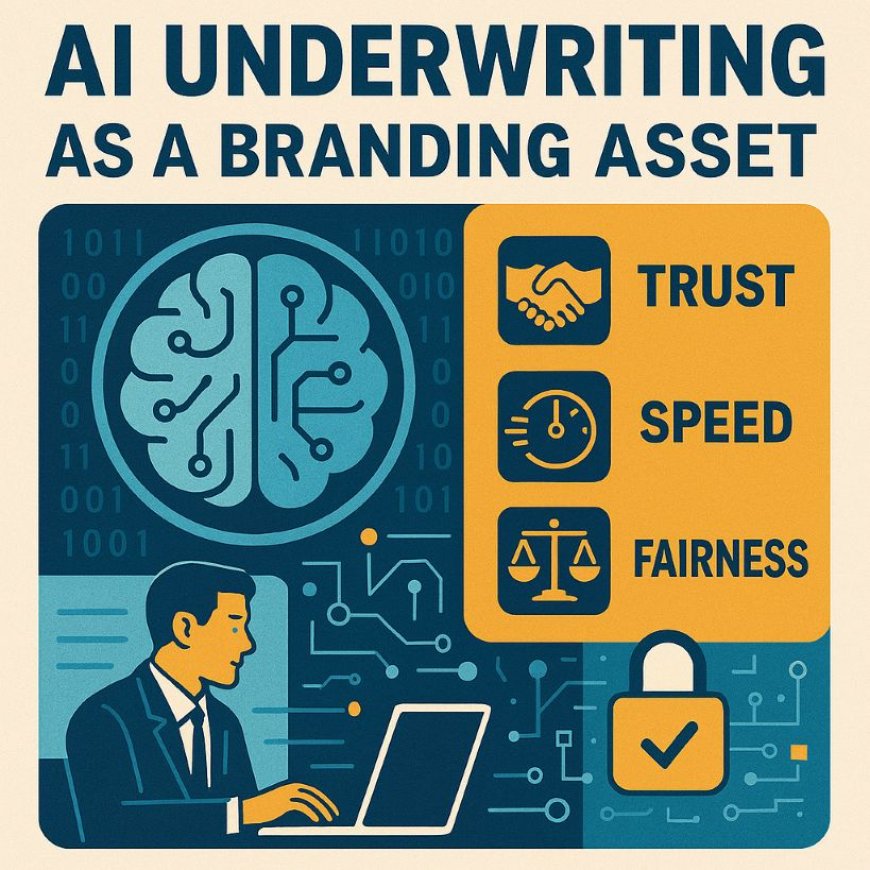
Here’s the provocation: AI-driven risk processing isn’t just a technical upgrade. It’s a brand differentiator. In industries where trust is currency, speed is loyalty, and fairness is reputation, the way institutions process risk is now part of their public identity.
- Trust: Customers want to believe their insurer or bank sees them as more than a number. AI models that integrate diverse data sources can demonstrate fairness and transparency—if institutions brand them correctly.
- Speed: In a world of instant payments and one-click loans, delays are reputational liabilities. AI’s ability to process risk in milliseconds becomes a marketing message: “We protect you at the speed of life.”
- Fairness: Traditional underwriting often excluded those without pristine credit histories. AI’s use of alternative data can be branded as inclusion—“We see your potential, not just your past.”
The Editorial Challenge
Financial institutions face a choice. They can present AI risk processing as a cold, technical back-office upgrade—or they can seize it as a storytelling opportunity. Imagine campaigns that highlight:
- “Our AI doesn’t just detect fraud; it protects families.”
- “Our underwriting isn’t about gatekeeping—it’s about opening doors.”
- “Our risk models aren’t black boxes—they’re fairness engines.”
This is where branding meets algorithmic intelligence. Institutions that lean into transparency, ethical AI, and customer-centric narratives will own the conversation. Those that hide behind jargon will be seen as commoditized utilities.
Conclusion
The journey from data warehouses and heuristic rules to generative AI is more than a technological arc—it’s a cultural one. Risk processing has evolved from a hidden function into a visible brand asset. The winners in this new era won’t just be those with the fastest algorithms, but those who brand their intelligence as trust, speed, and fairness.
Written/published by Kevin Marshall with the help of AI models (AI Quantum Intelligence).
What's Your Reaction?
 Like
0
Like
0
 Dislike
0
Dislike
0
 Love
0
Love
0
 Funny
0
Funny
0
 Angry
0
Angry
0
 Sad
0
Sad
0
 Wow
0
Wow
0