














Hyperautomation: Reshaping the IT Industry
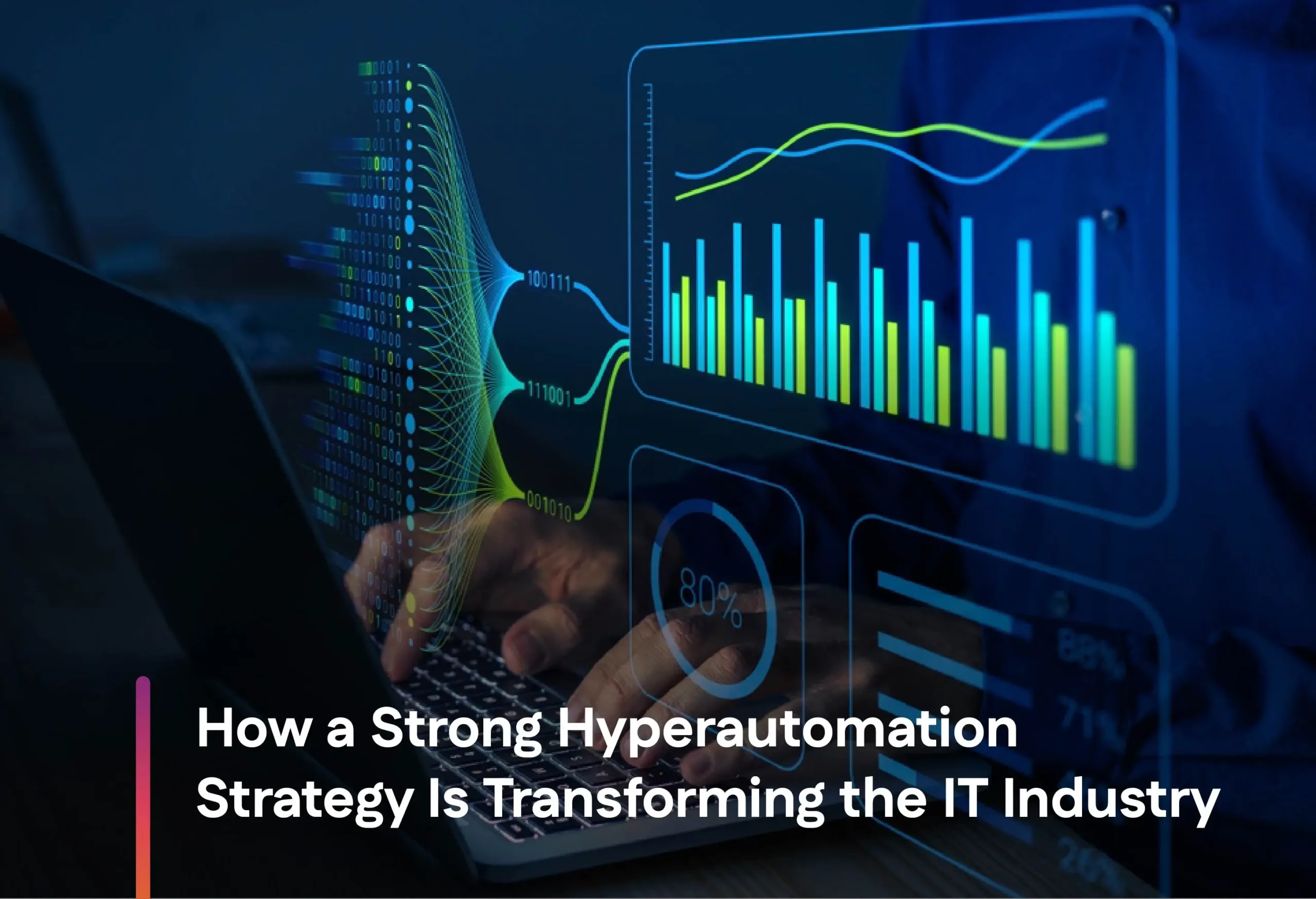
Hyperautomation is the next step in intelligent automation. It means extending traditional automation beyond repetitive tasks to include every possible business process using AI, RPA, machine learning, and analytics together to create a truly self-driven enterprise.
In simple terms, hyperautomation in IT is about making automation smarter, faster, and scalable helping organizations move from rule-based scripts to intelligent, adaptive digital operations.
Key Article Takeaways
- Hyperautomation combines AI, ML, and RPA to automate entire workflows, not just tasks.
- Start small, measure results, and scale automation across the organization.
- It boosts efficiency, reduces errors, and cuts operational costs.
- Successful hyperautomation adoption starts small, focuses on measurable outcomes, and scales through collaboration across teams.
What Makes Hyperautomation Different?
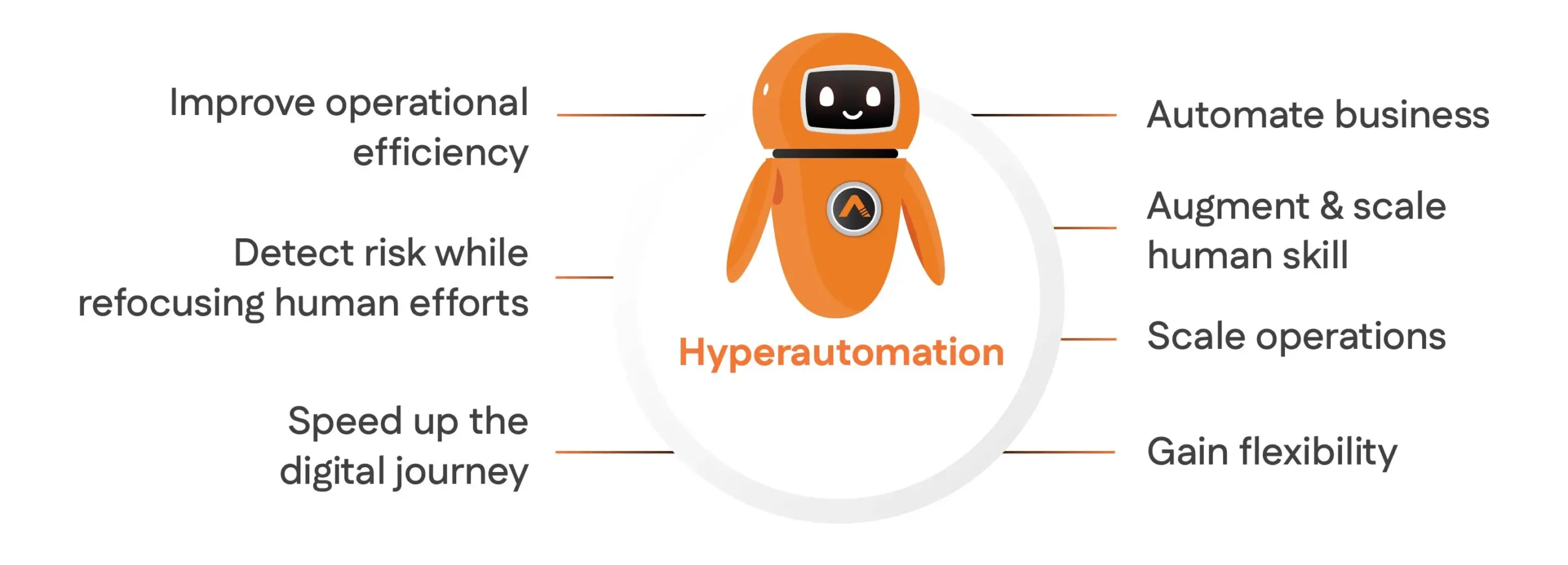
While traditional RPA automates specific rule-based tasks, hyperautomation takes it further by combining multiple technologies for broader process automation. It integrates AI, ML, process mining, and advanced analytics to automate complex, end-to-end workflows. This enables smarter decision making, faster scalability, and continuous process improvement across the enterprise.
Hyperautomation vs RPA – Key Differences

| Aspect | RPA (Robotic Process Automation) | Hyperautomation |
|---|---|---|
| Scope | Automates repetitive, rule-based tasks | Automates end-to-end workflows |
| Intelligence | Limited decision-making | Uses AI/ML, NLP, OCR for smart decisions |
| Scalability | Works on defined tasks | Scales automation across systems and teams |
| Outcome | Efficiency | Intelligent digital transformation |
In short: Hyperautomation vs RPA is like comparing a basic car to a self-driving one. Both move you forward but one learns, adapts, and optimizes along the way.
Key Components of a Strong Hyperautomation Strategy
A successful hyperautomation strategy combines the right tools, data, and people. The goal is not just to automate tasks, but to enable continuous digital evolution.
| Component | Purpose |
|---|---|
| RPA Foundation | Automate repetitive IT workflows and service desk operations |
| AI and ML | Add intelligence for predictions and smarter decision-making |
| Process & Task Mining | Discover automation opportunities from actual user actions |
| Low-Code Hyperautomation Platforms | Build and deploy automation with minimal coding |
| Analytics & Monitoring | Track performance and ROI of automation projects |
Low code hyperautomation platforms make it easier for IT and business users to collaborate empowering teams to automate faster without deep technical skills
Did you Know?
- Hyperautomation with generative AI has cut IT ticket resolution times by 40% and reduced agent workload by 25%.
- In manufacturing, firms leveraging hyperautomation saw a 30% boost in productivity and a 25% reduction in operating costs.
- Early adopters of hyperautomation report up to 30% cost savings across business processes.
- Banks now process 82% of direct debit refunds in under 30 seconds, 90% of batch payment exceptions, and 70% of payment errors automatically through hyperautomation.
How to Adopt Hyperautomation in IT
Adopting hyperautomation in IT is not just about technology it’s a journey.
- Assess your automation maturity – Identify which IT processes are manual, repetitive, or bottlenecked.
- Define clear business outcomes – Focus on efficiency, cost, and user experience goals.
- Select the right platform – Choose a low-code hyperautomation platform that integrates with your existing ITSM, CRM, and ERP systems.
- Start small and scale – Begin with one or two high-impact processes, measure ROI, then expand.
- Foster collaboration – Involve IT, operations, and business users in designing automation workflows.
With this approach, scaling hyperautomation across the organization becomes natural not forced.
Benefits of Hyperautomation for IT
The IT function often faces mounting workload pressure from ticket handling to infrastructure management. Hyperautomation in IT helps overcome these challenges through:
| Benefit | Impact |
|---|---|
| Faster IT Operations | Reduces response time for incidents and service requests |
| Reduced Human Error | Intelligent bots ensure consistent execution |
| Cost Optimization | Cuts operational costs by reducing manual dependencies |
| Scalability | Easily scales across applications and departments |
| Improved Compliance | Ensures processes follow security and governance standards |
| Employee Empowerment | Frees IT teams for strategic innovation instead of repetitive work |
Example:
An IT helpdesk using RPA can automatically reset passwords, but with hyperautomation, it can also predict common issues, route tickets intelligently, and resolve them proactively.
Hyperautomation Implementation Roadmap
Implementing hyperautomation requires a structured roadmap to ensure scalability and measurable results.
| Phase | Focus | Outcome |
|---|---|---|
| 1. Discovery & Assessment | Identify automation opportunities using process mining | Clear list of automation-ready processes |
| 2. Planning & Prioritization | Define automation goals and select right tools | Strategic hyperautomation blueprint |
| 3. Pilot Projects | Implement initial automations | Measurable ROI and insights |
| 4. Scale Across Organization | Expand automation to new departments and systems | Enterprise-wide efficiency |
| 5. Continuous Optimization | Use analytics to refine and improve bots | Sustainable automation growth |
A well-defined hyperautomation implementation roadmap ensures every automation adds real value and aligns with organisational goals.
Hyperautomation Challenges and Solutions
Despite its potential, banks face hurdles during hyperautomation implementation.
Here’s how to overcome them:
| Challenge | Solution |
|---|---|
| Tool Integration | Use unified platforms supporting RPA, AI, and analytics natively |
| Governance & Security | Implement access controls, audit trails, and compliance checks |
| Data Silos | Integrate systems with APIs and iPaaS tools |
| Resistance to Change | Involve employees early; focus on collaboration, not replacement |
| Skill Gaps | Upskill teams with low-code automation tools and AI literacy programs |
| ROI Measurement | Use analytics dashboards to track performance and savings |
Tip: Don’t treat hyperautomation as a one-time project. It’s a continuous improvement journey that grows with your organization.
Scaling Hyperautomation Across the Organization
To unlock true enterprise value, banks must focus on scaling hyperautomation across the organization beyond isolated processes.
Best Practices:
- Create a dedicated team to govern automation standards.
- Use low code hyperautomation platforms to empower non-developers.
- Standardize process documentation for easier replication.
- Integrate automation insights with business KPIs for visibility.
When done right, scaling automation improves agility, transparency, and customer satisfaction across departments.
Emerging Hyperautomation Trends 2026
The future of hyperautomation in IT is evolving rapidly. Here are the top hyperautomation trends 2026 to watch:
- Hyperautomation with the Cloud: On-demand, cloud-native automation that scales instantly for faster and more resilient workflows.
- Composable Automation: Reusable automation components to build faster, flexible workflows.
- Digital Twin of the Organization (DTO): Real-time simulation of processes using process and task mining.
- Voice and NLP-Based Automation: Smart chatbots managing IT requests conversationally.
- End-to-End Security Automation: Integrating cybersecurity and compliance into hyperautomation workflows.
- Low-Code Democratization: Increasing business user participation through visual automation tools.
These trends indicate a clear direction hyperautomation will no longer be optional for IT modernization; it will be essential.
Why Hyperautomation is the Future of IT
Hyperautomation is changing the way IT works. It moves teams from reacting to problems to predicting and preventing them. Instead of doing manual, repetitive work, IT can now focus on smarter, more strategic tasks. By bringing together AI, automation, and integration, hyperautomation helps organizations to stay agile and competitive in a fast-changing world.
Here’s why it’s becoming a game-changer:
- Predictive IT operations: Identify and resolve incidents before they affect users through AI-driven insights and self-healing systems.
- End-to-end automation: Eliminate manual intervention in workflows like ticketing, patching, and compliance checks.
- Faster service delivery: Automate approvals, deployments, and routine tasks for shorter turnaround times.
- Smarter decision-making: Use data analytics and AI models to optimize resources and reduce operational costs.
- Improved scalability: Integrate automation across tools, systems, and departments without disrupting ongoing operations.
- Enhanced compliance & security: Automate audit trails, reporting, and access management to maintain consistent standards.
Start Your Hyperautomation Journey with AutomationEdge
In conclusion, hyperautomation is transforming the IT landscape by integrating RPA, AI, and low-code tools to build smarter, scalable, and self-optimizing systems. It helps IT teams move beyond manual operations toward innovation, agility, and data-driven decision-making. As businesses prepare for 2026 and beyond, having a clear hyperautomation strategy will be vital to achieving real digital transformation.
At AutomationEdge, we are your trusted partner in this journey. Our intelligent automation platform empowers organizations to easily adopt and scale hyperautomation making IT operations faster, smarter, and more efficient.
Let us help you unlock the true potential of hyperautomation and accelerate your path to a future-ready enterprise.
Frequently Asked Questions
The post Hyperautomation: Reshaping the IT Industry appeared first on AutomationEdge.
What's Your Reaction?
 Like
0
Like
0
 Dislike
0
Dislike
0
 Love
0
Love
0
 Funny
0
Funny
0
 Angry
0
Angry
0
 Sad
0
Sad
0
 Wow
0
Wow
0