

















Is RPA Dead? No — But 60% Projects Will Fail Unless You Add AI
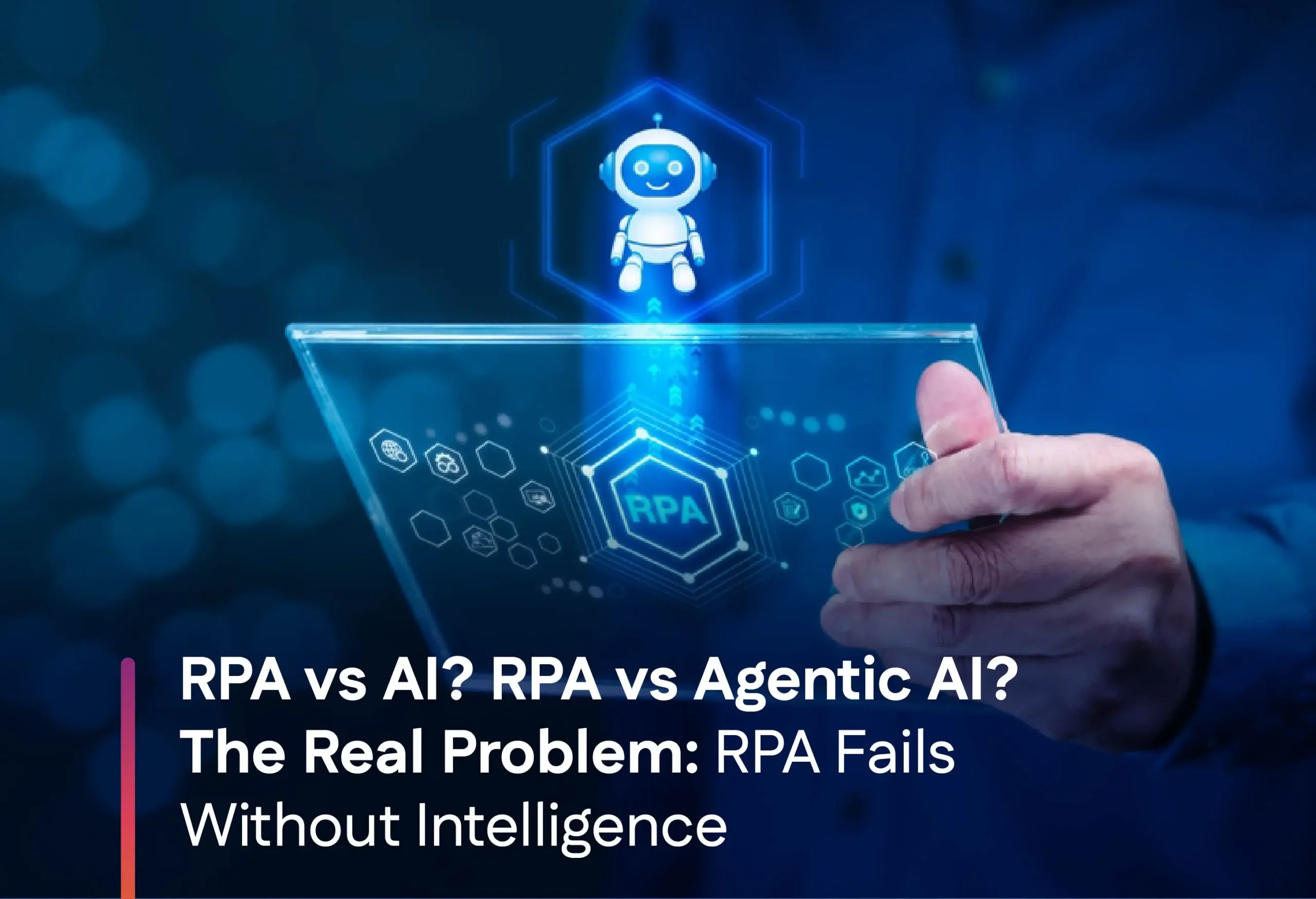
Is RPA Dead?
No. RPA is not dead—but RPA without AI is failing. Traditional RPA is slowing down because rule-based bots can’t handle today’s fast-changing, exception-heavy processes. That’s why so many RPA projects fail. RPA still matters, but it can’t survive alone. The future is RPA + AI bots and intelligent automation that can read documents, understand context, make decisions, and handle unstructured data—making it scalable and future-ready.
Gartner says nearly 50% of RPA projects fail to scale because rigid systems can’t handle real-world process changes, while Deloitte reports 37% fail due to poor change management, both challenges that RPA combined with AI can solve through adaptability and intelligence.
This blog covers why traditional RPA is slowing down and why AI is now essential for automation success. It explains the differences between RPA, AI, and agentic AI, why many RPA projects fail, and how AI transforms rule-based bots into intelligent, decision-making systems.
Key Article Takeaways
- RPA isn’t dead, but RPA without AI can’t handle today’s complex, changing processes.
- AI adds the intelligence RPA lacks, enabling decision-making, adaptability, and handling unstructured data.
- Agentic AI takes automation further by planning, deciding, and executing tasks autonomously.
- Most RPA failures happen because bots break with exceptions, variations, and process changes.
- The future of automation is RPA + AI + agentic AI working together as autonomous digital employees.
How RPA, AI & Intelligent Automation Differ?
-
RPA (Robotic Process Automation)
RPA uses rule-based software bots to automate repetitive, structured tasks. It follows predefined steps and doesn’t learn or adapt.
Example: A bot copying customer data from emails into a CRM every day.
-
AI (Artificial Intelligence)
AI enables systems to understand data, learn patterns, and make decisions. It handles variation, predictions, and complex logic.
Example: A model identifying fraudulent transactions by spotting unusual behaviour.
-
Intelligent Automation (IA)
Intelligent Automation combines RPA with AI to automate end-to-end processes that require both execution and decision-making.
Example: A system that reads customer documents, extracts data, validates it, and updates the core banking system automatically.
Comparing RPA vs Intelligent Automation
| Category | RPA (Robotic Process Automation) | Intelligent Automation (IA) |
|---|---|---|
| Core Capability | Executes rule-based tasks | Combines RPA + AI for smarter automation |
| Handling Unstructured Data | Limited, often fails | Processes documents, emails, images, conversations |
| Decision-Making | No decision capability | Uses AI models to make informed decisions |
| Adaptability | Breaks with process or data changes | Learns, adapts, and improves over time |
| Scope | Task-level automation | End-to-end process automation |
| Use Cases | Data entry, simple workflows | Claims processing, customer service, risk checks, loan approvals |
RPA is great for simplifying repetitive, rule-based tasks, but it struggles when data becomes unstructured or decisions are required. That’s where Intelligent Automation takes over.
By combining RPA with AI, it can read documents, understand context, make decisions, and automate entire workflows end-to-end. This shift helps organizations move from basic task automation to true digital transformation with higher accuracy, speed, and scalability.
Did you know?
- 30–50% of early RPA projects fail because bots can’t scale, can’t handle exceptions, and lack AI.
- The RPA market hit $22.79B in 2024, proving it’s growing fast, but Gartner says AI is now essential for success.
- 53% of businesses use RPA, and failure rates drop below 20% when AI is added for smarter processing.
- RPA delivers 30–200% ROI in the first year and can reach up to 300% long-term.
- 82% of RPA projects underperform without AI/ML, while AI-driven automation improves success by 3x.
Why So Many RPA Projects Fail
RPA works well only for simple, repetitive tasks that follow fixed rules. It cannot think, judge, or make decisions when situations change. The moment a process needs reasoning, approval logic, or human-like judgment, traditional RPA reaches its limit and starts failing.
- Struggles with real-world exceptions: Approvals, edge cases, and process variations cause frequent failures because RPA cannot reason or adapt.
- Bots break whenever processes change: A small UI change, policy update, or new field requires rework, making RPA costly to maintain.
- No true end-to-end automation: RPA handles small tasks but still needs humans for verification, decisions, classification, and exception handling.
- No intelligence or autonomy: RPA only follows fixed rules and cannot think, learn, or make decisions, for example, it can copy invoice data but cannot understand an email, judge urgency, or decide the next action like AI or Agentic AI can.
In short: RPA didn’t fall short it was simply missing the intelligence layer that AI now delivers.
Will RPA Be Replaced by AI?
No. RPA will not be replaced by AI—but it will be absorbed into AI-led automation platforms. AI handles intelligence and decision-making, while RPA executes tasks across systems. Together, they form intelligent automation. Enterprises that treat AI and RPA as competitors often fail; those that integrate them succeed.
Why RPA Needs AI to Survive and Scale
RPA needs AI because enterprises no longer run on clean, predictable data. Emails, PDFs, scanned documents, customer messages, policy changes, and exceptions are now the norm. RPA implementation challenges without AI include:
- Inability to process unstructured data
- Frequent bot failures due to process variations
- High maintenance costs when UI or rules change
- Dependence on humans for decisions and exception handling
This is exactly why RPA needs AI. By adding AI for robotic process automation, organizations transform fragile bots into intelligent systems that can read, understand, decide, and act.
The Turning Point: AI + RPA = Intelligent, Self-Improving Automation
RPA becomes powerful only when combined with AI technologies like:
- Machine learning
- NLP
- Document intelligence
- Predictive analytics
- Agentic AI models
- Conversational AI
- Vision AI
With AI, automation stops being rule-based and becomes decision-based.
In a modern enterprise automation setup:
- RPA executes tasks across systems
- AI understands data and context
- Machine learning improves decisions over time
- Agentic AI orchestrates end-to-end workflows autonomously
This shift moves automation from task-level scripting to enterprise automation strategy built on RPA + AI.
Enterprises that succeed don’t ask “Will RPA be replaced by AI?”
They ask “How fast can we integrate AI into RPA?”
Across industries, examples of RPA + AI success show that:
- Bots become resilient instead of brittle
- Automation scales across departments
- Manual interventions drop dramatically
- ROI increases while operational risk decreases
In short, AI doesn’t kill RPA—it saves it.
How AI changes the game
AI can understand, analyse, interpret, and decide the exact abilities RPA lacks. This transforms RPA from a simple “do task” robot into a digital employee that can:
- read PDFs, forms, and images
- understand emails and messages
- detect fraud patterns
- make decisions
- escalate exceptions
- prioritise tasks
- self-correct and self-learn
This is why RPA vs AI or RPA vs agentic AI isn’t a competition; it’s an evolution. AI elevates RPA to intelligent automation.
Unlock how leading companies are using AI to eliminate manual work, speed up operations, and deliver faster customer experiences. Explore practical demos, real success stories, and see what AI can truly do for your business.
If you want to fast-track your own automation journey, you can directly connect with our experts for tailored guidance.
Tip for Business Leader:
Start shifting from task-based RPA to AI-driven, end-to-end automation for real scalability.
RPA vs AI vs Agentic AI: The Real Difference
A simple breakdown leaders can understand:
| Category | RPA (Rule-Based Automation) | AI (Cognitive + Predictive Intelligence) | Agentic AI (Autonomous Digital Workforce) |
|---|---|---|---|
| Core Ability | Follows predefined rules | Understands and learns from data | Plans → decides → executes autonomously |
| Handling Variation | Breaks when data changes | Handles variation with models | Adapts in real time, self-learns |
| Use Cases | Simple, repetitive tasks | Complex decision support | End-to-end workflow automation |
| Intelligence Level | No learning | Learns patterns, predicts outcomes | Full autonomy & reasoning across systems |
| Scope of Work | Single-task automation | Supports complex cases | Automates entire processes across systems |
This is why enterprises are moving from RPA → AI → agentic AI as their automation maturity evolves.
How to Add AI to RPA in 6 Practical Steps
- Fix the processes where RPA struggles
Target steps with high exceptions, unstructured data, or human judgment. - Use Document AI to read complex data
Extract information from invoices, claims, emails, contracts, receipts, and KYC forms. - Add NLP for language understanding
Let AI read messages, emails, tickets, and customer queries.
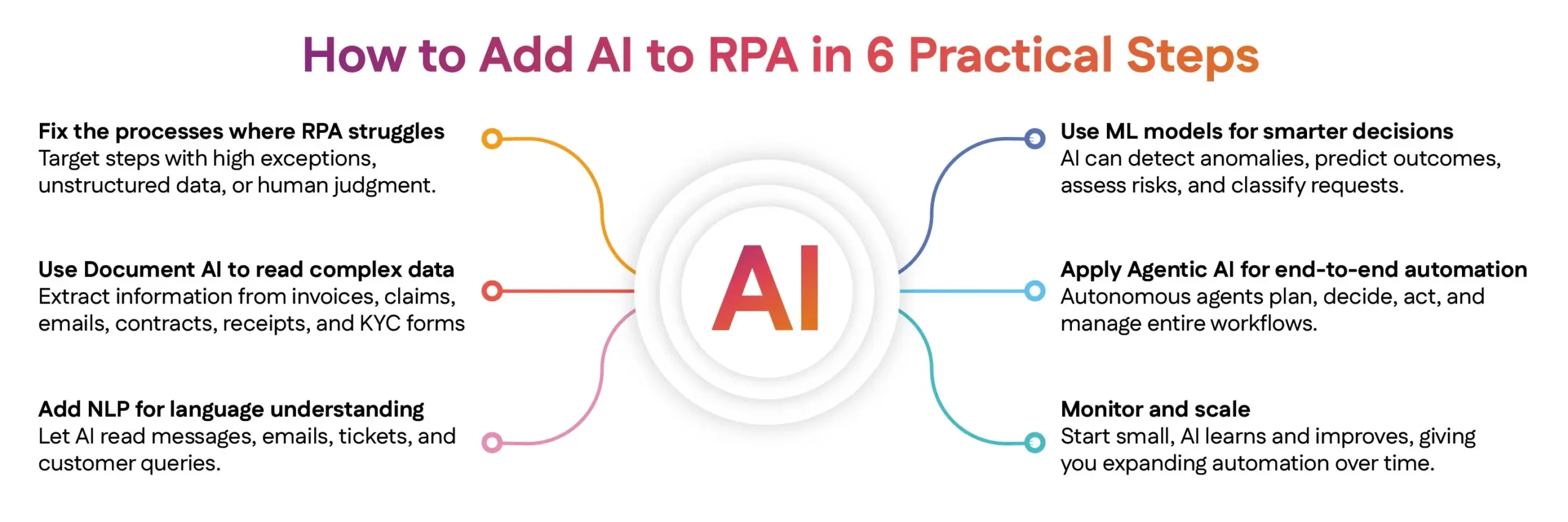
- Use ML models for smarter decisions
AI can detect anomalies, predict outcomes, assess risks, and classify requests. - Apply Agentic AI for end-to-end automation
Autonomous agents plan, decide, act, and manage entire workflows. - Monitor and scale
Start small, AI learns and improves, giving you expanding automation over time.
Tip Business Leaders:
Begin small, measure outcomes, and scale AI-led automation across functions for maximum ROI.
Use Cases: Real-World Examples of RPA + AI Success
These examples show how enterprises are winning by combining RPA, AI, and agentic automation:
-
Banking & Financial Services
- Loan underwriting automation: AI analyses income, credit patterns, and risk; RPA handles approvals.
- KYC/AML automation: AI-powered KYC automation reads and validates documents and flags anomalies; RPA updates systems across onboarding and compliance workflows.
- Fraud detection: ML models detect suspicious patterns in real time.
-
Insurance
- Claims processing: AI extracts data, validates documents, detects fraud; RPA initiates payments.
- Policy servicing: Conversational AI handles updates, changes, and queries automatically.
-
Healthcare
- Patient onboarding: AI reads insurance cards, forms, and claims; RPA syncs data to EMR systems.
- Prior authorizations: AI reviews clinical data to support prior authorizations, while RPA processes approvals and updates core systems.
-
IT & Shared Services
- Ticket triage: For IT ticket automation, AI understands the issue first, then RPA resolves or routes the task automatically.
- User provisioning: AI validates; RPA creates access automatically.
-
HR & Operations
- Employee onboarding: AI processes onboarding documents for employee onboarding, and RPA sets up accounts and access across systems.
- Payroll accuracy: AI identifies mismatches before payroll runs.
Transform how your teams get support from onboarding to daily HR queries with Gen AI–powered automation. See how leading companies are delivering faster, smarter, always-on employee support with zero manual effort.
If you’re ready to elevate your employee experience, our experts are here to guide you.
The Future: RPA Is Evolving, Not Dying
RPA will remain relevant, but only as a component of a larger AI automation ecosystem.
- RPA becomes the “hands”
- AI becomes the “brain”
- Agentic AI becomes the “autonomous worker”
Future trends to watch
The future of automation is shifting from simple task execution to intelligent autonomy. Most workflows will soon run on Agentic AI that can think, decide, and act on its own, reducing dependency on rigid, rule-based bots. As a result, traditional RPA licenses will decline while AI-first automation platforms take over, designed with intelligence at the core rather than added later.
End-to-end autonomous workflows will replace isolated task bots, automating complete processes instead of small steps. With this growing independence of AI, strong governance and compliance frameworks will also rise to ensure these systems remain secure, transparent, and trustworthy.
The future of RPA isn’t death, it’s rebirth through AI.
Conclusion
RPA alone cannot handle the complexity of modern enterprise work. But when combined with AI and agentic AI automation, it becomes scalable, intelligent, and truly future-ready. The companies winning today are not the ones relying on traditional bots but the ones upgrading their automation with AI-driven, autonomous capabilities.
If you’re modernizing your automation strategy, start with AI + RPA now before the gap becomes too big. With AutomationEdge’s Agentic AI platform, we help organizations move beyond basic RPA and build intelligent, self-running workflows that accelerate operations and deliver real business impact.
Frequently Asked Questions
The post Is RPA Dead? No — But 60% Projects Will Fail Unless You Add AI appeared first on AutomationEdge.
What's Your Reaction?
 Like
0
Like
0
 Dislike
0
Dislike
0
 Love
0
Love
0
 Funny
0
Funny
0
 Angry
0
Angry
0
 Sad
0
Sad
0
 Wow
0
Wow
0