





The Uncertain Future: People vs. Machines, or Partners in Progress?
An op-ed exploring the fear, uncertainty, and shifting balance of power between artificial intelligence, robotics, and automation versus human workers and students. The article examines cultural and socio-economic perspectives on the future of work, the potential collapse of the job-based economy, and the possibility of collaborative human-machine progress. It concludes with a bold statement on how evidence suggests humanity must reinvent value and purpose in an AI-driven world.
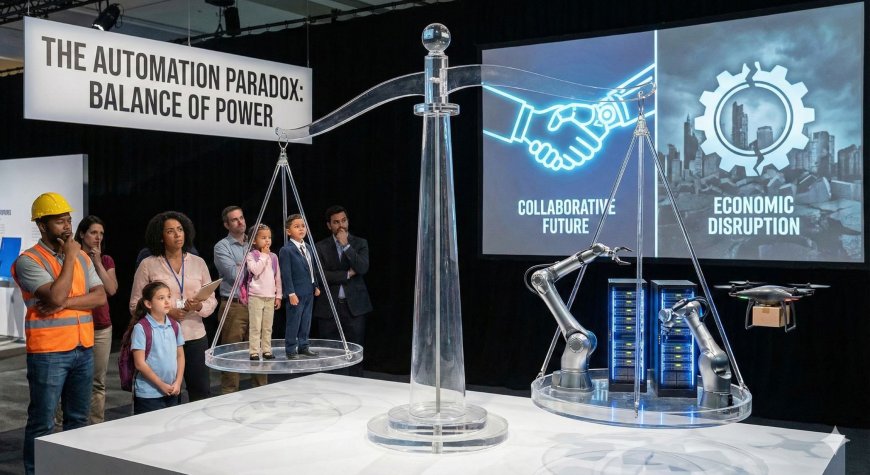
Fear, Uncertainty, and the Balance of Power
Artificial intelligence, robotics, and automation are no longer distant possibilities—they are accelerating realities. With each new announcement of breakthroughs in generative AI, humanoid robotics, or autonomous systems we sharpen the tension between human potential and machine capability. For workers, students, and entire societies, the question is no longer if these technologies will reshape our lives, but how—and whether humanity will remain empowered or sideline itself in the process.
The fear is palpable: jobs disappearing, skills rendered obsolete, and traditional pathways to meaning and purpose eroded. Yet the uncertainty also carries promise: collaboration between humans and machines could unlock unprecedented creativity, efficiency, and prosperity. The balance of power is shifting, but it is not yet decided.

Perspectives on this future vary dramatically depending on geography, socio-economic status, and cultural values:
- Optimists and Opportunists
- In tech-forward nations like South Korea, Japan, and the U.S., automation is often seen as a partner in progress. Students are encouraged to embrace AI as a tool for learning, while businesses view robotics as a way to scale productivity.
- Wealthier classes tend to see opportunity: AI as a lever for entrepreneurship, passive income, and creative ventures.
- Skeptics and the Fearful
- In regions where economic inequality is stark, such as parts of Africa or Latin America, automation is feared as a job destroyer. For workers in manufacturing, agriculture, or service industries, the prospect of machines replacing human labor feels like existential displacement.
- Older generations, less exposed to digital education, often express anxiety about being left behind in a system that increasingly rewards technological fluency.
- Education as a Divider
o Highly educated populations tend to frame AI as augmentation—something that enhances human capacity.
o Those with limited access to education or digital literacy often see AI as a threat, widening the gap between the empowered and the excluded.
The Looming Collapse of the Job-Based Economy
The traditional economic model—where household income is tied to employment—faces unprecedented strain. If machines can perform most tasks faster, cheaper, and more reliably, what happens to wages, careers, and the very notion of “work”?
Some economists argue that universal basic income (UBI), digital dividends, or machine-taxation schemes may be necessary to sustain households. Others suggest a radical rethinking of value itself: shifting from labor-based worth to creativity, community, and human connection as the new currencies of meaning.
⚡ The Path Ahead: Collaboration or Displacement?
The future is not binary. It is a spectrum of possibilities:
- Collaborative Future: Humans and machines co-create, with AI handling repetitive tasks while people focus on creativity, empathy, and leadership.
- Displacement Future: Machines dominate, leaving humans scrambling for relevance, with social unrest and economic collapse as potential outcomes.
- Hybrid Future: A messy middle ground where some sectors thrive on collaboration, while others experience painful obsolescence.
A Bold Statement on What Evidence Suggests
Current evidence points to a hybrid trajectory: automation will indeed strip away millions of traditional jobs, but it will simultaneously create new domains of human-machine collaboration. The collapse of the job-based economy is not a distant theory—it is already underway in industries like logistics, customer service, and creative content.
The bold truth is this: humanity is approaching a tipping point where “work” as we know it will no longer define value. Instead, societies will be forced to design new systems—economic, cultural, and educational—that reward creativity, adaptability, and human uniqueness. AI, robotics, and automation will not replace us entirely, but they will demand that we reinvent ourselves.
The future will not be machines versus people. It will be machines with people—or machines without people. The choice, and the balance of power, is ours to decide.
Written/published by Kevin Marshall in collaboration with AI models (AI Quantum Intelligence)
What's Your Reaction?
 Like
0
Like
0
 Dislike
0
Dislike
0
 Love
0
Love
0
 Funny
0
Funny
0
 Angry
0
Angry
0
 Sad
0
Sad
0
 Wow
0
Wow
0