
















Efficiency Over Ego: China’s 2026 Pivot Toward Pragmatic AI Agents
China’s 2026 AI roadmap signals a strategic shift from LLM chat paradigms to high-efficiency 'Agentic' AI. Explore the move toward industrial AI+ integration and the new efficiency-first technical roadmap.
-
Original Title: 新华深读丨2026年中国AI发展趋势前瞻 (Xinhua Deep Read: Outlook on China's AI Development Trends in 2026)
-
Source: Xinhua News Agency (Official State Media)
-
Publication Date: January 28, 2026
-
Topic: A comprehensive look at the state of China's artificial intelligence sector at the start of the "15th Five-Year Plan" (2026–2030), analyzing key trends in technology, infrastructure, and application.
Summary
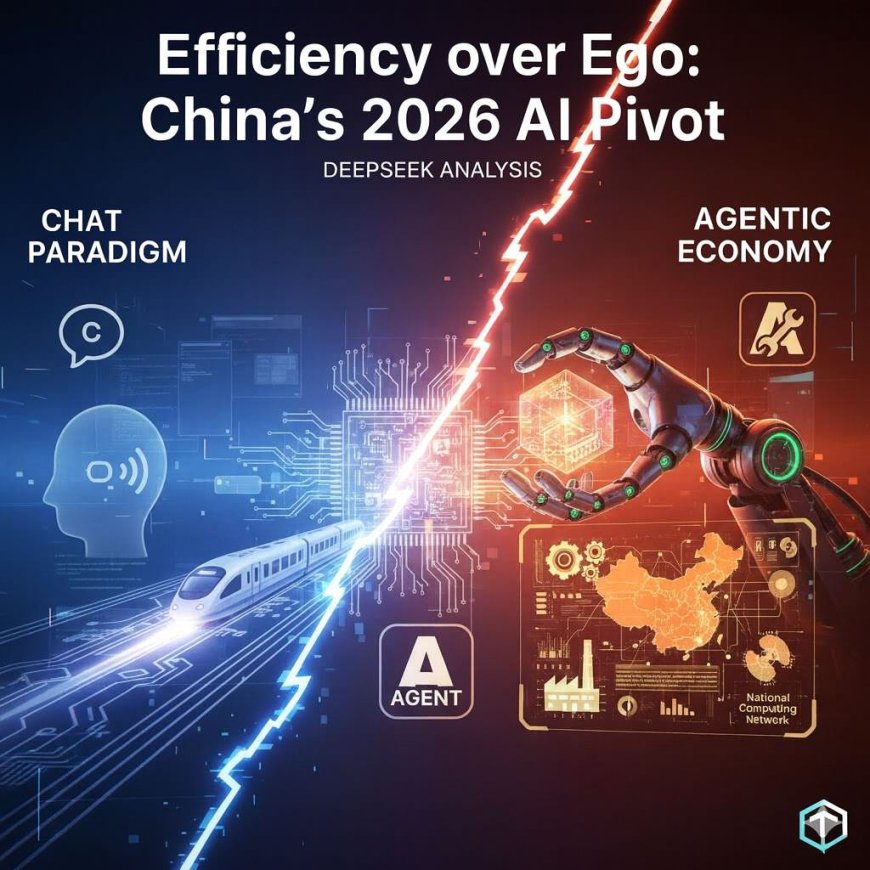
The article argues that 2026 marks a pivotal shift in China’s AI landscape, moving away from the "Chat" paradigm (chatbots) toward an "Agent" paradigm (AI that executes tasks). It outlines the current scale of the industry: China now hosts over 6,000 AI enterprises, with a core industry value exceeding 1.2 trillion RMB (approx. $165 billion USD), and domestic open-source models have surpassed 10 billion cumulative downloads.
Key Trends Identified:
-
From "Chatting" to "Doing": The Rise of Agents The "Hundred Models War" (the rush to build LLMs) is effectively over. The new focus is on "AI Agents"—systems capable of autonomy, planning, and tool use. The article cites DeepSeek, a leading Chinese AI lab, which published two influential papers in January 2026 that reportedly signal a divergence in China's technical roadmap: prioritizing "lighter models, smarter architectures, higher efficiency, and lower prices." Industry experts declare that the era of AI primarily as a conversational interface is ending; the future belongs to "smart butlers" capable of solving complex physical and digital problems.
-
Infrastructure: The "National Computing Network" Computing power is described as the "new oil." China is accelerating its "Eastern Data, Western Computing" initiative, aiming for a unified national computing grid. The focus is shifting from raw chip accumulation to systemic synergy—optimizing software, hardware, energy, and networking together. Green computing is a major priority, with data centers expected to consume 3% of China's total electricity by 2030.
-
Data: Quality Over Quantity The competitive edge has moved from data volume to data quality. The article notes that while general web data is abundant, high-value industry-specific data (e.g., medical imaging, industrial manufacturing logs) is the new gold. The government is intervening to break down "data silos" in hospitals and factories to create standardized, high-quality datasets for training vertical models.
-
Industry Empowerment: The "AI+" Manufacturing Push Unlike the US focus on closed-source proprietary models, the article claims China is leading the open-source market, which accelerates industrial adoption. Daily token consumption in China skyrocketed from 100 billion in early 2024 to over 30 trillion by mid-2025. The "AI+ Manufacturing" initiative is pushing AI beyond customer service bots and into R&D and production lines, helping traditional industries (like battery manufacturing) improve efficiency.
-
Governance and Safety Acknowledging the global concern over "AI slop" (low-quality AI-generated content), the article emphasizes China's "distinctive governance path." This involves a mix of "soft" ethical guidance and "hard" legal constraints (such as the newly revised Cybersecurity Law) to manage risks like deepfakes and algorithmic bias without stifling development.
Op-Ed: The Implications of China’s "Pragmatic Turn" in AI
The Pivot to Utility This article confirms a strategic pivot that has been brewing in China's tech sector for the last two years. While Silicon Valley continues to chase AGI (Artificial General Intelligence) through massive scaling laws and multi-modal reasoning, China appears to be betting the house on pragmatism. The narrative has shifted from "Can we build a smarter model than GPT-5?" to "Can we build a cheaper, smaller model that actually runs a factory?"
The explicit mention of DeepSeek’s January 2026 papers is telling. It suggests that Chinese researchers are looking for architectural "shortcuts" to bypass hardware constraints (likely due to continued export controls on advanced GPUs). By focusing on "lighter models" and "higher efficiency," China is trying to win on unit economics rather than raw intelligence supremacy. If they succeed, we might see a bifurcation in the global AI market: the West dominating the highest-end "super-intelligence," while China dominates the "blue-collar AI"—affordable, specialized agents that power the world's supply chains and consumer electronics.
The "Agent" Hype vs. Reality The article’s enthusiasm for "AI Agents" (systems that do things rather than just say things) mirrors global trends but carries a specific weight in China. The Chinese internet ecosystem is heavily transactional (e.g., WeChat's "Super App" model). An AI that can book tickets, order food, and manage logistics fits naturally into this existing infrastructure. However, the claim that the "Chat paradigm is over" might be premature. Agents still rely on the reasoning capabilities of foundational LLMs. If the underlying models lag behind the cutting edge in reasoning, the "Agents" will likely remain fragile and prone to error.
Alternative Points of View
-
The Hardware Ceiling: The article glosses over the "chip war." It speaks of "systemic synergy" as a way to overcome hardware limitations. A skeptic would argue that software optimization has diminishing returns. Without access to the absolute cutting-edge lithography and GPUs, there is a hard ceiling on how smart these "efficient" models can get. You can optimize a factory engine all you want, but it won't turn into a rocket ship.
-
Data Isolation: While the government pledges to break down data silos, this is historically difficult in China's bureaucratic landscape. Hospitals and State-Owned Enterprises (SOEs) are notoriously protective of their data. The top-down mandate to share data for AI training might face significant passive resistance on the ground, slowing down the "vertical AI" progress the article predicts.
-
The "Slop" Problem: The article mentions "AI slop" as a Western concern, but China’s internet is arguably even more susceptible to content pollution due to the sheer volume of users and the speed of content farms. Strict censorship helps filter political content, but it may struggle to filter low-quality spam that degrades the user experience, potentially poisoning the very data wells they need to train future models.
Conclusion The "Xinhua Deep Read" outlines a mature, confident strategy: stop chasing the US on every benchmark and instead integrate AI into the real economy (manufacturing, governance, infrastructure). It is a bet that the value of AI lies not in passing the Turing Test, but in lowering the cost of production. For Western observers, the takeaway is clear: expect 2026 to be the year China floods the market not with "smarter" chatbots, but with ultra-cheap, specialized AI tools embedded in everything from EVs to home appliances.
Written/published by Kevin Marshall with the help of AI models (AI Quantum Intelligence).
What's Your Reaction?
 Like
0
Like
0
 Dislike
0
Dislike
0
 Love
0
Love
0
 Funny
0
Funny
0
 Angry
0
Angry
0
 Sad
0
Sad
0
 Wow
0
Wow
0