













AI Reality Check: How AI Is Rewriting the Rules of Product Differentiation
AI is collapsing traditional sources of product differentiation and shifting competitive advantage from features to intelligence. This week’s AI Reality Check explores how adaptive systems, learning velocity, and proprietary context are becoming the new moats in the AI driven economy.
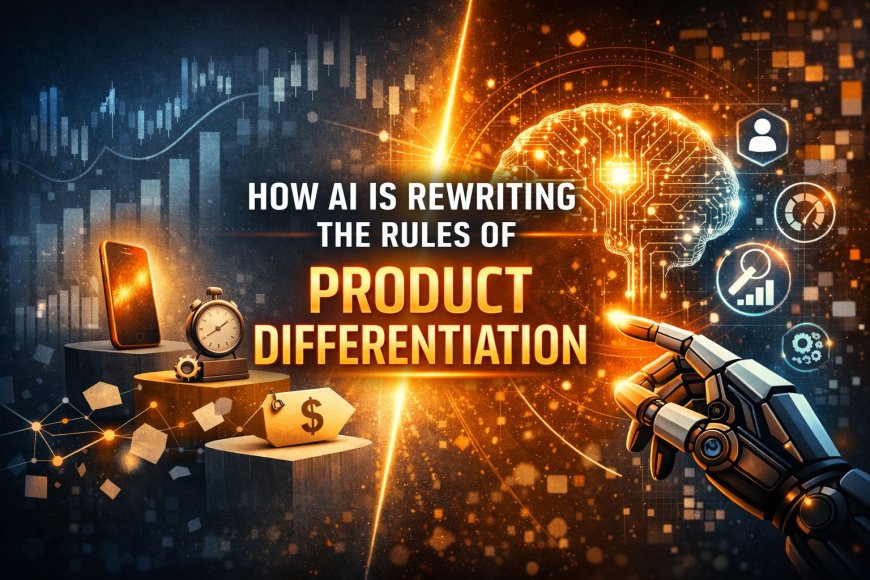
For decades, product differentiation followed a predictable playbook: better features, better performance, better price, better brand. Companies competed on what they built — and how efficiently they could build it.
AI has destroyed that logic.
We are entering a world where the traditional sources of differentiation are collapsing under the weight of automation, commoditization, and algorithmic acceleration. The competitive edge is no longer in the product itself, but in the intelligence surrounding it.
This is the uncomfortable truth businesses must confront: AI is not just changing how products are made — it’s redefining what a product is.
1. The Death of Feature-Based Differentiation
For most of the industrial and digital eras, companies won by adding features faster than competitors. But AI has turned features into a commodity.
- A startup can replicate your core functionality in weeks.
- Open-source models can match your “unique” capabilities overnight.
- AI agents can generate, test, and refine features at a pace no human team can match.
The result?
Features no longer differentiate. They merely keep you in the game.
The companies still clinging to feature wars are fighting a battle that AI has already made obsolete.
2. The Rise of Intelligence-Based Differentiation
If features no longer matter, what does?
The intelligence layer — the adaptive, contextual, personalized system that surrounds the product.
This includes:
- Real-time personalization
- Predictive anticipation of user needs
- Dynamic workflows that evolve with usage
- Context-aware recommendations
- Continuous learning loops
In other words, the product is no longer the thing you ship. The product is the intelligence that shapes the experience.
Two companies can offer identical tools — but the one whose AI understands the user better wins every time.
3. Differentiation Shifts From “What You Build” to “How You Learn”
In the pre-AI world, competitive advantage came from:
- proprietary technology
- economies of scale
- brand equity
- distribution channels
In the AI world, advantage comes from:
- data flywheels
- feedback loops
- contextual understanding
- behavioral modeling
- adaptive systems
This is the new hierarchy of differentiation:
- Learning velocity
- Contextual intelligence
- User-specific adaptation
- Ecosystem integration
- Brand trust
Companies that learn faster than competitors will out-innovate them, out-adapt them, and eventually out-survive them.
4. The New Moat: Proprietary Context, Not Proprietary Code
Code can be copied. Models can be replicated. Features can be cloned.
But context cannot.
Context is:
- your proprietary data
- your user behavior patterns
- your operational workflows
- your domain-specific insights
- your real-world feedback loops
This is the moat AI cannot erode.
The companies that win will be those that build context-rich intelligence systems that competitors cannot easily imitate.
5. AI Turns Every Product Into a Service — and Every Service Into a Relationship
AI collapses the boundary between product and service.
A static product becomes a dynamic system. A one-time purchase becomes an ongoing interaction. A transactional experience becomes a relationship.
This shift has profound implications:
- Retention becomes more important than acquisition
- User data becomes more valuable than user dollars
- Experience becomes more important than functionality
- Trust becomes the ultimate differentiator
In the AI era, the companies that win are those that build relationships powered by intelligence, not products powered by features.
6. The Power Shift: From Product Teams to Intelligence Teams
Traditional product teams optimized for:
- roadmaps
- feature releases
- UX flows
- competitive benchmarking
AI-native teams optimize for:
- learning loops
- model performance
- data quality
- context integration
- user-level adaptation
This is a structural shift in how companies operate.
The organizations that cling to old product paradigms will fall behind those that reorganize around intelligence as the core asset.
7. The Strategic Imperative: Redefine Your Differentiation Before AI Does It For You
The companies that thrive in the next decade will be those that answer three questions with ruthless clarity:
1. What intelligence does your product create that competitors cannot?
If the answer is “none,” you are already in trouble.
2. How fast does your system learn compared to the market?
Learning velocity is the new competitive speed.
3. What proprietary context do you own that AI can amplify?
This is your moat. Protect it. Expand it. Leverage it.
AI is not just a technology shift. It is a strategic redefinition of value.
8. The Reality Check
AI is rewriting the rules of product differentiation — and most companies still play by the old ones.
The winners of the next era will be those who understand:
- The product is no longer the differentiator.
- The intelligence surrounding the product is.
- The companies that learn fastest will dominate.
- The companies that cling to feature wars will disappear.
The future belongs to those who build adaptive, contextual, intelligence-driven systems that evolve with every interaction.
Everything else is already a commodity.
Conceived, written and published by AI Quantum Intelligence with the help of AI models.
What's Your Reaction?
 Like
2
Like
2
 Dislike
2
Dislike
2
 Love
2
Love
2
 Funny
0
Funny
0
 Angry
0
Angry
0
 Sad
0
Sad
0
 Wow
1
Wow
1