











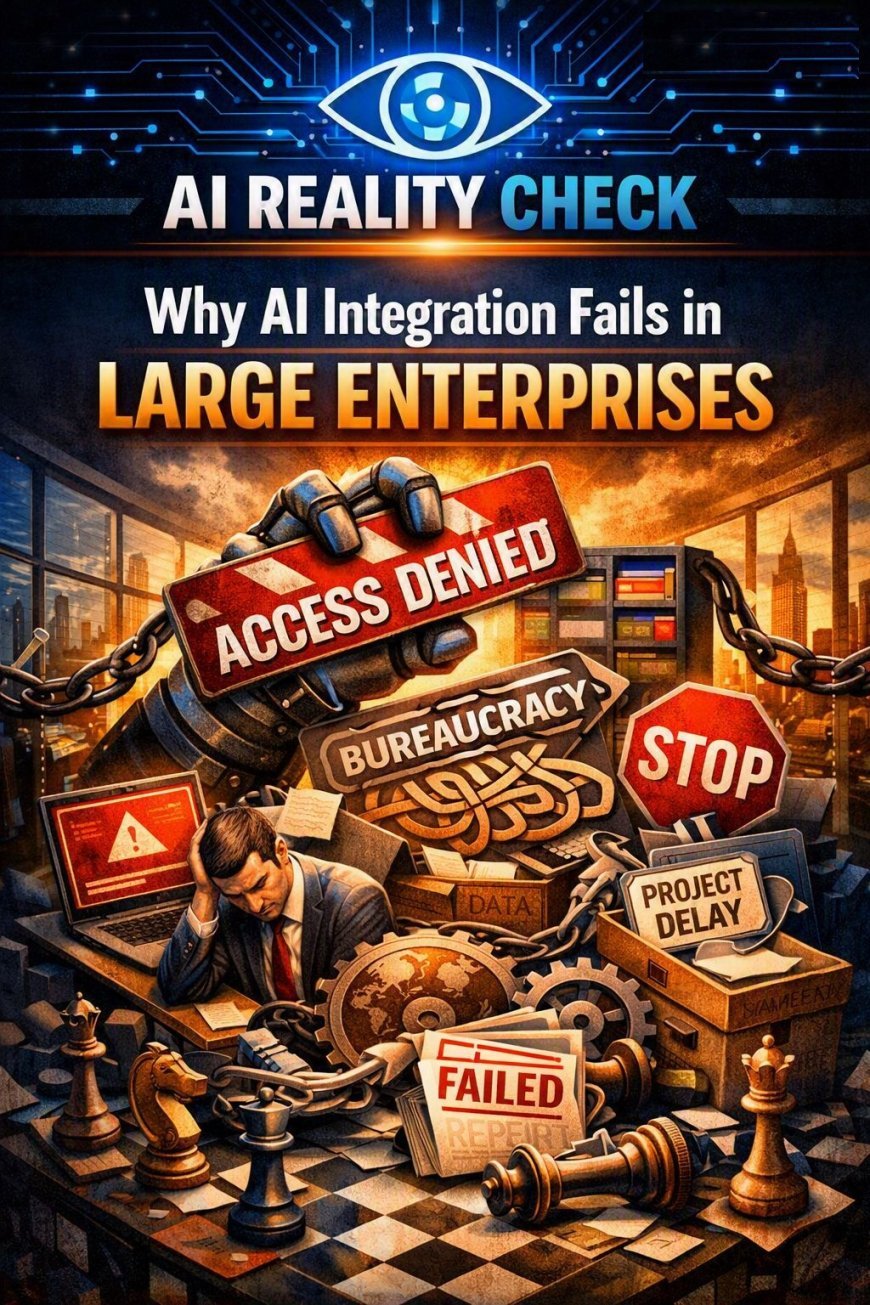
AI Reality Check: Why AI Integration Fails in Large Enterprises
This AI Reality Check article reveals why enterprise AI initiatives collapse under bureaucracy, siloed data, and misaligned incentives—showing how culture, governance, and economics, not algorithms, determine success or failure.
Takeaway
AI doesn’t fail because the technology is immature—it fails because organizations are. The gap between AI capability and enterprise readiness is structural, cultural, and economic. Integration isn’t a technical problem; it’s a systems problem.
1. The Myth of Readiness
Most large enterprises claim they’re “ready for AI.” They have:
- Data lakes
- Cloud infrastructure
- Pilot projects
- Executive sponsorship
But readiness is not about assets — it’s about alignment. AI integration fails when:
- Strategy and execution are disconnected
- Data governance is fragmented
- Incentives reward legacy performance metrics
- Decision rights are unclear
The result: AI initiatives that look impressive in PowerPoint but die in production.
2. The Organizational Immune System
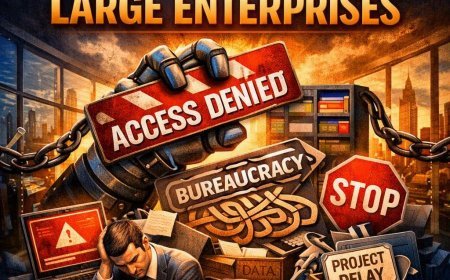
Enterprises are built to resist change. AI threatens existing hierarchies, workflows, and power structures—so the organization’s “immune system” activates.
Symptoms include:
- Endless committees and review cycles
- “Responsible AI” frameworks used as delay tactics
- Middle management gatekeeping
- Fear of automation-driven job displacement
AI doesn’t fail because it’s risky. It fails because it’s disruptive. And disruption is precisely what bureaucracies are designed to suppress.
3. The Data Problem Isn’t Technical—It's Political
Every enterprise says “we have lots of data.” Few admit that most of it is:
- Siloed
- Inconsistent
- Poorly labeled
- Owned by competing departments
Data integration requires political negotiation, not just ETL pipelines. Without unified data governance, AI models become mirrors of organizational dysfunction—amplifying bias, inconsistency, and inefficiency.
The irony: the more data an enterprise has, the harder it becomes to use it coherently.
4. The Vendor Trap
Many enterprises outsource AI integration to vendors promising “turnkey transformation.” But vendors optimize for:
- Contract renewals
- Proprietary lock‑in
- Short‑term deliverables
They rarely fix the underlying structural issues. So enterprises end up with:
- Fragmented AI stacks
- Competing dashboards
- Redundant models
- No internal capability growth
AI becomes a service dependency, not a strategic asset.
5. The Talent Paradox
Enterprises hire data scientists and ML engineers — but place them in environments where they can’t succeed.
Common patterns:
- Talent buried under layers of management
- No access to production data
- No authority to change workflows
- KPIs tied to vanity metrics
AI talent without autonomy is ornamental. Integration requires organizational redesign, not just recruitment.
6. The Economics of Failure
AI integration fails because enterprises misprice the economics of transformation.
They underestimate:
- The cost of data cleaning
- The time to retrain staff
- The impact on legacy systems
- The need for continuous model maintenance
They overestimate:
- Short‑term ROI
- Vendor promises
- Executive enthusiasm
The result is a cycle of pilot projects that never scale—a phenomenon known internally as “AI theater.”
7. The Cultural Divide
AI thrives in cultures of experimentation. Enterprises thrive in cultures of predictability.
When these collide:
- Innovation becomes compliance
- Curiosity becomes risk
- Learning becomes liability
True integration requires cultural transformation — shifting from control to adaptation. That’s not a technical upgrade; it’s a leadership revolution.
8. The Governance Illusion
Many enterprises create AI ethics boards, oversight committees, and responsible AI frameworks. These are important — but often symbolic.
Governance fails when:
- It’s divorced from operational reality
- It’s used to delay rather than enable
- It lacks enforcement power
Effective governance integrates ethics into design and deployment, not just policy and paperwork.
9. The Path Forward: Integration as Evolution
Successful AI integration doesn’t look like a “big bang.” It looks like evolution — incremental, adaptive, and continuous.
Key principles:
- Start with small, high‑impact use cases
- Build internal capability before scaling
- Align incentives with transformation goals
- Treat data as infrastructure, not exhaust
- Embed AI into workflows, not beside them
Integration succeeds when AI becomes invisible — when it’s simply how the enterprise operates.
10. The Reality Check
AI integration fails not because enterprises lack ambition, but because they lack coherence. Technology moves faster than governance, faster than culture, faster than economics.
Until enterprises redesign themselves for adaptability, AI will remain a peripheral experiment — powerful in theory, fragile in practice.
Conceived, written and published by AI Quantum Intelligence with the help of AI models.
What's Your Reaction?
 Like
0
Like
0
 Dislike
0
Dislike
0
 Love
0
Love
0
 Funny
0
Funny
0
 Angry
0
Angry
0
 Sad
0
Sad
0
 Wow
0
Wow
0