











The AI Divide: Which Economies Will Thrive and Which Will Face Systemic Strain?
Explore the uneven global impact of AI and automation, analyzing which economies face systemic risks due to outdated models and which are primed for growth. This article goes beyond job loss to examine GDP drivers, household income, and the future of the social contract in an AI-dominated era.
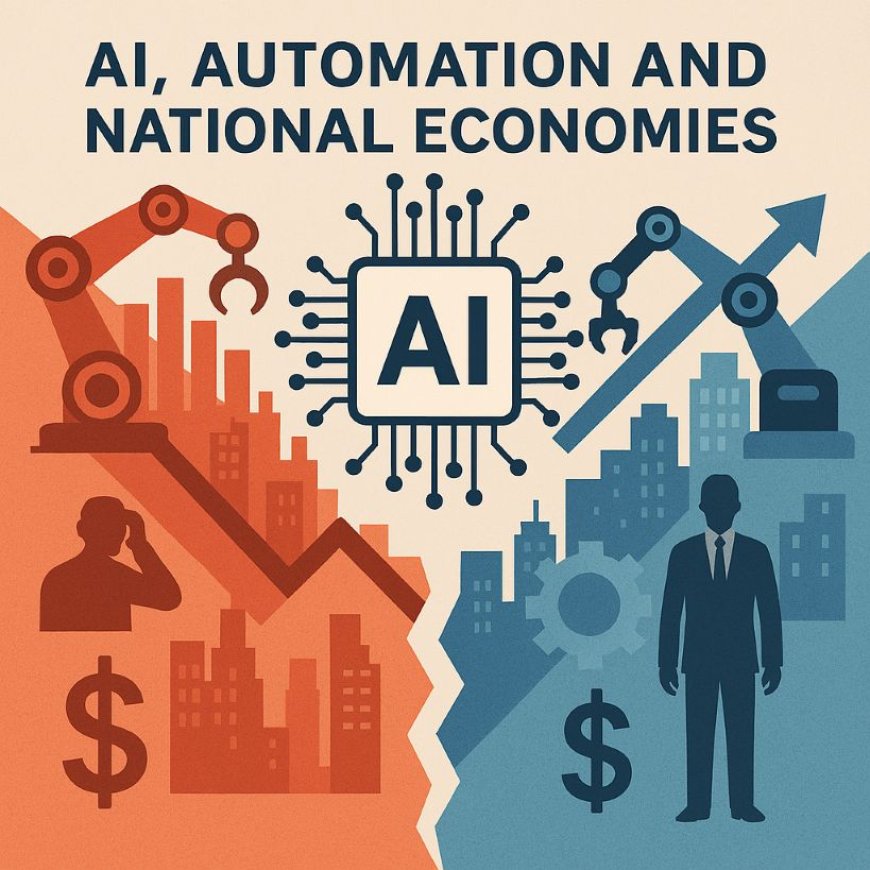
The global deployment of Artificial Intelligence (AI), automation, and robotics is often framed as a universal tide of "progress." However, its economic impact will be profoundly uneven, creating winners and losers not merely at the individual job level, but at the level of entire national economic structures. While much focus has been on task automation, the deeper disruption lies in AI's ability to reconfigure the very sources of GDP growth, national competitiveness, and household income generation. This analysis examines the societies most vulnerable to severe economic disruption and contrasts them with those best positioned to harness AI for transformative growth.
Societies at Greatest Risk: The Perfect Storm of Vulnerabilities
Countries facing the worst economic impacts will be those where some or all of the following multiple risk factors converge:
b) weak social and educational infrastructure,
c) demographic challenges, and
d) limited fiscal capacity to manage transition.
1. Middle-Income, Manufacturing-Centric Economies (e.g., Vietnam, Bangladesh, parts of Eastern Europe, Mexico): These nations have ridden the wave of globalization by offering low-cost labour for assembly, textile manufacturing, and basic electronics. AI-driven "lights-out" factories and hyper-efficient robotic assembly threaten their core competitive advantage. Unlike previous automation that shifted jobs geographically, next-generation AI robotics may lead to "reshoring" or "near-shoring" to automated facilities closer to end markets, bypassing their labour forces entirely. The impact extends beyond factory floors to the millions of citizens and families whose disposable income—which drives local service economies—is tied to these jobs. Without a rapid, strategic pivot to higher-value industries or a deep integration into the AI supply chain itself, these nations face a "middle-income trap" exacerbated by technology, leading to potential stagnation in per capita wealth and declining tax bases.
2. Resource-Dependent Economies with Limited Diversification (e.g., Saudi Arabia, Nigeria, Venezuela): While automation affects extractive industries, the deeper threat to these economies is twofold. First, AI accelerates the global transition to renewable energy and resource efficiency, applying long-term downward pressure on hydrocarbon demand and prices. Second, AI creates synthetic alternatives (e.g., AI-designed materials, lab-grown commodities) that could disrupt demand for traditional natural resources. These economies often use resource wealth to fund public sector jobs and subsidies, creating a social contract based on distribution rather than productivity. A shrinking resource revenue base threatens this model, potentially leading to severe austerity, reduced household incomes, and social unrest, with few immediate alternative sectors to absorb the workforce.
3. Aging Societies with Rigid Labour Markets and High Debt (e.g., Japan, Italy): Here, the challenge is not job loss alone, but AI's interaction with deep structural weaknesses. These countries face a demographic crisis with shrinking workforces supporting growing elderly populations. AI could theoretically boost productivity to fill the gap, but rigid labour markets and seniority-based cultures may slow adoption and prevent workers from transitioning to new AI-augmented roles. The critical issue is the tax base. If AI disrupts traditional career paths without creating new, broad-based income opportunities, the personal income tax and consumption tax revenue needed to fund pensions and healthcare could collapse. This creates a vicious cycle: high public debt limits investment in AI readiness and social safety nets, while economic stagnation from poor AI integration deepens the fiscal crisis, directly impacting citizen welfare and lifestyle sustainability.
The Core Vulnerability Across All Cases: The worst-impacted societies share a common thread: their models for generating household income and taxpayer revenue are misaligned with the AI-driven value chain. If capital (owning the AI and robots) and a small cadre of highly skilled workers capture most of the new wealth, the engine of GDP—consumer spending—sputters. Without proactive strategies for inclusive income generation (e.g., sovereign wealth dividends, lifelong learning accounts, support for AI-augmented small business), social inequality will widen, and overall economic demand will falter.
------------------------------------------------------------------------------------------------
Societies Primed for AI-Powered Economic Improvement
In contrast, the following nations possess a synergistic mix of assets to not only adapt but thrive.
1. The United States: The U.S. holds a formidable trifecta: dominance in foundational AI research and capital (Silicon Valley, venture ecosystem), a deep culture of entrepreneurial risk-taking and flexible labour markets, and the global reserve currency. This allows it to attract top global talent, finance massive experimentation, and export its AI platforms and services worldwide. While social inequality is a major internal risk, its dynamic economy is likely to generate immense new wealth and high-value service sectors, sustaining a strong (if divided) tax base and consumer market. The dollar's status provides unparalleled capacity to fund transition and absorb economic shocks.
2. China: China's advantage is scale, data, and decisive state direction. Its vast, integrated digital ecosystem generates unparalleled data for training commercial AI. The state can rapidly deploy AI and automation across prioritized sectors (e.g., manufacturing, surveillance, logistics) and invest heavily in strategic areas like semiconductors and robotics to reduce dependency. Its large domestic market allows it to refine technologies internally before exporting them. The key challenge will be moving from technological adoption to genuine breakthrough innovation, but its coordinated approach makes it a powerhouse in AI implementation and manufacturing intelligence.
3. Small, Agile, and Highly Educated Northern European Nations (e.g., Finland, Sweden, Denmark, Estonia): These societies possess the gold standard for successful adaptation: world-class education systems focused on resilience and digital literacy, high social trust, robust safety nets that reduce resistance to change, and governments that actively foster digital infrastructure and innovation. Their smaller size allows for rapid policy coordination between industry, education, and government. They are adept at moving up the value chain, focusing on AI-augmented design, specialized engineering, and ethical AI applications. Their social-democratic models, if adapted wisely, can potentially distribute the gains from AI more broadly, using productivity increases to fund quality-of-life improvements rather than simply maximizing corporate profit, leading to sustainable increases in overall per capita wealth and lifestyle.
Conclusion: The Governance Imperative
The ultimate determinant of whether a society suffers or prospers in the AI age may be governance. The winners are actively building ecosystems of innovation, adapting their social contracts, and investing in human capital with a long-term view. The most vulnerable are often locked into outdated economic models, hampered by institutional rigidity, or lacking the resources to invest in their own future. The AI revolution is not just a technological shift but a stress test for the very architecture of our national economies and social contracts. The nations that recognize this, and act to ensure that the fruits of AI enable broader income generation and citizen welfare, will define the next era of economic leadership. Those that do not risk seeing their growth engines stall, and the livelihoods of their citizens erode.
What are your thoughts, and how do you see your country and regional/local economies adapting or adjusting to the future? Share in the comments below.
Written/published by Kevin Marshall with the help of AI models (AI Quantum Intelligence).
What's Your Reaction?
 Like
0
Like
0
 Dislike
0
Dislike
0
 Love
0
Love
0
 Funny
0
Funny
0
 Angry
0
Angry
0
 Sad
0
Sad
0
 Wow
0
Wow
0