










The Invisible Co-Pilot: How AI Runs the Control Room of a Quantum Computer
Discover how AI is solving the biggest bottleneck in quantum computing. From real-time calibration to noise suppression, learn how an 'Invisible Co-Pilot' of software makes unstable quantum hardware usable for the first time.
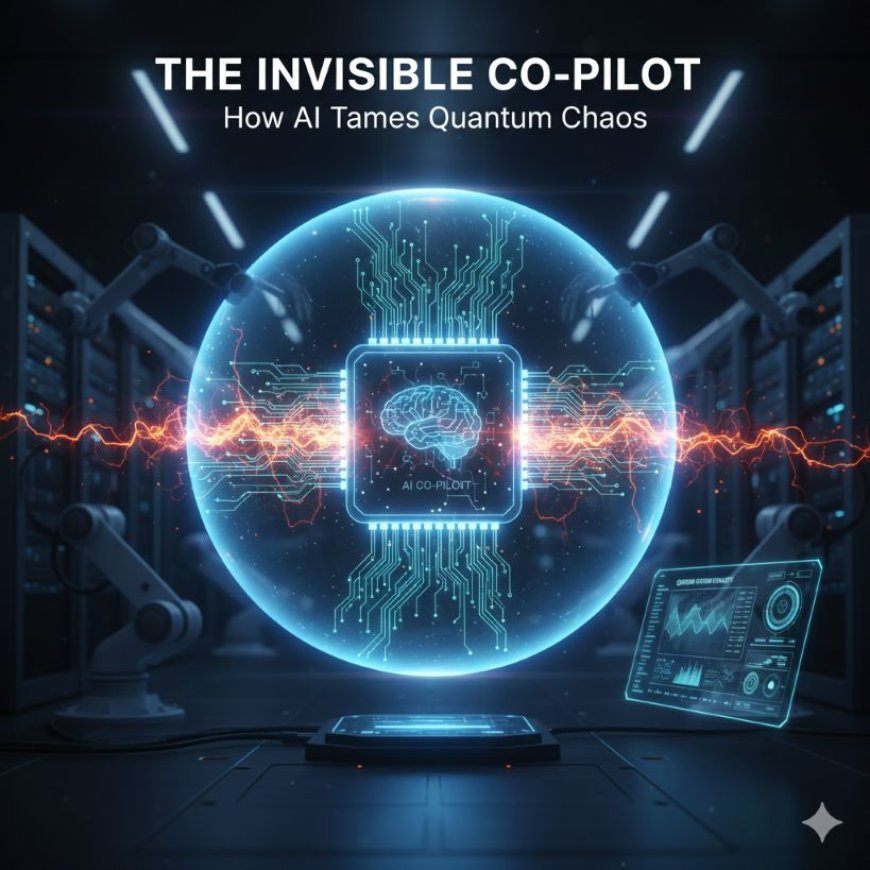
Imagine you are trying to balance a spinning plate on the tip of a needle. Now, imagine that the needle is shaking, the room is windy, and the plate is made of thin glass that shatters if it wobbles even a fraction of a millimeter.
That is what it feels like to run a quantum computer.
While news headlines focus on "qubits" and "quantum supremacy," there is a silent hero working behind the scenes. It isn't a new type of hardware or a freezing-cold refrigerator. It’s an AI co-pilot. Without this invisible layer of software, today’s quantum computers would be little more than expensive, frozen paperweights.
Quick Look: Key Article Takeaways
- The Stability Challenge: Quantum computers are incredibly "shaky." Unlike regular computers, they are sensitive to heat and magnets, requiring constant tuning to stay working.
- The Calibration Bottleneck: Modern quantum chips have thousands of settings. Humans are too slow to adjust them manually, creating a massive bottleneck for the technology.
- AI to the Rescue: Advanced AI acts as an "Invisible Co-Pilot," using techniques like Bayesian Optimization to find the perfect settings in milliseconds.
- Real-Time Fixes: This AI software doesn’t just start the computer; it stays active, fighting noise and correcting errors while the program is running.
- The Future of Engineering: Scientists are moving from being "manual tuners" to "supervisors," letting AI handle the messy physics while they focus on big-picture discoveries.
The Calibration Bottleneck: Why Humans Can't Keep Up
In a normal laptop, a "1" is a "1" and a "0" is a "0." They stay that way because silicon chips are incredibly stable. Quantum bits, or qubits, are different. They are sensitive to everything: tiny changes in temperature, magnetic fields from a passing elevator, or even the microwave signals used to control them.
Because they are so sensitive, qubits "drift." A setting that worked perfectly at 9:00 AM might be completely wrong by 9:05 AM. To keep the computer working, engineers have to perform calibration—fine-tuning the pulses of energy that tell the qubits what to do.
The Problem of Scale
If you have two qubits, a human engineer can calibrate them by hand. But as we move toward computers with dozens, hundreds, or thousands of qubits, the math becomes impossible. There are simply too many "knobs" to turn. If it takes an hour to calibrate one qubit, and you have 1,000 qubits, your computer will be out of date before you even finish the first row.

Meet the Co-Pilot: AI in the Control Stack
To solve this, scientists have handed the "steering wheel" over to Artificial Intelligence. This AI doesn't write poetry or generate art; it lives inside the control stack, the layer of electronics that connects the human programmer to the quantum hardware.
1. Finding the Perfect Pulse (Bayesian Optimization)
To talk to a qubit, the computer sends a tiny burst of microwave energy called a "pulse." If the pulse is too long, the qubit flips too far. If it’s too short, it doesn't flip enough.
AI uses a technique called Bayesian Optimization to find the "Goldilocks" pulse. It tries a few variations, measures the results, and uses probability to predict which tweak will work best. It’s like a high-speed game of "Hot or Cold" that happens in microseconds.
2. Learning on the Fly (Reinforcement Learning)
Sometimes, the environment changes in unpredictable ways. This is where Reinforcement Learning comes in. The AI acts like a pilot in a flight simulator, receiving "rewards" when the qubits stay stable and "penalties" when errors occur. Over time, the AI learns to anticipate noise and counteract it before it even happens.

A Day in the Life of a Quantum Processor
To see the co-pilot in action, let’s look at what happens when a scientist hits the "Run" button on a quantum program:
- Initialization (The Pre-Flight Check): Before the calculation starts, the AI scans every qubit. It checks for "noise" in the system and recalibrates the microwave generators to ensure the "0" and "1" states are crystal clear.
- Execution (The Flight): As the program runs, the AI monitors the hardware. If it detects a specific type of interference—say, a tiny spike in heat—it adjusts the control pulses in real-time to "steer" around the error.
- Error Mitigation (The Landing): Once the results come back, they are often a bit "fuzzy" due to quantum noise. The AI analyzes the patterns of these errors and cleans up the data, separating the true answer from the background static.
The New Role of the Quantum Engineer
Does this mean human engineers are out of a job? Not at all. Instead, their role is shifting.
In the early days, a quantum engineer was like a mechanic who had to keep their hands under the hood of a car just to keep the engine idling. Today, they are more like flight directors. They don't turn the individual knobs; they supervise the AI that does it for them. They design the goals, and the AI handles the exhausting, high-speed micro-adjustments required to meet those goals.
Conclusion: Making Hardware Usable
The biggest bottleneck in quantum computing today isn't just building a bigger chip—it's making the chips we already have actually work. The "Invisible Co-Pilot" is the bridge between a delicate scientific experiment and a reliable tool for discovery.
As AI continues to get faster and smarter, it will allow us to push quantum computers to their absolute limits, solving problems in medicine, chemistry, and energy that were once thought impossible.
Want to dive deeper into the world of AI and Quantum? If you're looking for more articles on how these two technologies are merging, or want to find the best learning sites to start your own journey, check out AI Quantum Intelligence for the latest guides and industry insights.
Key Sources:
https://www.efficiencyai.co.uk/knowledge_card/quantum-circuit-calibration-2
https://developer.nvidia.com/blog/nvidia-and-quera-decode-quantum-errors-with-ai/
Written/published by Kevin Marshall with the help of AI models (AI Quantum Intelligence)
What's Your Reaction?
 Like
0
Like
0
 Dislike
0
Dislike
0
 Love
0
Love
0
 Funny
0
Funny
0
 Angry
0
Angry
0
 Sad
0
Sad
0
 Wow
0
Wow
0