








The Lie We Tell Ourselves About AI and Jobs
AI isn’t just reshaping work—it’s dismantling it. From lawyers to accountants, automation is hollowing out high-paying jobs while leaving low-wage service roles intact. The future of work may not be a partnership with machines, but a divide between a creative elite and everyone else.
For years, the tech industry has sold us a comforting fairy tale: AI won’t take our jobs, it will “free us” to be more creative, more strategic, more human. It’s a nice story. It’s also a lie.
The truth is far messier—and far more dangerous. AI isn’t just coming for factory workers or call center agents. It’s coming for the very professionals who smugly believed they were untouchable.
The Hollowing of the Middle
Automation doesn’t politely “partner” with humans. It strips away the routine, billable, repeatable tasks that make jobs viable. What’s left is either hyper-specialized work for a shrinking elite—or scraps of commoditized labor.
Take law. AI can now draft contracts, review documents, and analyze case law faster and cheaper than armies of junior associates. That’s not “augmentation.” That’s elimination. The same is happening in accounting, financial analysis, even software development. The middle of the job market—the stable, well-paying roles that sustained the professional class—is being hollowed out.
The Paradox of Low-Wage Work
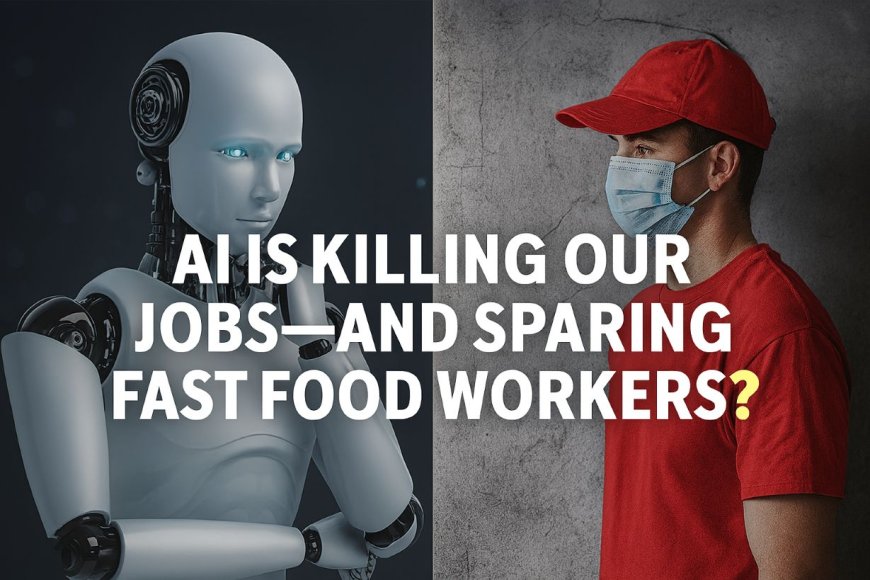
Here’s the irony: the jobs most likely to survive in the short term are the ones nobody wants. Fast food workers, retail clerks, restaurant servers—roles that are physically messy, unpredictable, and, for now, too expensive to automate.
So while white-collar professionals are displaced by algorithms, the barista and the cashier may still be standing. Not because society values them more, but because the economics of replacement don’t yet add up.
The Silent Majority Problem
The polite fiction is that displaced workers will simply “reskill” into higher-value roles. But let’s be honest: not everyone can become a strategist, a designer, or a machine learning engineer. The majority of jobs don’t require deep creativity or abstract thinking—and the majority of workers aren’t being trained for it.
We are staring at a future where millions of people are told to “move up the value chain” when the value chain itself is shrinking.
The Coming Labor Divide
The real future of work isn’t a harmonious partnership between humans and machines. It’s a bifurcation:
- A small elite thriving in creative, strategic, and technical niches.
- A vast majority trapped in low-wage service work—or pushed out of the labor force entirely.
This isn’t science fiction. It’s already happening. Tens of thousands of jobs have quietly disappeared in the past year alone, replaced not by robots in factories but by lines of code in the cloud.
Stop Pretending
The biggest danger isn’t AI itself—it’s the delusion that we can glide into this future without disruption. By clinging to the myth of universal “upskilling,” we risk sleepwalking into an economy that no longer needs most of us.
The question isn’t whether AI will change the nature of work. It already has. The question is whether we’re willing to face the uncomfortable truth: for many, there may be no “higher-value” job waiting on the other side.
Written/published by Kevin Marshall with the help of AI models (AI Quantum Intelligence)
What's Your Reaction?
 Like
0
Like
0
 Dislike
0
Dislike
0
 Love
0
Love
0
 Funny
0
Funny
0
 Angry
0
Angry
0
 Sad
0
Sad
0
 Wow
0
Wow
0