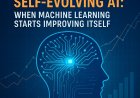








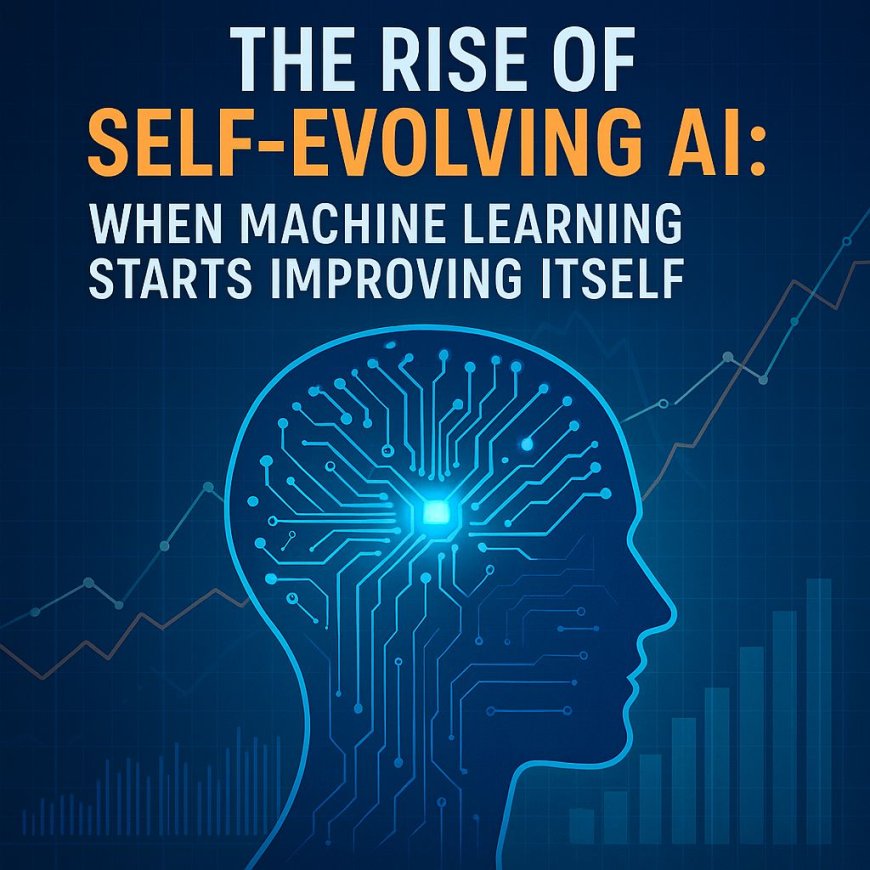
The Rise of Self Evolving AI: When Machine Learning Starts Improving Itself
Self evolving AI is no longer theoretical. Explore how meta learning, evolutionary algorithms, and self critique loops are creating machine learning systems that analyze their own performance and generate improved versions of themselves.
The Dawn of Self-Evolving AI: Why Machine Learning Is Learning to Improve Itself
Artificial intelligence has always promised systems that learn from data. But the next frontier is far more ambitious — and far more disruptive. We’re entering an era where AI doesn’t just learn from the world. It learns from itself.
Across research labs and industry deployments, a new class of machine learning systems is emerging: models that analyze their own performance, critique their own limitations, and generate improved versions of themselves. This isn’t science fiction. It’s happening now, and it’s reshaping how we think about model development, optimization, and even the future of autonomy.
The question many practitioners are now asking — sometimes quietly, sometimes boldly — is simple: Can AI become its own data scientist?
The answer is increasingly yes.
From AutoML to Autonomous ML
For years, AutoML tools have automated the tedious parts of model development: hyperparameter tuning, feature selection, architecture search. But these systems were fundamentally reactive. They optimized within boundaries set by human engineers.
The new wave of self-improving AI goes further.
These systems don’t just tweak parameters. They:
- Evaluate previous model versions
- Diagnose weaknesses
- Propose architectural changes
- Rewrite training loops
- Generate new model variants
- Select the best offspring
- Repeat the cycle indefinitely
In other words, they behave less like tools and more like collaborators — or, depending on your perspective, competitors.
Meta-Learning: AI That Learns How to Learn
Meta-learning, often described as “learning to learn,” is one of the most mature examples of this shift. Instead of optimizing a single model, meta-learning systems optimize the process of learning itself.
They evaluate:
- Objective metrics like loss curves and error distributions
- Subjective heuristics like simplicity, interpretability, or robustness
- Training dynamics such as gradient smoothness or convergence stability
The result is a model that doesn’t just perform a task — it understands how to improve its own ability to perform that task.
This is the conceptual bridge between traditional ML and self-evolving AI.
Evolutionary Algorithms: Natural Selection for Neural Networks
If meta-learning is the brain, evolutionary algorithms are the ecosystem.
These systems generate thousands of model variants, mutate them, recombine them, and select the best performers. Over time, they evolve architectures that no human would design — and often outperform human-engineered models.
This approach has already produced breakthroughs in:
- Neural architecture search (NAS)
- Reinforcement learning
- Robotics
- Optimization-heavy regression problems
It’s Darwinian evolution, but at silicon speed.
Self-Critique Loops: When AI Becomes Its Own Reviewer
Large language models have introduced another powerful mechanism: self-critique.
A model generates an output, evaluates it, identifies flaws, and regenerates a better version. This loop — sometimes called self-refinement — is now used in:
- Reinforcement learning from AI feedback (RLAIF)
- Chain-of-thought refinement
- Self-consistency sampling
- Autonomous reasoning agents
This is where subjective evaluation enters the picture. Models can judge their own clarity, coherence, creativity, or correctness — even when no objective metric exists.
It’s not hard to see how this becomes a foundation for self-improving regression models, too.
The Gödel Machine Era: AI That Rewrites Its Own Code
The most provocative developments are happening at the edge of research.
The theoretical Gödel Machine — an AI that rewrites its own code whenever it can prove the new version is better — has long been a thought experiment. But recent work, including the Darwin Gödel Machine, is pushing this idea into reality.
These systems:
- Maintain archives of model variants
- Evaluate new versions against old ones
- Permanently adopt improvements
- Iterate endlessly
This is the closest thing we have to a truly autonomous, self-evolving AI.
It’s not mainstream yet. But it’s no longer hypothetical.
Why This Matters Now
Self-improving AI isn’t just a technical milestone. It’s a strategic one.
It changes:
- How companies build models
- How fast innovation cycles move
- How much human oversight is required
- How we think about AI safety and alignment
- Who controls the direction of model evolution
And it raises a profound question for the industry:
If AI becomes capable of improving itself faster than humans can improve it, what role do we play in the loop?
Some see this as the path to AGI. Others see it as a necessary evolution of automation. Many see both.
Regression Models Are Next
While much of the attention goes to large language models and reinforcement learning, regression models — the workhorses of industry — are quietly being transformed by the same principles.
AutoML already optimizes regression pipelines.
Meta-learning already tunes regression architectures.
Evolutionary algorithms already evolve regression models.
Self-critique loops already evaluate regression outputs.
The next step is obvious:
Regression models that analyze their own performance and generate improved successors.
This will redefine forecasting, risk modeling, scientific modeling, and every domain where regression is foundational.
The Future: AI That Learns From Its Own Learning
We’re witnessing the emergence of systems that don’t just learn from data — they learn from their own learning processes. They reflect, critique, adapt, and evolve.
This is the beginning of a new paradigm:
- Less manual tuning
- More autonomous optimization
- Faster iteration cycles
- Models that improve continuously
- Systems that behave more like organisms than algorithms
It’s not AGI. Not yet.
But it’s a step toward AI that is self-directed in its improvement.
And that changes everything.
Written/published by Kevin Marshall with the help of AI models (AI Quantum Intelligence).
What's Your Reaction?
 Like
0
Like
0
 Dislike
0
Dislike
0
 Love
0
Love
0
 Funny
0
Funny
0
 Angry
0
Angry
0
 Sad
0
Sad
0
 Wow
2
Wow
2