










Quiet Revolutions in AI: Unsung Innovators Building Practical, Local Solutions Beyond Silicon Valley
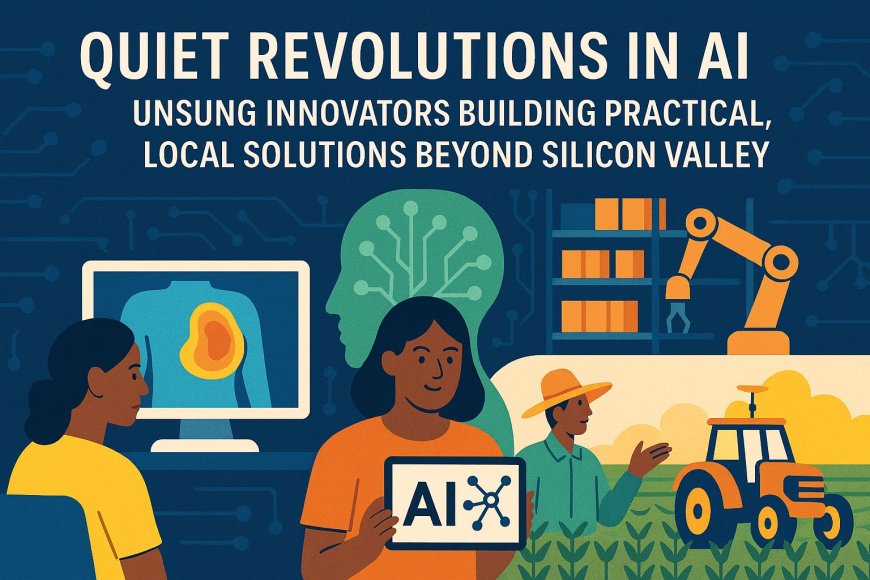
Small teams, community labs, and regionally focused platforms are quietly building practical, deployable AI that solves everyday problems—health screening, local‑language NLP, supply‑chain reliability and farm mechanization—yet these advances rarely make global headlines. This article spotlights those innovations, explains what they do, and why they matter for the future of equitable AI.
Introduction
When the world talks about AI it often centers on a handful of global tech giants and headline models. That focus misses a parallel story: incremental, context‑aware innovations developed by startups, research collectives, and civic projects in Asia, Africa, Latin America and beyond. These efforts are not flashy; they are pragmatic, built for constrained budgets, local data, and immediate human needs. Recognizing them matters because scalable, ethical AI will be shaped as much by these small, applied wins as by large-scale, heavily funded frontier research—and because they produce models and systems that generalize better to the majority of the world’s users.
Health: low‑cost, privacy‑aware diagnostics and resilient supply chains
Across low‑ and middle‑income countries, innovators are redesigning diagnostics and logistics to fit local realities. Niramai’s Thermalytix uses high‑resolution thermal sensing plus machine learning to screen for breast abnormalities in a radiation‑free, portable format suitable for community clinics and outreach programs; clinical studies and regulatory clearances support its use in multiple countries.
On the supply side, mPharma digitizes pharmacy inventory and uses forecasting and pooled procurement to reduce stockouts and lower prices across partner pharmacies in several African countries—impacting millions of patients by making essential medicines more predictable and affordable.
Language & Culture: community‑driven NLP and problem‑focused competitions
Language is infrastructure. Projects led by local researchers are building the datasets and models that global labs often overlook. Masakhane is a grassroots pan‑African NLP community that produces open datasets, training notebooks and machine‑translation baselines for dozens of African languages—lowering barriers to entry and centering African researchers in the research lifecycle.
Complementing research communities, Zindi runs region‑focused data‑science competitions that connect African datasets and social problems (crop disease, traffic, health logistics) with a growing pool of practitioners—creating both solutions and hiring pipelines.
Infrastructure & Talent: maker labs, mechanization platforms, and convenings
Sustainable AI ecosystems need people, compute, and networks. Deep Learning Indaba convenes, trains and funds African researchers through annual gatherings and local IndabaX events, seeding mentorship and research collaborations across the continent.
Applied platforms like Hello Tractor combine IoT, marketplace design and PAYG financing to put mechanization within reach of millions of smallholder farmers—demonstrating how domain‑specific platforms scale impact by solving a single, high‑friction problem.
Local R&D hubs such as iCog Labs in Ethiopia show how regionally based research and robotics work can incubate products and talent that speak to local needs and languages.
Risks, trade‑offs, and next steps
Data governance, funding sustainability, and rigorous validation are recurring challenges: local datasets reduce cultural mismatch but require governance and long‑term support. Funders and journalists should prioritize deployment metrics (people reached, cost per user), open datasets, and interviews with local teams to surface these stories. Amplifying these pockets of innovation will make global AI more robust, fair, and useful—because the future of AI will be decided as much in community labs and regional startups as in Silicon Valley.
Written/published by Kevin Marshall with the help of AI models (AI Quantum Intelligence).
What's Your Reaction?
 Like
0
Like
0
 Dislike
0
Dislike
0
 Love
0
Love
0
 Funny
0
Funny
0
 Angry
0
Angry
0
 Sad
0
Sad
0
 Wow
0
Wow
0