










The AI Mirage: How Our Illusions Create Flashy Products and Stifle Real Progress
This article debunks common AI misconceptions (like sentience and infallibility), explains how these myths fuel misleading "AI-washing" in marketing, and reveals how the hype distorts innovation away from practical, high-value applications toward populist but shallow products.
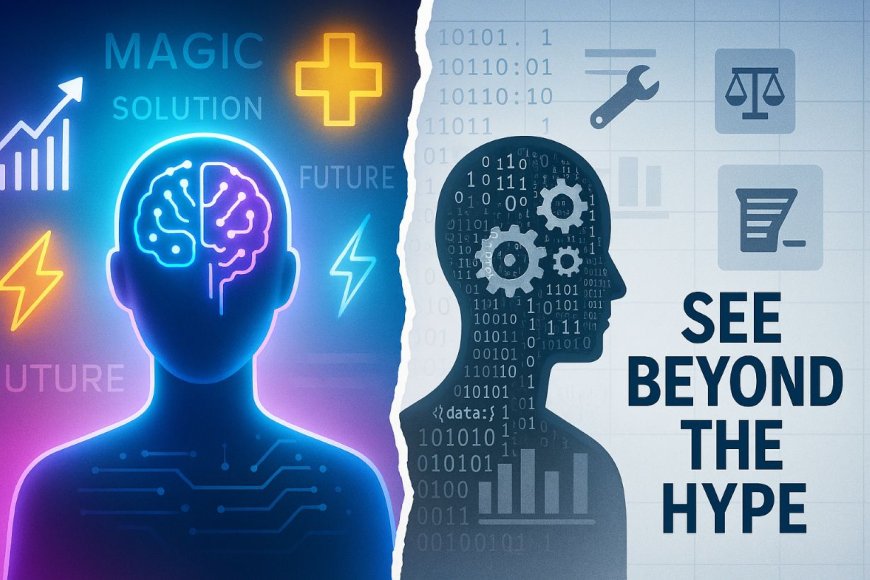
Artificial intelligence has captured the public imagination like no other technology of our era, fueled by equal parts breakthrough science and science fiction. Yet, beneath the dazzling surface of conversational chatbots and algorithmically-generated art lies a profound gap between popular perception and operational reality. This chasm isn’t harmless; it is actively shaping what gets built, funded, and celebrated—often steering innovation toward theatrical demos and away from substantive progress. To understand why, we must first dispel the most prevalent myths that have come to define AI in the popular consciousness.
- "AI is an All-Knowing, Conscious Intelligence": The most common misconception is that AI, like ChatGPT or a recommendation engine, possesses understanding, sentience, or general intelligence. People often anthropomorphize it, believing it "thinks" or "knows" things. In reality, even the most advanced models are sophisticated pattern-matching systems, statistically predicting outputs based on training data. They have no consciousness, beliefs, or desires.
- "AI is Infallible and Objective": The belief that because it's a "machine," its outputs are neutral, fair, and purely factual. This ignores the fundamental truth: AI is a mirror of its training data. If the data contains human biases (historical, social, economic), the AI will learn and amplify them. It has no inherent sense of truth, only probability.
- "AI Operates in a Magical 'Black Box' Beyond Comprehension": While some models (like deep neural networks) are complex, the principle isn't magic. There's a growing field of Explainable AI (XAI). The misconception leads to either unwarranted fear or blind trust, preventing sensible questions about how a decision was reached.
- "Machine Learning = Traditional Programmed Logic": People often don't grasp the paradigm shift. Traditional software follows explicit if-then rules written by a programmer. Machine Learning infers its own rules from data. This means its behavior emerges from examples, not direct programming, making it powerful but also unpredictable for scenarios not well-represented in its training data.
- "AI/ML and IoT are the Same Thing" (The Buzzword Blender): These are often conflated. IoT is about sensors and devices generating data streams. AI/ML are tools to analyze that data and make predictions or decisions. People think adding "smart" to a device means it has AI, when it might just have simple automation or a cloud connection.
- "Automation vs. Augmentation": The belief that AI's primary role is to fully replace human jobs. While automation happens, the more profound and common value is augmentation—enhancing human capabilities (e.g., doctors with diagnostic aids, writers with editing tools, analysts with pattern detectors).
- "If It's Called AI, It Must Be the Latest and Greatest": "AI" is used as a blanket term for everything from simple rule-based chatbots from 2010 to cutting-edge large language models. This leads to confusion about actual capabilities.
How These Misconceptions Shape Marketing
The marketing of AI tools is almost entirely built upon exploiting these misconceptions, a phenomenon often called "AI Washing."
- The "Intelligence" Aura: Products add "Powered by AI" to imply sophistication, autonomy, and competitive edge, even if the underlying tech is basic statistics or automation. It's a premium label.
- Selling Certainty, Hiding Complexity: Marketing promises "data-driven, unbiased decisions" playing into the infallibility myth. It rarely highlights the required data hygiene, potential bias, and need for human oversight.
- The Futurism Pitch: Ads show hyper-intelligent agents solving world hunger, playing into the conscious AI trope to create excitement and secure investment, while the actual product may be a modest analytics dashboard.
- Obfuscation as a Feature: The "black box" myth is sometimes used as a shield—"the AI decided it, it's too complex to explain," which can avoid accountability for poor outcomes.
Impact on Innovation: The "Populist Appeal" vs. "Real Value-Add" Divergence
This dynamic absolutely distorts the innovation pipeline, creating a vicious cycle:
- Capital Follows the Hype: Venture capital and corporate investment flood into flashy, consumer-facing applications that resonate with the populist myths—anthropomorphic companions, meme generators, or solutions looking for a problem that can be branded as "AI." This draws talent and resources away from less-sexy but high-value domains.
- The Theater of Demos: Innovation becomes about creating impressive, narrow demos that wow people with "human-like" performance (e.g., a convincing conversation) rather than solving robust, real-world problems with measurable ROI (e.g., optimizing a complex supply chain, accelerating material science discovery).
- Neglect of the "Boring" Infrastructure: The foundational, unglamorous work that makes AI truly valuable gets short-changed. This includes:
- Data Engineering: The crucial, difficult work of cleaning, labeling, and managing data.
- Model Governance & Ethics: Building frameworks for fairness, safety, and accountability.
- Evaluation & Validation: Rigorous testing for edge cases and failure modes.
- Integration: The hard work of fitting a model into existing human workflows and business systems.
- The Sustainability Problem: Startups built on a populist AI narrative often collapse when the hype cycle wanes and users realize the product is a thin wrapper around an API with no durable competitive advantage or practical utility.
Where Real Value-Add Innovation is Often Found (and overlooked):
- Specialized Vertical AI: Tools for specific industries (e.g., predicting machine failure in manufacturing, analyzing crop health from satellite imagery).
- Augmenting Experts: AI assistants for scientists, engineers, and lawyers that help them navigate vast technical literature or data.
- Behind-the-Scenes Optimization: Radically improving efficiency in logistics, energy grids, or backend business processes.
Conclusion
The gap between perception (shaped by marketing and sci-fi) and reality (statistical models on data with human oversight needed) is vast. This gap fuels a market that often rewards theatrical applications over substantive ones. It drives innovation towards performative intelligence rather than practical tools, creating a market bubble of expectations that can lead to an "AI winter" of disillusionment. The path to sustainable value requires demystification—educating decision-makers and the public on what these technologies actually are and are not, and redirecting focus to the hard, unglamorous work of integrating them responsibly into systems that augment human potential.
Written/published by Kevin Marshall with the help of AI models (AI Quantum Intelligence).
What's Your Reaction?
 Like
0
Like
0
 Dislike
0
Dislike
0
 Love
0
Love
0
 Funny
0
Funny
0
 Angry
0
Angry
0
 Sad
0
Sad
0
 Wow
0
Wow
0