

What is RPA? Everything You Need to Know About It
Robotic Process Automation (RPA) is an important element of the ‘Future of Work’ toolkit. According to research, about 70% to 80% of rules-based business processes can be automated. Large organizations have realized the benefits of automation and are trying to utilize this quick and effective tool. In this blog, [...] The post What is RPA? Everything You Need to Know About It appeared first on AutomationEdge.

Robotic Process Automation (RPA) is an important element of the ‘Future of Work’ toolkit. According to research, about 70% to 80% of rules-based business processes can be automated. Large organizations have realized the benefits of automation and are trying to utilize this quick and effective tool. In this blog, we will give you a rundown of everything you need to know about RPA, from its benefits to use cases, and more.
At first glance, RPA may sound like a theoretical machine in the lines of self-aware artificial intelligence, but it’s not as much a new set of technology as it is the application of technology in day-to-day business processes.
What is RPA?
Robotic Process Automation (RPA) is a technology that uses software robots—or “bots”—to automate repetitive, rules-based business tasks such as data entry, invoice processing, and report generation. Unlike AI, which learns and adapts, RPA follows predefined workflows to increase efficiency, cut costs, and reduce human error.
In simple terms: RPA is like a digital workforce that performs routine tasks faster, more accurately, and at scale. RPA is not self-aware AI—its software bots automating rule based tasks—but increasingly integrated with AI/ML for cognitive automation.
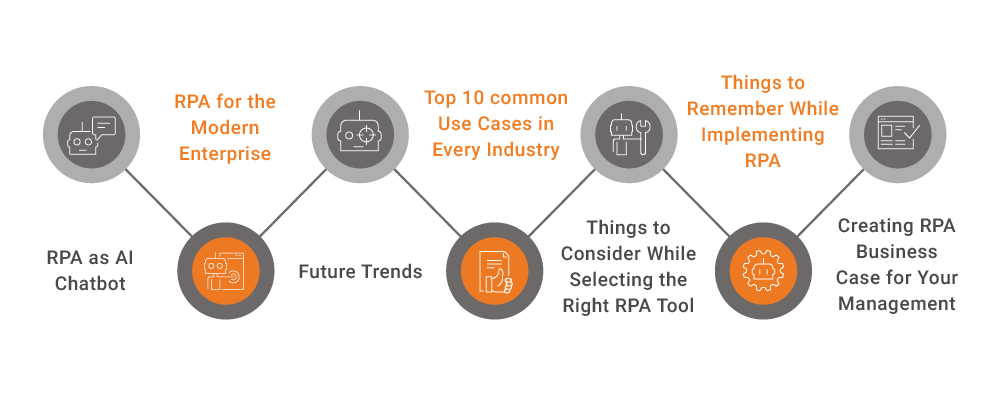
RPA as AI Chatbot and Its Influence on the Customer Care Industry
Chatbots have existed for years and are now going mainstream by providing support to apps, social networking sites, Microsoft, etc.
Reports published by Pew Research in 2015, suggest that mobile messengers are used by 36% of smartphone owners. And this number will grow to 49% in the age group of 18-29 years.
A survey by a market research firm One Reach, researched on US consumer behavior towards texting in customer service applications and found out that 64% of consumers would prefer texting over voice as customer service support, and 77% of consumers have a positive approach towards companies that offer text capability.
Mobile messengers such as WhatsApp, WeChat, and Facebook Messenger have become a popular means of communication on mobile phones. WhatsApp has a billion monthly active users, whereas Facebook Messenger and WeChat has about 900 million and 700 million users respectively. In terms of popularity, they have surpassed social networks proving the importance of Artificial Intelligence in the customer care system of organizations.
[Also Read: How AI Chatbot Is Transforming Customer Care industry ]
RPA for the Modern Enterprise
The key to effective RPA implementation is to understand its benefits and challenges. While manual processes are inefficient and capable of errors, RPA enables the modern enterprise in the following ways:
- It increases process speed along with a reduction in errors
- Since IT departments spend 30% of their time on low-level tasks, automation allows them to focus on higher skilled work, improving business and employee satisfaction
- 50% of companies spend $5 to $25 on a manually-processed invoice. RPA increases the quality of data by reducing manual data edits and reducing compliance risks
Traditional vs Cognitive vs Agentic RPA
| Feature / Criteria | Traditional RPA | Cognitive RPA | Agentic RPA |
|---|---|---|---|
| Definition | Automates repetitive, rule-based tasks | Combines RPA with AI to handle semi-structured data | Uses autonomous agents that plan, act, and learn |
| Core Technology | Rule engines, scripting | AI/ML, NLP, OCR | LLMs, multi-agent systems, reinforcement learning |
| Human-like Decision-Making | No | Limited (pattern recognition) | Yes (autonomously adjusts to goals & context) |
| Data Handling | Structured data only | Structured + semi-structured | Unstructured, multi-modal, and dynamic data sources |
| Learning Ability | None (static scripts) | Learns from data over time | Continuously learns and adapts autonomously |
| Interaction Style | Mimics UI clicks and keystrokes | Interprets data, reads documents | Understands goals, context, and user intent |
| Scalability | Limited by ruleset complexity | Moderate with training data | Highly scalable through self-organization |
| Ideal Use Cases | Invoice entry, data scraping, form filling | Claims processing, email classification | Intelligent assistants, end-to-end process automation |
| Deployment Speed | Fast (script-based setup) | Moderate (requires training models) | Slower initially but self-improving over time |
| Maintenance Effort | High – changes break scripts | Moderate – models retrainable | Low – learns and self-corrects in real time |
| User Autonomy | Low | Moderate | High (acts as a co-pilot or digital worker) |
| Example Tools / Platforms | UiPath, Automation Anywhere (classic bots) | AutomationEdge with IDP, IBM RPA + Watson | Microsoft Copilot, UiPath Autopilot, Open Agents |
| Future Outlook | Stable but limited scalability | Growing adoption in digital operations | Emerging frontier in AI-driven enterprise automation |
Future Trends: A Shift in How Organizations Are Doing Business
RPA is currently one of the most popular AI application, as 98% of IT business leaders consider automation to be essential in driving profits. Listed here are some of the trends related to automation, which will help in finding out where exactly it’s headed in the future: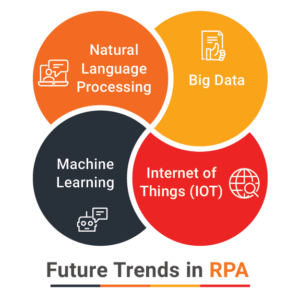
- RPA can play an important role in the analysis of Big Data and the Internet of Things by streamlining data management. The software can analyze available data along with the time taken to process it, and the number of automation activities left in the end
- These tools will enable industries to utilize a flexible and scalable workforce, resulting in a reversal of outsourcing jobs
- When integrated with other technologies, the benefits of RPA transcend and yields even better and more efficient outcomes
- RPA software works on customer experience enhancement by mimicking human activities and has proven to be a good alternative to humans, while creating a loyal relationship with customers
Why RPA Matters in 2025
According to Gartner, more than 90% of organizations worldwide will adopt some form of RPA by 2025 as part of their digital transformation strategy. Businesses across banking, healthcare, HR, and IT are using RPA to improve accuracy, speed, and compliance while freeing employees to focus on innovation. The global RPA market is projected at ~$6–23 billion in 2025, growing rapidly as enterprises shift to cloud and AI powered automation.
Top RPA Trends in 2025
Automation is evolving from simple task bots to intelligent ecosystems. Here are the key RPA trends shaping industries:
- AI + RPA (Intelligent Automation): Combining AI, ML, and NLP with RPA for smarter decision-making.
- Hyperautomation: Integrating RPA with process mining, workflow automation, and analytics for end-to-end automation.
- Cloud RPA: Growing adoption of SaaS-based RPA tools for remote scalability.
- Industry-Specific Solutions: Healthcare EVV bots, BFSI fraud detection, HR onboarding automation.
- Citizen Development: Low-code RPA tools enabling business users (not just IT) to create bots.
Key Benefits of RPA
RPA is no longer just about cost savings—it’s about enabling agility and growth.
- Faster Processes: Reduces execution time by up to 70%.
- Lower Costs: Saves 30–50% in operational expenses.
- Error-Free Workflows: Eliminates human errors in repetitive tasks.
- Better Compliance: Creates audit trails for every automated process.
- Scalability: Bots can be scaled instantly during peak workloads.
- Employee Productivity: Frees teams to focus on strategic, value-driven work.
Top 10 common Use Cases in Every Industry
RPA has transformed numerous business processes. Researchers at Hadoop estimate that companies will potentially save between $5 trillion to $7 trillion with RPA, by 2025. They also predict that the software will give an output of 140 million FTEs, by performing day-to-day business tasks. Following are some examples/use cases that exist in various industries:
- Software installations
- Data migration and entry
- Procure-to-pay
- Quote-to-cash
- Periodic report preparation and dissemination
- Customer onboarding
- Creating and delivering invoices
- Customer Service
- Updating CRM
- Generating mass emails
RPA Use Cases by Industry:
| Industry | Function / Process Automated | Key Benefits |
|---|---|---|
| Banking & Finance | Invoice Processing, KYC Verification, Report Generation | Faster processing time Reduced manual errors Improved compliance |
| Healthcare | Patient Data Entry, Billing, Claims Processing | Enhanced accuracy Faster reimbursements Better patient experience |
| Insurance | Claims Intake, Underwriting, Policy Administration | Lower processing costs Fraud detection Improved customer trust |
| Retail & eCommerce | Order Processing, Inventory Updates, Customer Onboarding | Real-time updates Reduced stockouts Enhanced customer satisfaction |
| Telecom | Customer Service, CRM Updates, Billing Disputes | 24/7 support automation Error-free CRM Reduced churn |
| Manufacturing | Supply Chain Management, Quote-to-Cash, Report Generation | Streamlined operations Faster quote cycles Reduced delays |
| HR & Payroll | Employee Onboarding, Timesheet Processing, Payroll Management | Time-saving Reduced HR workload Accurate payroll |
| IT Services | Ticket Management, Data Backup, System Monitoring | Quick response time Reduced downtime Increased productivity |
Things to Consider While Selecting the Right RPA Tool
Among the three types of RPA tools – RPA bots, Self-learning solutions, and Cognitive/intelligent automation – the third tool cognitive/intelligent automation solutions are the most in demand. There have also been cases where RPA sellers have recommended programmable bots, rather than the cognitive automation solutions.
While choosing the RPA tool, the things to remember are that the tool should be easily integrated with the existing systems, it should be scalable with the growth of the company, and should be able to gather and analyze operational data and offer a detailed report about the process.
[ Also Read: Selecting The Right RPA Tool, Doing It Right The First Time ]

Things to Remember While Implementing RPA
There are few points you will have to keep in mind before RPA implementation:
- Identify the process that needs to be automated first – The pilot project for automation needs to be identified first before RPA is implemented on all processes. Once you are sure of the benefits, you can choose other processes. In a similar way, a process can be automated entirely or partly. Either way, understand the process first and the effect of automation on it, before selecting it as the pilot project.
- Human supervision is needed in automation – Ensure that the team has RPA certified professionals or at least are trained about RPA, the changes in the process after implementation, and the measures needed to be taken after deployment.
- Allocating budget – Automation is a costly investment, so you need to make sure that enough budget is allocated for implementing the process. You have to keep in mind that few processes show immediate result while others take time to provide a good ROI.
- Selecting the right vendor – Once the objective for automation is defined, stakeholders are convinced, and the process has been identified, you need to select the right software and vendor. The vendor should be technologically ahead, should provide training to use the software, and should provide customer support during initial use of the software
[ Also Read: 10 tips for successful Robotic Process Automation ]
Creating RPA Business Case for Your Management
Organizations are constantly looking for ways to improve their business processes, and RPA provides the opportunity to transform these processes at a low cost. Knowing that without a clear plan a small RPA pilot is likely to fail, you need to build an RPA business case that will deliver long-term results. You can either start small or first create a comprehensive automation strategy to seek the funding you require.
The approach to building a business case that delivers long-term results in RPA requires a clear plan, and following is a list of business case considerations related to RPA implementation:
- Clear on the goals and outcomes – You should be clear about the outcomes that you are expecting with the change
- Doing it right the first time – Complete a thorough review before starting the process
- The environment of the organization – Understand whether your business is inclined towards automation
- Delivering results long-term – See whether you will be able to create value by making a change on major initiatives
You will primarily need to do a comprehensive scan of your business processes, to understand what processes will be more conducive to automation. Once they are analyzed, you can choose the processes that will be targeted for automation.
Once the bots are operational, you can conduct a process evaluation to understand the capabilities of the bots. Choose a process for a proof of concept and once the bot is operational you can create a video of it performing the process. This is to highlight and have a clear understanding of the different steps taken by the bot, for justification and moving forward with the broader use of RPA.
Now that the original proof of concept is completed, start to proceed on the other processes with the additional bots. Your next steps in automation should include the following:
- Review the target areas and output
- Plan on your business priority and execution
- Create an RPA roadmap for your business
- Make a project team and engage an automation partner
- Start off with a detailed design phase
These steps are required to be well-defined while creating a business case. Once the case is completed and approved, the requirements for the procurement of RPA vendor should be finalized. While there are different approaches your company can take for developing a business case, the most important one is to create a strategy and secure the required funding.
Conclusion:
RPA implementation in organizations enables effective redeployment of employees to much more value-added roles. This, in turn, increases employee satisfaction, ROI, and customer satisfaction.
RPA can boost development across industries, and although the technology is in its infancy, experts believe that it will be worth $3.1 billion by 2019 and $4.9 billion by 2020. RPA systems are being welcomed by organizations eager to increase productivity, cut costs, and gain a competitive edge.
RPA is not just a cost-cutting tool—it’s a growth accelerator. From banking to healthcare to HR, automation empowers organizations to boost efficiency, compliance, and customer experience. As RPA integrates with AI and cloud solutions, it’s becoming the foundation of hyperautomation in the workplace.
The RPA market is projected to reach $25 billion by 2030, proving its long-term relevance. Businesses that adopt RPA today will be better positioned for agility, innovation, and competitive advantage in the years ahead.
Frequently Asked Questions
The post What is RPA? Everything You Need to Know About It appeared first on AutomationEdge.