












The Global AI Race: Contrasting US and China's Divergent Paths in AI, IoT, and Robotics
Explore the contrasting philosophies driving the global AI race. An in-depth analysis of the US 'Innovation Ecosystem' vs. China’s 'Strategic National Project,' comparing their divergent paths in foundation models, IoT, industrial robotics, and AI ethics.
Introduction: Two Visions, One Technological Frontier
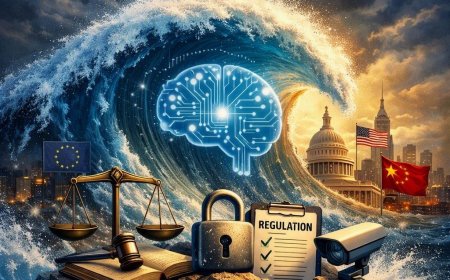
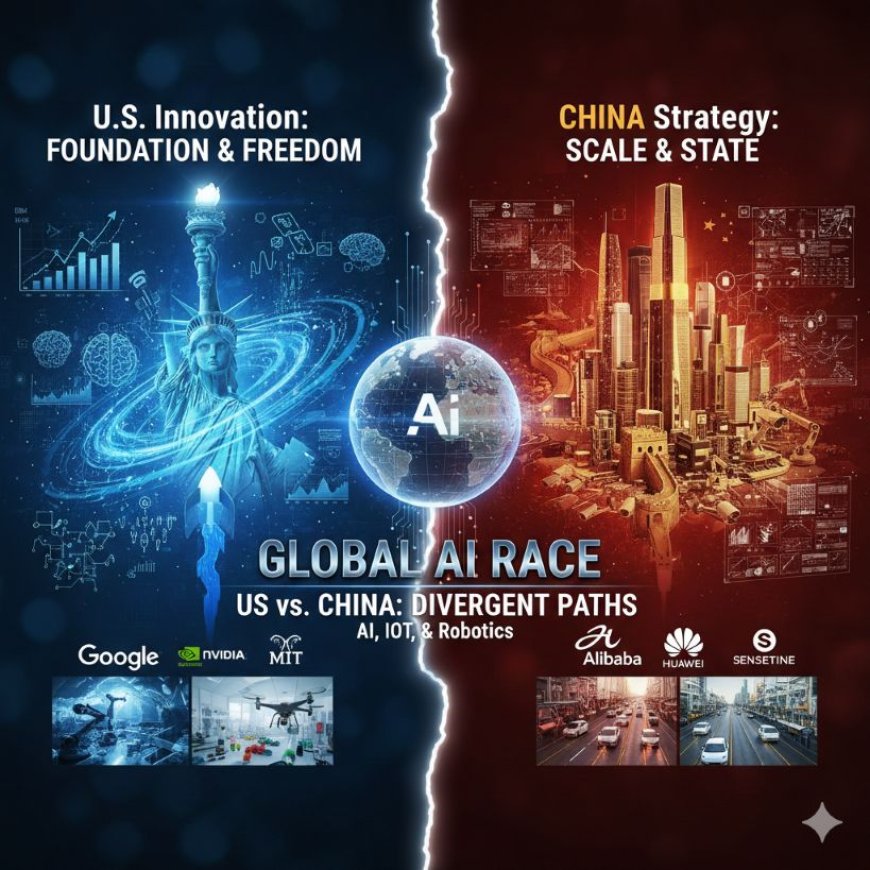
The global landscape of artificial intelligence, machine learning, Internet of Things (IoT), and robotics has evolved into a fascinating study of contrasting philosophies, with the United States and China emerging as the dominant but fundamentally different players. While Europe, Japan, South Korea, and others contribute significantly, the US-China dichotomy represents the most compelling divergence in technological approach, investment strategy, and societal implementation.
Part 1: Investment Patterns – Venture Capital vs. State-Led Coordination
United States: The Innovation Ecosystem Model
American advancement is fueled by a unique symbiosis between academic research (MIT, Stanford, Carnegie Mellon), private tech giants (Google, Microsoft, Meta, NVIDIA), and an unparalleled venture capital ecosystem. The U.S. invests heavily in foundational research and breakthrough innovation, with significant private-sector autonomy.
Key characteristics:
- Bottom-up innovation with multiple competing approaches
- Strong emphasis on fundamental algorithms and general AI
- Significant defense and intelligence applications (Project Maven, DARPA)
- Major cloud providers driving enterprise AI adoption
China: The Strategic National Project Model
China's approach is characterized by tight integration between government planning and corporate execution. Through initiatives like "Made in China 2025" and the "Next Generation Artificial Intelligence Development Plan," Beijing has directed resources toward specific technological goals with national competitiveness in mind.
Key characteristics:
- Top-down coordination with clear technological targets
- Massive data advantages from permissive privacy regulations
- Focus on applied technologies with immediate commercial/industrial use
- "Whole nation" approach mobilizing provincial governments and state-owned enterprises
Part 2: Areas of Specialization – Diverging Strengths
US Specializations:
- Foundation Models & General AI: US companies lead in developing large language models (GPT-4, Claude, Gemini) and fundamental research
- Semiconductor Design: Dominance in AI chips (NVIDIA, AMD, custom silicon from Google/Amazon)
- Enterprise & Cloud AI: Sophisticated B2B solutions and cloud infrastructure
- Biotech & Healthcare AI: Advanced applications in drug discovery and medical imaging
- Defense & Space Applications: Autonomous systems for military and aerospace
China Specializations:
- Computer Vision & Facial Recognition: Unmatched deployment scale and accuracy (SenseTime, Megvii)
- Smart Cities & Urban IoT: Integrated systems for traffic, surveillance, and municipal management
- E-commerce & Social Media Algorithms: Highly optimized recommendation systems (Alibaba, ByteDance)
- Industrial Robotics & Smart Manufacturing: World's largest market for industrial robots
- Surveillance Technology: Integrated public security systems with AI analytics
Part 3: The Sociocultural Context – Individualism vs. Collective Benefit
American AI Ethos:
The U.S. approach reflects its cultural emphasis on individual rights, privacy concerns, and market-driven solutions. This creates both strengths (innovation diversity, consumer choice) and challenges (regulatory fragmentation, ethical debates). The "move fast and break things" mentality often prioritizes speed over precaution, while ongoing debates about AI ethics, bias, and job displacement shape development.
Chinese AI Ethos:
China's technological development operates within a framework emphasizing social stability, collective benefit, and national rejuvenation. The cultural concept of "集体" (collective) influences everything from data collection norms to deployment priorities. This enables rapid scaling and integration but raises different ethical questions about social control and individual autonomy.
Part 4: Infrastructure & Data – Different Advantages
The US Edge:
- World's leading research institutions and talent attraction
- Deep capital markets for high-risk innovation
- Global software ecosystem dominance
- Strong intellectual property protections
The Chinese Edge:
- Unparalleled data volume from 1 billion+ internet users
- Integrated digital ecosystems (WeChat, Alipay)
- Manufacturing scale and supply chain integration
- Rapid prototyping and implementation cycles
Part 5: IoT and Robotics – Contrasting Implementation Philosophies
US Robotics:
- Emphasis on specialized applications (surgical robots, autonomous vehicles)
- Strong focus on human augmentation and collaborative robots (cobots)
- Regulatory caution slowing commercial drone adoption
- Silicon Valley's "robotics as a service" model
Chinese Robotics:
- Focus on manufacturing automation and logistics
- Rapid adoption of service robots (hotels, restaurants, hospitals)
- Aggressive government support for industrial robot adoption
- Seamless integration of robotics with broader IoT ecosystems
Part 6: Equivalent but Different? Assessing Relative Merits
The question of superiority depends entirely on the metrics applied:
If measuring breakthrough innovations and fundamental research, the U.S. model appears more effective, producing more Nobel laureates and foundational patents.
If measuring implementation speed and societal integration, China's coordinated approach demonstrates remarkable efficiency in deploying technology at scale.
If measuring global commercial reach, American companies maintain dominance in software and cloud services.
If measuring industrial transformation, China's manufacturing sector has automated more rapidly.
Conclusion: Convergence and Divergence in the AI Century
Rather than asking which approach is "better," we might recognize that these models reflect different societal priorities and historical contexts. The U.S. excels at exploratory innovation that opens new frontiers, while China demonstrates unprecedented capability in scaling and integrating proven technologies.
The most interesting development may be the emerging hybrid approaches: Europe's rights-based regulatory framework, Japan's human-centered robotics, and India's digital public infrastructure model all offer alternative paths.
What's clear is that this technological pluralism may ultimately benefit humanity more than a single approach ever could. The different specializations create a de facto global division of labor in AI advancement, while the ideological competition ensures multiple perspectives on AI's role in society.
The greatest risk isn't that one model "wins," but that geopolitical tensions fragment the global research ecosystem that has driven progress for decades. The ideal future would leverage each approach's strengths while maintaining collaborative spaces for addressing challenges that transcend borders—from climate change to pandemic preparedness to the ethical governance of increasingly powerful AI systems.
This analysis suggests that in technology as in nature, biodiversity creates resilience. The world may be best served by multiple AI futures unfolding simultaneously, rather than a single homogenized vision imposed globally.
Written/published by Kevin Marshall with help from AI models (AI Quantum Intelligence).
What's Your Reaction?
 Like
0
Like
0
 Dislike
0
Dislike
0
 Love
0
Love
0
 Funny
0
Funny
0
 Angry
0
Angry
0
 Sad
0
Sad
0
 Wow
0
Wow
0